How to Streamline Pre-Construction for Project Managers
How to Streamline Pre-Construction for Project Managers
TL;DR:
- Pre-construction optimization involves restructuring workflows, automating tasks, and using templates to reduce delays. AI tools can generate scope packages in under an hour and improve bid speed and accuracy. Implementing standardized processes and predictive analytics helps teams minimize risks and avoid costly schedule delays.
Pre-construction optimization is the process of restructuring workflows and automating key tasks to eliminate delays and improve accuracy before a single shovel breaks ground. Construction project managers who know how to streamline pre-construction gain a measurable edge: estimator headcount declined 14% in 2026, which means every remaining team member must produce more output with fewer resources. The answer is not longer hours. It is smarter infrastructure, standardized templates, and predictive analytics applied from day one. Modish Global Inc.'s Architectural Diagnostic Intelligence™ engine was built precisely for this moment, identifying structural and compliance failure points before construction commits.
The single biggest time drain in pre-construction is manual scope package assembly. Manual scope assembly takes 30–40 hours per bid. That is nearly a full work week consumed before a single subcontractor receives an invitation to bid.
AI scope agents change that equation entirely. These tools generate complete scope packages in under 60 minutes, enabling teams to bid twice as fast without sacrificing accuracy. The time savings compound across a full pursuit calendar.
Four automation tools define the modern pre-construction workflow:
- AI scope package generators. These engines pull project data, apply standardized language, and produce complete scope-of-work documents in under an hour. They eliminate the copy-paste errors that plague manual assembly.
- Centralized document repositories. Replacing scattered PDFs and shared drives with a single source of truth removes version confusion and reduces RFI volume before the project even starts.
- AI chat agents for estimator queries. Chat agents respond within 20 seconds, handling common questions instantly and preventing the context-switching that kills estimator productivity.
- Standardized bid leveling and risk review templates. These create a shared operational baseline that holds quality steady regardless of which team member runs the pursuit.
Modish’s Architectural Diagnostic Intelligence™ infrastructure integrates directly into this layer, flagging code compliance gaps and structural risk points before bid packages go out. That means fewer surprises post-award. For teams managing workflow automation across multiple active pursuits, the reduction in manual hours is not incremental. It is structural.
Pro Tip: Set up your AI scope agent to pull from a master scope library organized by trade and project type. This cuts generation time further and keeps language consistent across all bids.
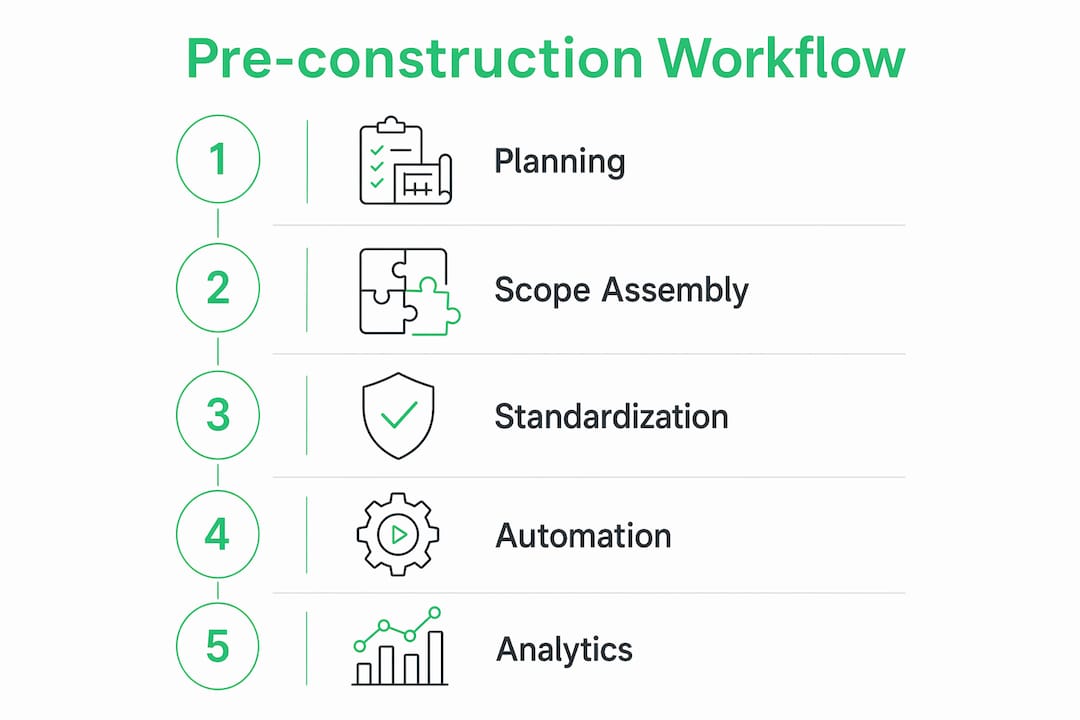
How can project managers implement standardized pre-construction workflows?
Structured planning is the foundation of every efficient pre-construction phase. Structured seven-step planning correlates directly with higher project profits and fewer change orders. The seven steps are site analysis, scheduling, budgeting, permitting, procurement, coordination, and final readiness review.
Each step requires its own documentation standard. Without that, quality depends entirely on individual judgment, which varies by person and by day.
Key practices that hold the framework together:
- Standardized bid leveling templates ensure every subcontractor submission gets evaluated on identical criteria, removing subjectivity from scope comparison.
- Scope review checklists catch missing line items before they become field change orders.
- Risk assessment templates force teams to document assumptions, exclusions, and contingencies at the pursuit stage rather than discovering gaps during construction.
- Realistic schedule modeling accounts for permit lead times and critical path dependencies, not just ideal-case timelines.
- Proactive communication protocols define who contacts subcontractors, building departments, and design teams, and when, so nothing falls through the gaps.
Standardizing templates and communication protocols creates a shared baseline that produces consistent project quality even as team composition changes. That consistency is what separates firms that scale from firms that stall.
| Workflow element |
Primary benefit |
| Standardized bid leveling |
Removes subjectivity from scope comparison |
| Risk assessment templates |
Surfaces assumptions before construction begins |
| Centralized document control |
Eliminates version conflicts and RFI volume |
| Proactive permit coordination |
Prevents schedule delays of up to three months |
What role does predictive analytics play in pre-construction optimization?
Predictive pre-construction is the practice of using AI and machine learning to analyze historical project data and forecast cost, schedule, and risk outcomes before design is finalized. Analyzing thousands of historical data points transitions teams from static assumptions to informed decisions. That shift is not cosmetic. It changes which projects get pursued and how bids get structured.
The core capabilities of a predictive pre-construction approach include:
- Supply chain risk identification based on historical material lead times and vendor performance data.
- Labor availability modeling that flags markets where skilled trade shortages will compress schedules.
- Weather constraint analysis that builds realistic float into schedules for climate-sensitive project types.
- Probability-range cost forecasting that replaces single-point estimates with outcome distributions, giving owners and GCs a clearer picture of financial exposure.
- Vendor selection intelligence drawn from past performance data, improving contract negotiation from a position of knowledge rather than assumption.
Predictive pre-construction empowers teams to move beyond static project assumptions to data-backed decision-making, enhancing risk management and schedule reliability. The firms that adopt this approach earliest will define the competitive standard for the next decade of construction.
The Project Definition Rating Index offers one structured framework for assessing scope maturity early, reducing cost and schedule risk before design freeze. Modish’s pre-design risk identification workflow applies this same logic through Architectural Diagnostic Intelligence™, surfacing failure points before they reach the field.
What common mistakes cause pre-construction delays?
The most expensive pre-construction mistakes are also the most preventable. Permit timelines catch teams off guard more than any other single factor. Simple projects require 2–4 weeks for permit processing. Custom or complex builds require 6–12 weeks. Initial plan reviews take 2–6 weeks, and follow-up reviews add another 2–4 weeks. Teams that ignore these timelines face delays of up to three months.
Four mistakes that consistently derail pre-construction schedules:
- Underestimating permit lead times. Build permit review windows into the master schedule from day one. Treat permit approval as a critical path item, not an administrative afterthought.
- Incomplete subcontractor scope letters. Missing scope details cause costly field change orders. The subcontractor scope letter is the single most critical document in pre-construction. Every exclusion and assumption must be explicit.
- Skipping early building department contact. A 10-minute call to the local building department before submission clarifies turnaround times, correction expectations, and local requirements. That call prevents weeks of waiting.
- Ordering long-lead materials too late. Mechanical equipment, specialty glazing, and structural steel all carry lead times that can exceed the permit review window. Order early or embed buffer periods that account for supply chain variability.
Pro Tip: Create a permit timeline tracker for every active project. Log the submission date, expected first-review date, and correction window. Review it weekly in your pre-construction team meeting.
Key Takeaways
Effective pre-construction requires AI-driven automation, standardized templates, and predictive analytics applied together from the earliest planning stage to reduce delays and improve bid accuracy.
| Point |
Details |
| Automate scope assembly |
AI tools cut 30–40 hour manual tasks to under 60 minutes per bid. |
| Standardize every workflow |
Templates for bid leveling, risk review, and scope letters hold quality steady across team members. |
| Apply predictive analytics |
Historical data models replace single-point estimates with probability ranges that reduce financial exposure. |
| Manage permit timelines |
Build 2–12 week permit windows into the critical path from day one to prevent three-month delays. |
| Use diagnostic intelligence |
Modish’s Architectural Diagnostic Intelligence™ surfaces compliance and structural risks before construction commits. |
Why the industry’s pre-construction problem is deeper than most teams admit
The conventional wisdom says pre-construction delays come from slow subcontractors or late permit approvals. I disagree. The root cause is structural: most pre-construction workflows were designed for a world with more estimators, more time, and less data. That world is gone.
What I have seen working with federal A&E teams and Fortune 500 procurement groups is that the firms still losing weeks to manual scope assembly are not lazy. They are running processes that made sense five years ago. The shift to AI-driven scope generation and predictive analytics is not an upgrade. It is a category change. The teams that adopt it earliest stop competing on price and start competing on certainty, which is a far more defensible position.
Modish’s Architectural Diagnostic Intelligence™ engine was built to give pre-construction teams that certainty. The AI-driven architectural review workflow identifies compliance failure points before bid packages go out, not after a costly RFI surfaces them in the field. That is the difference between a pre-construction phase that protects margin and one that erodes it.
My recommendation: audit your current scope assembly process this week. Time it. If it takes more than four hours per bid, you have a structural problem that no amount of overtime will fix.
— Ben
Modish Global Inc. and the future of pre-construction intelligence
Pre-construction teams that need faster diagnostics, cleaner compliance documentation, and AI-driven risk identification now have a purpose-built solution.
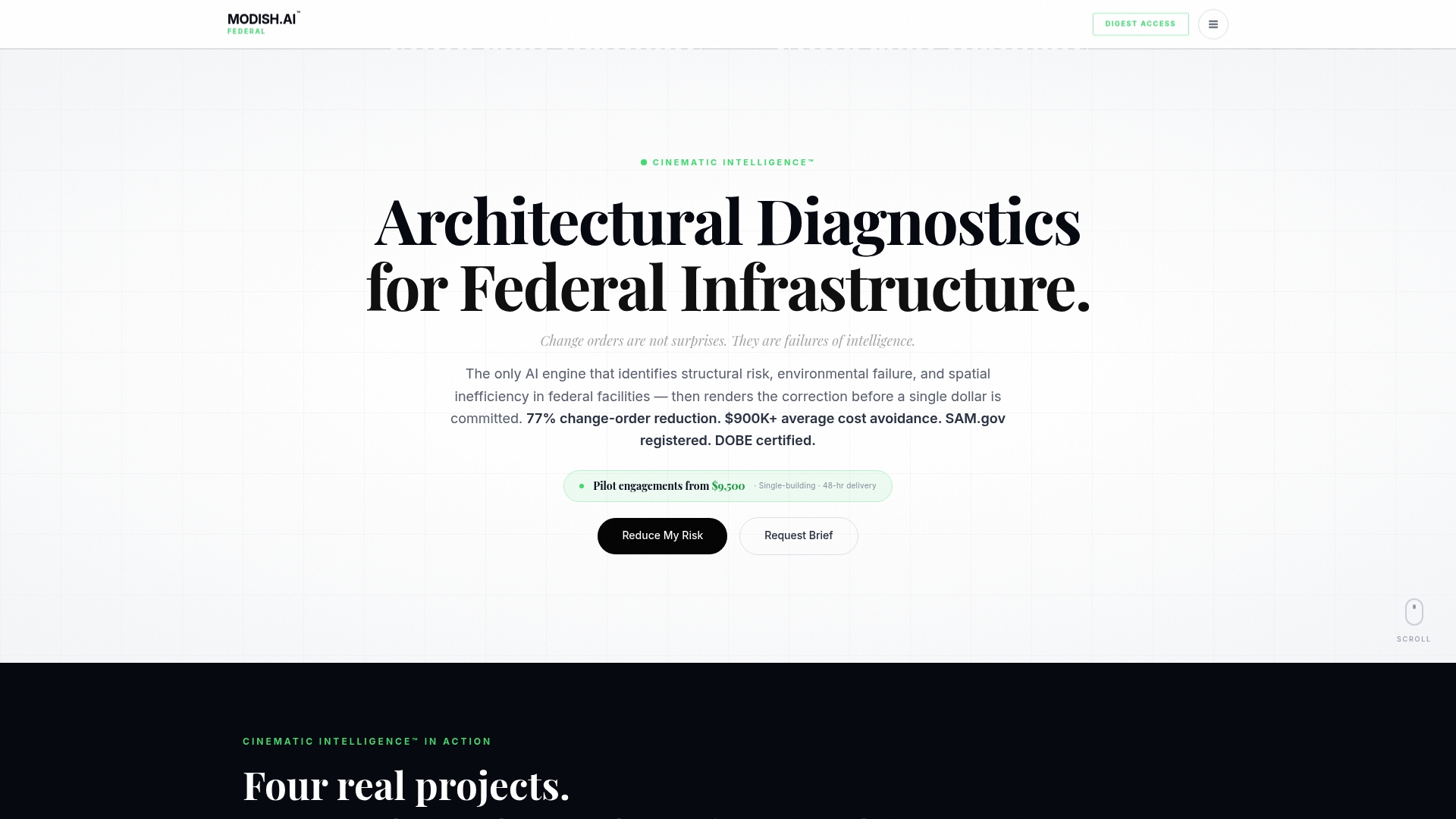
Modish Global Inc. is the only Disability:IN-certified DOBE architectural diagnostic intelligence firm in the United States. Its Architectural Diagnostic Intelligence™ engine delivers 192 corrective visualization options per Space, purpose-built for pre-bid evaluation, master planning, and pre-design risk identification on federal and commercial A&E pursuits. Every engagement counts as Tier 1 diverse spend credit for Fortune 500 supplier-diversity scorecards. Engagements begin at $9,500 for single-facility pilots. Explore the full capability set at Modish.ai and see how Architectural Diagnostic Intelligence™ transforms your pre-construction phase from a cost center into a competitive advantage.
FAQ
What is pre-construction optimization?
Pre-construction optimization is the practice of restructuring workflows, automating repetitive tasks, and applying standardized templates to reduce delays and improve accuracy before construction begins. The goal is faster bid preparation, fewer change orders, and more reliable schedule outcomes.
How much time does AI save in pre-construction scope assembly?
AI scope agents reduce manual scope package assembly from 30–40 hours to under 60 minutes per bid. That compression allows teams to pursue more work without adding headcount.
Why do permit timelines cause so many pre-construction delays?
Simple permits require 2–4 weeks for processing, while complex projects require 6–12 weeks. Teams that treat permit approval as an afterthought rather than a critical path item routinely absorb delays of up to three months.
What is the most important document in pre-construction?
The subcontractor scope letter is the single most critical pre-construction document. Missing scope details in that letter create costly field change orders that erode project margin after award.
How does predictive analytics improve pre-construction planning?
Predictive analytics analyzes thousands of historical data points to forecast supply chain risks, labor constraints, and cost ranges. This moves teams from single-point estimates to probability-range forecasting, which produces more reliable budgets and schedules.
Recommended