Pre-Design Facility Analysis: A Federal Project Guide
Pre-Design Facility Analysis: A Federal Project Guide
TL;DR:
- Pre-design facility analysis evaluates site, feasibility, program, and compliance issues before formal design begins. Its comprehensive report serves as a contractual baseline, reducing costly change orders and schedule delays. Properly conducting this phase ensures federal projects meet mandates and stay within budget.
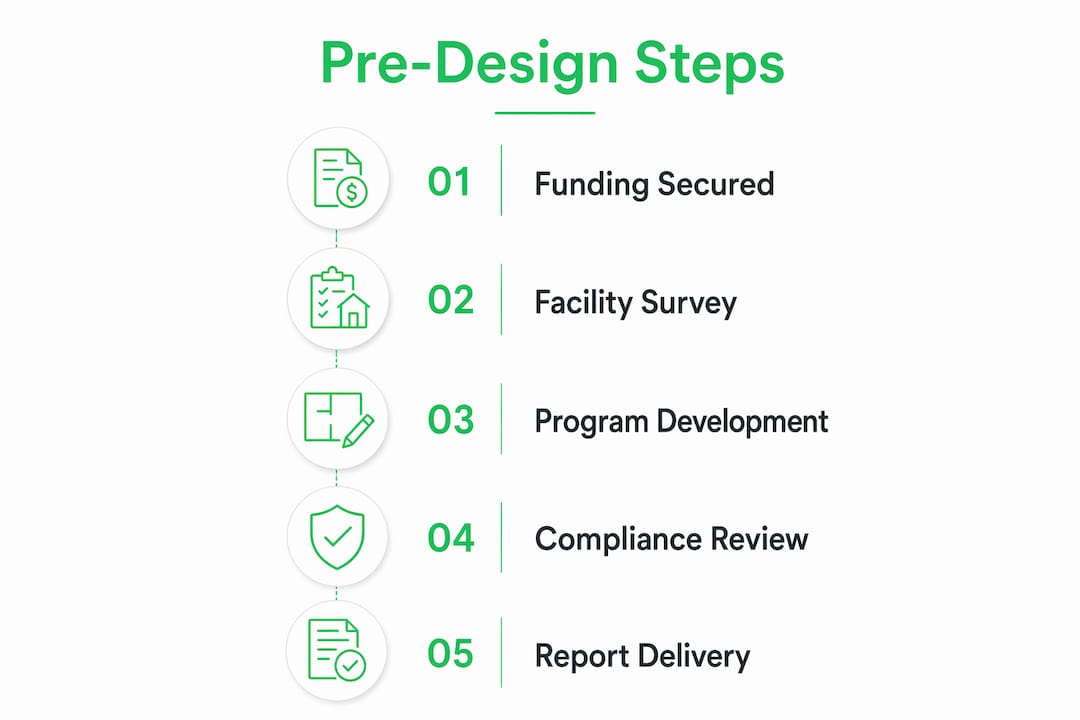
Pre-design facility analysis is defined as the investigative phase that occurs after funding is secured and before formal design begins, where site conditions, program requirements, regulatory compliance, and project feasibility are rigorously evaluated. The industry standard term for this work is the pre-design phase, and it serves as the foundational layer of every successful federal architectural project. Federal contracting officers and architecture firms that skip or compress this phase consistently face change orders, schedule slippage, and compliance failures that could have been identified weeks earlier at a fraction of the cost. This guide explains what pre-design facility analysis involves, why it matters for federal procurement, and how to conduct it with the rigor that government projects demand.
What is pre-design facility analysis and what does it include?
Pre-design facility analysis is the foundational phase that translates client needs into validated project parameters before a single design line is drawn. It answers three core questions: Is this site buildable? Is the program achievable within budget? Does the project comply with all applicable regulations? The answers to those questions define every decision that follows.
The phase breaks into four primary components:
- Site investigation: Topographic surveys, geotechnical reports, environmental assessments, and utility mapping. This work confirms what the land will and will not support.
- Feasibility studies: Budget modeling, technical viability reviews, and timeline projections that test whether the program is achievable given real constraints.
- Program definition: Spatial requirements, adjacency diagrams, and operational workflows that translate user needs into quantified square footage and performance criteria.
- Regulatory and compliance review: Zoning analysis, building code mapping, and federal mandate screening, including ADA, NEPA, and applicable UFC standards for military and federal facilities.
The Facility Condition Index (FCI) is an industry standard scoring system used during this phase to quantify the current state of existing infrastructure. An FCI score below 0.10 signals a facility in good condition; a score above 0.30 signals a facility approaching the threshold for replacement rather than renovation. That single number can redirect an entire capital investment strategy before a design contract is awarded.
The deliverable from this phase is a pre-design report. It compiles site constraints, program documents, compliance summaries, and preliminary budget forecasts into a single contractual reference. Every team member, from the contracting officer to the structural engineer, works from the same document.
Why is pre-design analysis vital for federal projects?
Neglecting pre-design leads to compounding cost overruns and schedule delays because issues surface too late to address without expensive redesigns. Federal projects carry an additional layer of exposure. Regulatory mandates, including FAR compliance, federal accessibility standards, and agency-specific design criteria, do not surface during schematic design. They must be identified and documented before design begins.
Pre-design also defines who makes which decisions and when. Clear roles and decision-making frameworks during this phase prevent project paralysis when conflicts arise between program ambitions and site realities. A contracting officer who enters design without a pre-design report has no contractual baseline to defend against scope creep or differing site condition claims.
The distinction between a feasibility study and a full pre-design program matters here. A feasibility study assesses whether construction is possible. Pre-design defines how to build in a way that meets compliance and operational standards. Treating a feasibility study as a substitute for full pre-design programming is one of the most common and costly errors in federal A&E procurement. Change orders follow when federal mandates are realized too late in the design sequence.
Pro Tip: When reviewing a proposed project schedule, verify that pre-design is listed as a discrete phase with its own deliverables and budget line. If it is folded into schematic design, the project is already at risk.
The pre-design report also preserves government leverage. Rigorous documentation of existing site conditions and program needs creates a contractual baseline that protects the government’s position throughout design and construction.
How is pre-design facility analysis conducted effectively?
Effective pre-design analysis follows a structured sequence that builds from raw data to validated conclusions. The steps below reflect best practice for federal A&E teams.
- Establish a centralized data repository. A single source of truth for all site and program information is what separates projects that finish on budget from those that do not. Every survey, report, and regulatory finding lives in one place, accessible to all team members.
- Conduct a Facility Condition Assessment (FCA). Integrating digital asset data from FCAs prevents design assumptions built on outdated information. An FCA documents the physical condition of existing structures, systems, and infrastructure before any design work begins.
- Complete site and regulatory evaluation. Topographic, geotechnical, environmental, and construction scheduling constraints must be mapped against applicable federal codes and agency design criteria. Gaps between site conditions and program requirements become visible at this step.
- Align all stakeholders on project realities. Ignoring site constraints early causes even well-funded projects to fail. Owners, architects, engineers, and contracting officers must agree on constraints and priorities before design begins.
- Apply diagnostic visualization tools. Modish’s Architectural Diagnostic Intelligence™ and DesignVault 3D™ infrastructure identify structural, environmental, and code compliance failure points before construction commits. The Cinematic Intelligence™ engine renders 192 corrective visualization options per Space, giving federal teams a federal submission-grade visual record of pre-design findings.
Pro Tip: Request that your pre-design team deliver an FCI score alongside the program document. That number gives contracting officers a defensible, quantified basis for capital investment decisions and scope justification.
What deliverables come from the pre-design phase?
The pre-design report is the primary deliverable, and its contents determine the quality of every design phase that follows. A complete report includes a site constraints analysis, a program requirements document, a regulatory compliance summary, and preliminary budget forecasts tied to the program.
Fit plans, massing models, and test fits accompany the written report to visually confirm that the program fits the site. These are not design documents. They are feasibility tools that test spatial assumptions before design fees are committed.
The table below shows how pre-design deliverables differ from design phase outputs:
| Pre-design deliverable |
Purpose |
| Site constraints analysis |
Documents physical, regulatory, and environmental limits of the site |
| Program requirements document |
Quantifies spatial needs and operational performance criteria |
| Regulatory compliance summary |
Maps applicable codes, federal mandates, and zoning requirements |
| Preliminary budget and timeline |
Tests program viability against available funding and schedule |
| FCI score and FCA report |
Quantifies existing infrastructure condition to guide capital decisions |
| Fit plans and massing models |
Visually confirms program fits site before design begins |
Each deliverable functions as a contractual baseline. When a contractor later claims differing site conditions, the pre-design report is the document that resolves the dispute. When a program grows beyond original scope, the program requirements document is the reference that limits unauthorized expansion.
Key Takeaways
Pre-design facility analysis is the phase where project success is determined, not during construction, and federal teams that treat it as a discrete, documented phase consistently outperform those that do not.
| Point |
Details |
| Define pre-design as a distinct phase |
Treat it as a separate, budgeted phase with its own deliverables, not a subset of schematic design. |
| Use FCI scoring |
Apply the Facility Condition Index to quantify existing infrastructure and justify capital investment decisions. |
| Distinguish feasibility from pre-design |
A feasibility study tests if a project is possible; pre-design defines how to build it to federal compliance standards. |
| Build a centralized data repository |
All site, program, and regulatory findings must live in one document that every team member references. |
| Document for contractual protection |
Pre-design reports protect the government’s position against scope creep and differing site condition claims. |
Pre-design is where I draw the line on risk
Pre-design is consistently undervalued and consistently punished for being undervalued. I have seen federal A&E pursuits where the pre-design phase was compressed to a two-week desktop review, and the resulting design contract carried three rounds of change orders before construction even started. Every one of those change orders traced back to a site condition or regulatory requirement that a proper pre-design assessment would have caught.
The most common mistake I see is conflating a feasibility study with a full pre-design program. A feasibility study tells you whether to proceed. Pre-design tells you how to proceed without violating federal mandates or blowing the budget. Those are fundamentally different questions, and answering only the first one is not enough for a federal project.
What Modish’s Architectural Diagnostic Intelligence™ infrastructure adds to this phase is not a shortcut. It is a layer of diagnostic depth that manual assessments miss. When 192 corrective visualization options are generated per Space, contracting officers and A&E primes see failure points rendered at federal submission grade before a design dollar is spent. That changes the conversation at the pre-design table from assumption to evidence.
Federal contracting officers should treat the pre-design report as the most important document in the project file. It is the baseline that every subsequent claim, change, and decision will be measured against. Protect it accordingly.
— Ben
Modish and federal pre-design: from diagnosis to submission-grade clarity
Federal A&E teams working on pre-design risk identification now have access to a capability that did not exist in any corporate supplier database until Modish built it.
Modish is the only Disability:IN-certified DOBE in architectural diagnostic intelligence, purpose-built for pre-bid evaluation, master planning, and pre-design risk identification on federal pursuits. The Cinematic Intelligence™ engine delivers 192 corrective visualization options per Space, rendered at federal submission grade. Engagements start at $9,500 for single-facility pilots and scale to $150,000+ for enterprise licenses. Modish is SAM.gov registered and teamed under READIGOV (SDVOSB/WOSB prime) for complete federal A&E execution. Every engagement counts as Tier 1 DOBE diverse spend. Explore federal diagnostic services to see how pre-design analysis changes when diagnostic intelligence replaces assumption.
FAQ
What is pre-design facility analysis?
Pre-design facility analysis is the investigative phase after funding is secured and before design begins, covering site investigation, feasibility studies, program definition, and regulatory compliance review. It produces a pre-design report that serves as the contractual baseline for all subsequent design and construction work.
How does pre-design differ from a feasibility study?
A feasibility study determines whether a project is viable. Pre-design analysis defines how to build it in compliance with federal mandates and operational standards. Treating a feasibility study as a substitute for full pre-design programming leads to costly change orders when regulatory requirements surface during design.
What is the Facility Condition Index and why does it matter?
The Facility Condition Index (FCI) is an industry standard metric that quantifies the physical state of existing infrastructure. An FCI score guides capital investment decisions by distinguishing facilities that warrant renovation from those that require replacement.
What deliverables should a pre-design report include?
A complete pre-design report includes a site constraints analysis, program requirements document, regulatory compliance summary, preliminary budget and timeline forecasts, FCI score, and fit plans or massing models confirming spatial feasibility.
Why is pre-design analysis critical for federal contracting officers?
Pre-design reports create a contractual baseline that protects the government against scope creep and differing site condition claims. Federal mandates, including ADA, NEPA, and UFC standards, must be identified before design begins to avoid change orders and schedule delays.
Recommended