Why Architectural Diversity Matters for Design and Culture
Why Architectural Diversity Matters for Design and Culture

TL;DR:
- Architectural diversity enhances property values, social inclusion, and urban vitality through culturally responsive design. Public subsidies and advanced diagnostic tools can help cities and practitioners implement varied, equitable, and compliant architecture. Embracing diversity as a measurable investment supports healthier, more vibrant communities worldwide.
Architectural diversity is defined as the deliberate integration of multiple cultural, social, and aesthetic perspectives into the built environment to create spaces that reflect and serve a broad spectrum of communities. Why architectural diversity matters is not an abstract question for theorists. It is a measurable, empirical reality with direct consequences for property values, public health, cultural equity, and the long-term vitality of cities. Research from the Centre for Economic Performance and the Green Home Institute confirms that diverse design produces economic premiums, social inclusion, and psychological wellbeing that uniform construction cannot replicate. Modish Global Inc., the only Disability:IN-certified DOBE specializing in Architectural Diagnostic Intelligence™, positions this evidence at the center of every engagement.
Why architectural diversity matters: the economic case
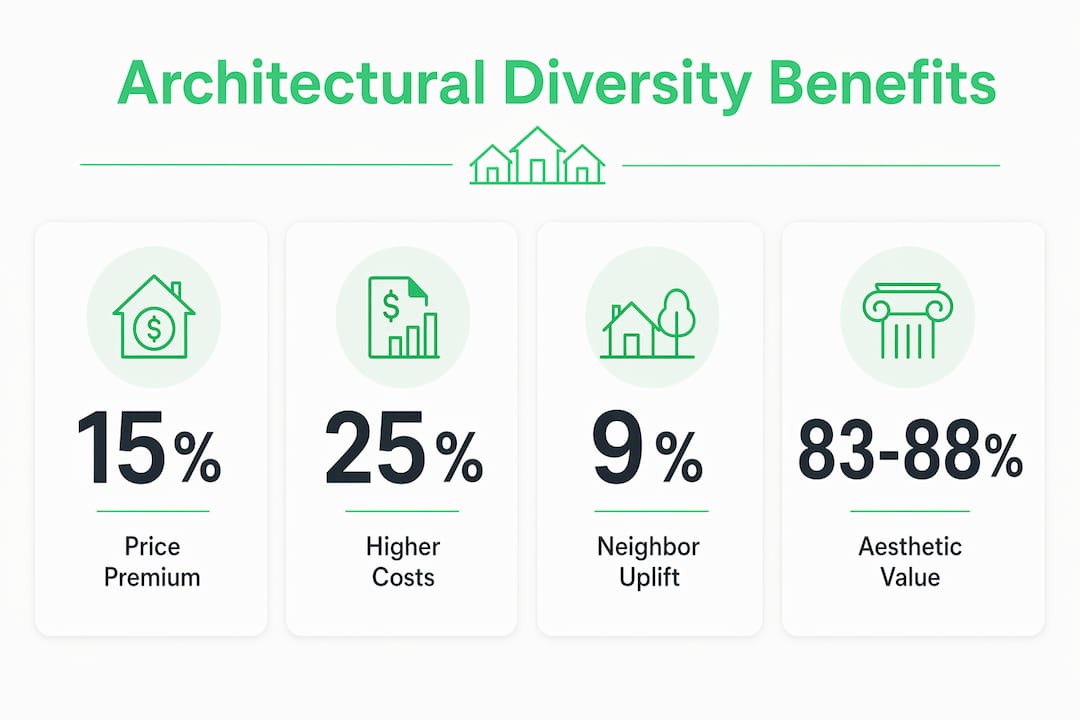
Distinctive architecture is not an aesthetic luxury. Buildings with distinctive architectural design command a 15% higher selling price than non-distinctive ones and increase neighboring property values by 9%. That spillover effect is a textbook social externality: the developer captures the premium on their own parcel, but the surrounding block absorbs a value gain it did not pay for.
The cost barrier is real. Distinctive design carries approximately 25% higher construction costs compared to standard builds. This gap explains why private developers default to repetitive typologies even when the market rewards variety. The solution is policy-level alignment: public subsidies of roughly 10% of construction costs effectively close the gap between private expense and societal benefit, incentivizing developers to deliver the architectural quality that communities actually need.
For urban planners and A&E primes, this data reframes the conversation. Advocating for design diversity is not a soft cultural argument. It is a return-on-investment argument backed by peer-reviewed economics.
| Economic factor |
Impact |
| Selling price premium |
+15% for distinctive buildings vs. non-distinctive |
| Neighboring property uplift |
+9% value increase on adjacent parcels |
| Additional construction cost |
~25% above standard build cost |
| Optimal public subsidy level |
~10% of construction cost to align incentives |
Pro Tip: When presenting a project proposal to a municipal planning board, cite the 9% neighboring property value uplift as a fiscal argument for design incentives. Boards respond to tax base expansion, not aesthetic theory.
How does architectural diversity enhance cultural representation?
Cultural representation in architecture is not decorative. Culturally diverse urban users show near-universal agreement on the presence of urban problems but divergent preferred design solutions aligned with distinct cultural orientations, with 81 to 94% consistency within each cultural group. This finding, known as the Convergent Appreciation Divergent Activation (CADA) model, dismantles the assumption that universal design solves inclusion. It does not. It homogenizes.
The importance of architectural variety extends to neurodiversity as well. Redundancy in spatial design supports neurodivergent needs and extends a building’s functional lifespan by making spaces adaptable without major renovation. Overlapping programmatic zones and varied circulation routes are not inefficiencies. They are inclusion infrastructure.
Monoculture architecture carries a documented psychological cost. Human brains evolved to prefer environmental variety, and monotonous streetscapes induce stress while reducing social dynamism. A uniform block of identical facades is not neutral. It is actively harmful to the communities living within it.
Strategies for integrating cultural narratives without homogenizing design include:
- Map cultural activation patterns before schematic design begins, identifying which spatial configurations resonate with the primary user communities.
- Avoid universal design as a ceiling. Use it as a floor, then layer culturally specific programming, material choices, and spatial hierarchies above it.
- Incorporate vernacular references at the material and detail scale rather than imposing them as superficial stylistic gestures.
- Build in spatial redundancy through overlapping circulation and multi-use zones that serve different cultural activation modes simultaneously.
Pro Tip: Commission a cultural activation audit alongside your standard site analysis. Interviewing three to five community stakeholders from distinct demographic groups before schematic design will surface divergent spatial preferences that no universal design checklist captures.
What aesthetic values support the case for architectural variety?
Aesthetic preference research validates what experienced designers already sense. Diversity scores highest among aesthetic values in both residential and commercial buildings, with importance ratings between 83% and 88%. Complexity, by contrast, ranks lowest. The implication is precise: users want variety, not chaos. They want rhythm and harmony expressed through differentiated forms, not visual noise.
Intentional asymmetry in scale, massing, and amenity distribution is the design strategy that operationalizes this preference. Celebrating difference in design fosters richer social environments and stronger place identity. A streetscape where every building acknowledges its neighbors while asserting its own character is not an accident of history. It is the product of deliberate design policy.
The emotional engagement that varied architecture produces translates directly into urban vitality. Districts with high architectural variety attract foot traffic, support retail, and generate the kind of spontaneous social interaction that urban planners have been trying to engineer for decades.
| Aesthetic value |
Importance rating |
Building type |
| Diversity |
83–88% |
Residential and commercial |
| Harmony |
High |
All building types |
| Rhythm |
High |
Commercial and administrative |
| Complexity |
Lowest rated |
All building types |
How can professionals implement architectural diversity in practice?
Implementation begins before the first line is drawn. The steps below reflect how regional light, climate, and cultural traditions must shape design decisions to prevent homogenization and the loss of embedded environmental knowledge.
- Conduct a regional context audit. Document local climate patterns, material traditions, and cultural spatial norms before schematic design. Globalized architectural styles erase centuries of local adaptation when applied without this grounding.
- Run Multiplicity Modeling™ scenarios. Modish’s Multiplicity Modeling™ engine generates varied design outcomes from a single facility brief, allowing teams to evaluate how different formal strategies perform against compliance, cost, and cultural fit criteria simultaneously.
- Use Architectural Diagnostic Intelligence™ for pre-bid risk identification. Modish’s Cinematic Intelligence™ infrastructure identifies structural, environmental, and code compliance failure points before construction commits, then renders corrective solutions in federal submission-grade visualization. This catches the points where design diversity collides with regulatory constraint early enough to resolve them without cost overruns.
- Integrate DesignVault 3D™ for corrective visualization. When a design iteration fails a compliance or cultural fit check, DesignVault 3D™ delivers up to 192 corrective visualization options per Space, giving design teams concrete alternatives rather than abstract feedback.
- Balance distinctiveness with budget reality. Use the 10% subsidy benchmark as a negotiating anchor in public-private projects. Frame design variety as a public good with a documented economic return, not as an added cost.
Pro Tip: Use AI in pre-design to run compliance and cultural fit diagnostics before design development locks in. Catching a regulatory conflict at the schematic stage costs a fraction of what it costs at construction documents.
Key takeaways
Architectural diversity produces measurable economic premiums, cultural equity, and psychological wellbeing that uniform design cannot replicate, making it a non-negotiable priority for any serious architecture or urban planning practice.
| Point |
Details |
| Economic premium is documented |
Distinctive buildings sell at a 15% premium and lift neighboring values by 9%. |
| Universal design is insufficient |
The CADA model shows cultural groups need tailored solutions, not one-size-fits-all frameworks. |
| Diversity tops aesthetic rankings |
Users rate diversity 83 to 88% in importance, above harmony, rhythm, and complexity. |
| Redundancy serves inclusion |
Overlapping spatial zones support neurodiversity and extend building lifespan without renovation. |
| Diagnostic intelligence reduces risk |
Tools like Cinematic Intelligence™ and DesignVault 3D™ resolve compliance conflicts before construction commits. |
The uncomfortable truth about architectural monoculture
I have reviewed hundreds of federal and commercial facility briefs over the course of my career, and the pattern is consistent. The projects that fail culturally are rarely the ones that tried too hard to be distinctive. They are the ones that defaulted to a universal template because it felt safe and defensible. Safety in design is not neutrality. It is a choice with consequences.
The CADA research confirmed what I had observed empirically: communities do not disagree about whether a space has problems. They disagree about what a good solution looks like. That divergence is not an obstacle to good design. It is the raw material of it. When you treat varied cultural activations as data rather than complications, you build spaces that actually work for the people inside them.
What Modish brings to this conversation is the ability to run that diagnostic work at scale, before a single dollar of construction is committed. Cinematic Intelligence™ does not replace the architect’s judgment. It gives that judgment a factual foundation that architectural master planning alone cannot provide. The only DOBE-certified firm in this category exists precisely because diverse design requires diverse intelligence infrastructure, not just diverse intent.
— Ben
How Modish supports diverse, compliant architectural design
Modish Global Inc. is the only Disability:IN-certified DOBE delivering Architectural Diagnostic Intelligence™ at federal submission grade. The Cinematic Intelligence™ engine identifies compliance failure points before construction commits. Multiplicity Modeling™ generates varied design outcomes from a single brief. DesignVault 3D™ renders up to 192 corrective visualization options per Space, giving design teams concrete paths forward rather than abstract risk flags. Every Modish engagement counts as Tier 1 diverse spend credit for Fortune 500 procurement teams and adds DOBE diversity scoring to federal A&E proposals. Explore the full diagnostic intelligence capabilities at Modish’s Federal Division, or visit modish.ai to request a pilot engagement starting at $9,500.
FAQ
Why does architectural diversity matter for urban planning?
Architectural diversity produces measurable economic, social, and psychological benefits including a 15% property price premium, reduced stress from environmental variety, and stronger cultural representation. Urban planners who treat design variety as a policy goal rather than an aesthetic preference deliver demonstrably better outcomes for communities.
What is the CADA model in architecture?
The Convergent Appreciation Divergent Activation (CADA) model shows that culturally diverse urban users agree on the presence of problems but prefer distinct design solutions aligned with their cultural orientations, with 81 to 94% consistency within each group. It is the primary research argument against universal design as a sufficient inclusion strategy.
How does architectural diversity affect property values?
Buildings with distinctive architectural design command a 15% premium over non-distinctive equivalents and increase neighboring property values by 9%, making design variety a quantifiable asset for developers and municipalities alike.
What is intentional asymmetry in architectural design?
Intentional asymmetry is a design strategy that deliberately varies scale, massing, and amenity distribution across a development to prevent monoculture and support diverse emotional and social needs. It is the formal mechanism through which architectural variety becomes embedded in the built fabric rather than applied as surface decoration.
How does Modish support architectural diversity in federal projects?
Modish delivers Architectural Diagnostic Intelligence™ through Cinematic Intelligence™ and DesignVault 3D™, identifying compliance and design conflicts before construction and generating corrective visualization options. As the only DOBE-certified firm in this category, Modish adds both diagnostic capability and diversity scoring to federal A&E proposals.
Recommended