What Is Corrective Architectural Intelligence for Builders
What Is Corrective Architectural Intelligence for Builders
TL;DR:
- Corrective architectural intelligence embeds governance constraints directly into the design process to identify failures before construction. It shifts AI control from suggestion-based inference to deterministic, system-enforced rules that enhance compliance and reduce costs. Adoption of this approach enables firms to improve audit outcomes, mitigate risk, and stay ahead in regulatory-driven project environments.
Most architects and engineers treating AI as a design accelerant are missing the more consequential question: what governs it? What is corrective architectural intelligence is not a theoretical inquiry. It is the operational difference between a facility that passes federal review and one that fails it at the bid stage. Corrective architectural intelligence addresses what conventional AI tools and manual compliance workflows cannot. It embeds self-correcting governance directly into the design and diagnostic process, catching structural, environmental, and code compliance failures before they become construction commitments.
Table of Contents
Key takeaways
| Point |
Details |
| Correction as system logic |
Corrective architectural intelligence encodes governance constraints at the design level, not after the fact. |
| Compliance is architecture |
Embedding fiduciary controls into workflows makes noncompliance operationally difficult, not just procedurally discouraged. |
| Feedback loops are mandatory |
Failures recur when corrections are not formalized as permanent architectural rule changes within the system. |
| Preventive and corrective work together |
Mature automated governance reduces audit failures by up to 60% when both corrective and preventive mechanisms operate together. |
| DOBE-certified intelligence exists |
Modish is the only Disability:IN-certified firm delivering Architectural Diagnostic Intelligence™ with federal submission-grade corrective visualization. |
What corrective architectural intelligence actually means
The corrective architecture definition starts at the system level. Corrective architectural intelligence is not a feature you add to a building model. It is a governing framework that encodes fiduciary constraints, ethical controls, and error-correction logic directly into the design infrastructure before a single construction document is issued.
Traditional architectural workflows treat compliance as a downstream review. Someone checks drawings against code after the design is substantially complete. Corrective architectural intelligence inverts that sequence entirely.
Architectural intelligence shifts AI control from prompt-based inference to deterministic, machine-readable constraints embedded within system architecture. That shift is the defining distinction between a corrective approach and conventional AI-assisted design. The key structural components include:
- Corrective flux modules: Mechanisms that detect deviation from compliance baselines and redistribute corrections across the design system in real time
- Responsibility distribution: Semantic channels that assign accountability for each corrective action to the appropriate project stakeholder or system node
- Temporal correction loops: Processes that synchronize ethical and regulatory judgment across the project lifecycle, not just at review milestones
- Embedded governance constraints: Machine-readable rules at design level that operate independently of post-hoc code reviews or large language model safeguards
Pro Tip: Treat governance as a structural layer in your design workflow, not a checklist. If your compliance logic lives in a spreadsheet someone opens at the end of a phase, you are practicing policy enforcement, not corrective architecture.
The distinction between corrective and preventive design strategies matters here. Prevention anticipates failures before they arise. Correction identifies failures that have materialized and converts them into permanent system modifications. Both are necessary. Neither alone is sufficient.
Why corrective architecture matters in building projects
The importance of corrective architecture becomes concrete when you price what it replaces. Manual compliance checks, reactive code reviews, and post-bid redesigns carry measurable costs that most project teams accept as standard friction.
They are not standard. They are architectural failures.
Automated governance and compliance scanning reduce audit failures by up to 60% when both corrective and preventive mechanisms are active simultaneously. That is not a marginal improvement. On a federal A&E pursuit with a $40 million construction budget, that reduction translates directly into bid competitiveness and post-award performance.
The strategic benefits of corrective architecture extend well beyond audit scores:
- Risk mitigation through architectural enforcement: The system prevents noncompliance structurally rather than catching it through human review
- Continuous regulatory adaptation: Corrective loops adjust to updated codes and environmental stressors without requiring manual workflow rewrites
- Early feedback on structural and safety gaps: AI-driven pattern recognition flags anomalies beyond fixed thresholds, enabling teams to act before commitment
- Reduced rework in pre-construction phases: Corrective intelligence operating at the pre-bid stage eliminates the most expensive category of design error
Modish’s Architectural Diagnostic Intelligence™ engine operationalizes these benefits across commercial and federal facilities, delivering 192 corrective visualization options per Space in federal submission-grade output.
Pro Tip: If your project’s compliance strategy depends on a person remembering to check something, you already have an architectural problem. Corrective intelligence replaces memory with mechanism.
The connection to fire protection compliance and new construction safety is direct. Corrective architectural intelligence identifies code failure points across mechanical, structural, and life-safety systems before those systems are committed to construction drawings.
Corrective intelligence vs. other architectural approaches
Understanding the types of architectural intelligence requires separating corrective systems from two categories often confused with them: predictive self-correction and AI-assisted design tools.
| Approach |
Mechanism |
When it acts |
Governance model |
| Predictive self-correction |
Sensor networks and structural modeling |
Real-time environmental response |
Autonomous parameter adjustment |
| AI-assisted design |
LLM-based inference and suggestion |
During design authoring |
Prompt-dependent, human-reviewed |
| Corrective architectural intelligence |
Deterministic constraints and feedback loops |
Pre-commitment, pre-bid |
Embedded, system-enforced |
Predictive architecture self-correction uses sensor data to recalibrate structural parameters based on environmental stressors. That is a performance optimization tool. It does not address regulatory compliance, design governance, or pre-construction risk identification.
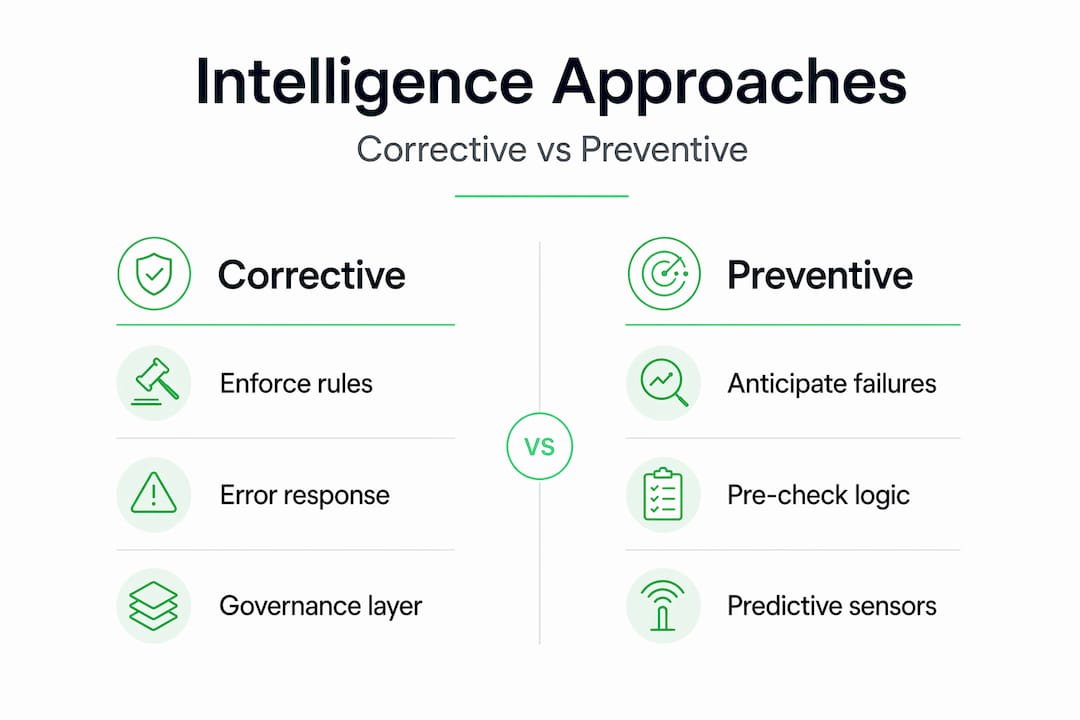
AI-assisted design tools operate on inference. They suggest. They generate. They do not enforce. And only 6% of architectural professionals regularly use AI, with 90% citing concerns about inaccuracy. That trust gap exists precisely because suggestion-based tools lack the governance architecture that makes output reliable.
Corrective architectural intelligence fills that gap through deterministic enforcement. Enterprise AI integration succeeds when domain-specific knowledge is curated in a bridge layer that interfaces between AI agents and legacy systems. That bridge layer is corrective intelligence made operational.
How to implement architectural intelligence in your workflow
The practical steps for how to implement architectural intelligence require structural thinking, not just tool adoption.
- Audit your current correction points. Map every location in your workflow where a human is currently catching a compliance gap. Each one is a candidate for architectural enforcement.
- Define machine-readable constraints. Translate your most common code requirements and design standards into deterministic rules that can be evaluated automatically at each project phase.
- Build approval logic into phase gates. Design cannot advance past a phase gate until the corrective loop for that phase is closed. This is not a manual checklist. It is a system condition.
- Establish a feedback formalization protocol. Recurring design errors persist when corrections are documented but not embedded as permanent rule changes. Every correction generates a rule update.
- Integrate AI oversight at the pre-bid stage. Corrective loops operating before construction commitment deliver the highest return. Post-construction correction is exponentially more expensive.
Pro Tip: Start with your highest-risk failure category, typically life-safety or accessibility compliance, and build one corrective loop that closes completely before expanding. A single closed loop produces more value than five open ones.
AI-driven architectural review at the pre-bid stage is where corrective intelligence produces its most measurable returns: fewer change orders, stronger federal proposals, and compliance documentation that survives audit.
My take on where this is heading
I have spent enough time watching architectural firms treat compliance as a cultural problem rather than a structural one to know that the correction-as-intelligence paradigm is not optional anymore. It is where the profession is being pulled by regulatory complexity and AI acceleration simultaneously.
What I find most interesting is not the technology itself. It is the governance question underneath it. The firms that are ahead are not the ones with the best AI tools. They are the ones that stopped treating correction as an embarrassing admission of error and started treating it as the primary mechanism of design intelligence.
Corrective intelligence reframes error as a resource for knowledge creation, not a failure to be minimized. That reframe changes everything about how a firm organizes its workflows, trains its teams, and structures its project delivery.
Modish’s Cinematic Intelligence™ engine is built on exactly this premise. Every Space processed through the Modish infrastructure does not just identify a failure point. It generates corrective visualization options that can be submitted directly to federal reviewers. That is not AI assistance. That is architectural governance made visible.
The professionals who adopt corrective intelligence frameworks in 2026 will be positioned for federal A&E pursuits, Fortune 500 facility programs, and enterprise compliance contracts that competitors without that infrastructure simply cannot win.
— Ben
See corrective intelligence in action with Modish
Modish Global Inc. is the only Disability:IN-certified DOBE firm delivering Architectural Diagnostic Intelligence™ with federal submission-grade corrective visualization. The Cinematic Intelligence™ engine processes each Space and returns 192 corrective visualization options, purpose-built for pre-bid evaluation, master planning, and pre-design risk identification. Every engagement counts as Tier 1 diverse spend credit for Fortune 500 procurement teams and adds DOBE diversity scoring to federal A&E proposals. Explore Modish diagnostic services for enterprise and federal clients, or review the architectural diagnostic options to see how corrective intelligence applies directly to your next facility project. Single-facility pilots begin at $9,500.
FAQ
What is corrective architectural intelligence?
Corrective architectural intelligence is a governance framework that embeds deterministic compliance constraints, error-correction loops, and fiduciary controls directly into the design and diagnostic process, so failures are identified and corrected before construction commitment rather than during or after.
How does corrective architecture differ from preventive design?
Preventive design anticipates failures before they occur. Corrective architecture identifies failures that have materialized and converts them into permanent system-level rule changes, closing the feedback loop so the same error cannot recur.
What are the measurable benefits of corrective architecture?
Automated corrective governance reduces audit failures by up to 60% and lowers compliance-related project costs significantly when both corrective and preventive mechanisms operate together within the design workflow.
Traditional AI tools operate on inference and suggestion, not enforcement. With only 6% adoption among architectural professionals due to accuracy concerns, the trust gap exists precisely because suggestion-based tools lack the embedded governance that corrective intelligence provides.
Who uses corrective architectural intelligence in practice?
Federal A&E primes, Fortune 500 facility teams, and commercial project managers use corrective architectural intelligence to strengthen pre-bid compliance documentation, reduce design rework, and meet evolving regulatory standards before construction drawings are committed.
Recommended