DOBE architectural intelligence: what it means and why it matters
DOBE architectural intelligence: what it means and why it matters

TL;DR:
- DOBE architectural intelligence involves embedded systems operated by verified disability-owned firms that surface risk, validate compliance, and produce traceable outputs throughout project phases. It provides review-ready, citation-specific diagnostic reports, supporting federal procurement, diversity credit, and audit preparedness. Using continuous, lifecycle-wide intelligence enhances project accuracy, regulatory compliance, and competitive advantage in federal and corporate architecture projects.
Federal contracting officers and supplier diversity managers increasingly encounter the phrase “DOBE architectural intelligence” in procurement conversations, yet very few people can explain what it actually means. It gets lumped in with generative design, spatial analytics, and AI buzzwords that vendors attach to any product with a dashboard. That confusion is costly. When you misidentify what DOBE architectural intelligence is, you select the wrong vendors, write RFP language that invites misrepresentation, and leave traceable compliance value on the table. This article cuts through the noise and gives you a precise, working definition you can act on.
Table of Contents
Key Takeaways
| Point |
Details |
| Integrated project oversight |
DOBE architectural intelligence supports end-to-end risk and compliance throughout a project’s lifecycle. |
| Reliable vendor selection |
It helps procurement teams distinguish truly intelligent tools from generic solutions. |
| Compliance and diversity advantage |
Properly deployed, DOBE intelligence boosts audit success and RFP scores for federal work. |
| Future-proof procurement |
Making intelligence inseparable from project delivery is now a competitive necessity. |
Defining DOBE architectural intelligence
DOBE stands for Disability-Owned Business Enterprise. A DOBE-certified firm is verified through Disability:IN, the leading nonprofit corporate resource for disability inclusion in business. When you combine that certification with architectural intelligence, you are not describing a piece of software. You are describing an embedded system operated by a disability-owned firm that surfaces risk, validates compliance, and produces traceable design outputs at every stage of a project.
Think of it this way. Standard architectural consulting gives you expert opinion. Standard software gives you data visualization. DOBE architectural intelligence gives you both, delivered by a firm whose diversity credentials generate Tier 1 diverse spend credit for your procurement file. That is a category-specific value stack, not a feature toggle.
Submission-grade architectural intelligence requires outputs formatted and documented to withstand federal review. That standard separates genuine diagnostic intelligence from tools that generate attractive renders without regulatory defensibility.
As cove.inc describes, using intelligence systems to support architectural decision-making means embedding that intelligence across a project lifecycle, from concept through delivery, rather than treating it as a standalone tool. This framing matters enormously for procurement language. A tool you deploy once is a line item. An embedded system that continuously informs constraints, alternatives, and compliance implications is a program infrastructure investment.
Key outputs you should expect from a legitimate DOBE architectural intelligence engagement:
- Structural failure point identification before construction commits
- Environmental and code compliance diagnostics mapped to current federal standards
- Federal submission-grade visualizations with corrective solution overlays
- Audit-ready documentation linking each finding to a specific regulatory citation
- Supplier diversity credit verification tied to DOBE certification status
“Another ‘architectural intelligence’ framing in architecture practice is the general idea of using intelligence systems to support architectural decision-making across a project lifecycle (concept through delivery), rather than treating intelligence as only a standalone tool.” This distinction is exactly what separates defensible DOBE procurement from cosmetic diversity spend.
Coordinating compliance across a federal facility project requires this kind of structured, stage-aware intelligence, not a single report delivered at project close.
How DOBE architectural intelligence works across the project lifecycle

Understanding the definition is one thing. Seeing where value actually lands across a project timeline is what helps you write better scopes of work and evaluate vendor claims more precisely.
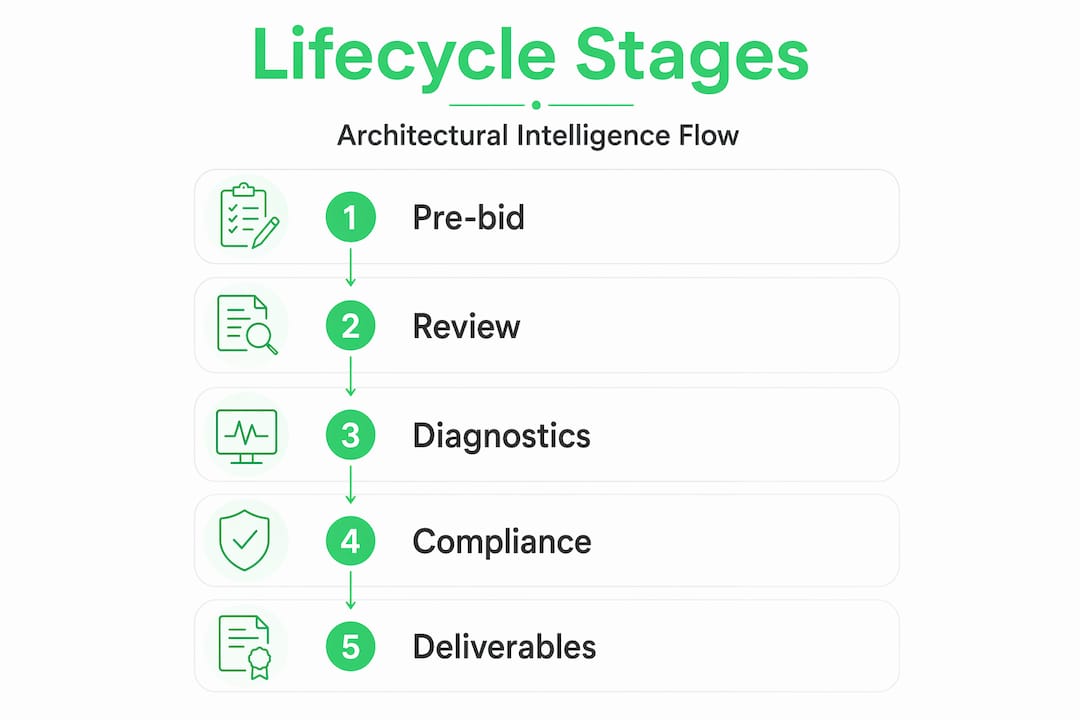
Here is how DOBE architectural intelligence operates at each major project stage:
- Pre-bid evaluation. Before your team commits to a site or design direction, diagnostic intelligence scans structural, environmental, and code-related risk factors. You get a risk profile before budget locks.
- Concept and schematic design. The intelligence system continuously tests design alternatives against federal requirements, surfacing constraints early when changes are still inexpensive to make.
- Design development. Simulation outputs validate compliance pathways and generate documentation that follows the design record forward into submission packages.
- Pre-construction review. Final diagnostic sweeps confirm that corrective solutions are embedded in construction documents, reducing RFI volume and contractor-driven scope changes.
- Audit and reporting. The full decision trail, every flagged risk, every corrective visualization, every compliance citation, is organized and exportable for supplier diversity reporting and federal audit response.
This is what AI-driven federal facility planning looks like when it is purpose-built for the federal environment rather than adapted from commercial real estate workflows.
| Project stage |
Intelligence function |
Procurement value |
| Pre-bid |
Risk profile generation |
Avoids costly site commitments |
| Schematic design |
Constraint mapping |
Reduces late-stage redesign cost |
| Design development |
Compliance simulation |
Strengthens submission packages |
| Pre-construction |
Document validation |
Lowers RFI and change order volume |
| Post-delivery audit |
Decision trail export |
Supports diversity spend reporting |
The diagnostic intelligence tools that produce these outputs generate 192 corrective visualization options per facility upload. That is not a brochure claim. It is a processing specification that translates directly into the number of defensible alternatives your team can evaluate before a single dollar of construction spend is committed.
Pro Tip: When evaluating DOBE intelligence vendors, ask them specifically how many corrective outputs their system generates per facility and whether those outputs are formatted for federal submission review. Vague answers indicate analytics products misrepresented as diagnostic intelligence.
Key features: What differentiates DOBE architectural intelligence
Procurement teams lose significant value when they accept generic “architectural AI” in place of true diagnostic intelligence. The difference is material, both legally and financially.
Digital Blue Foam notes a critical edge case: if a vendor uses “architectural intelligence” loosely, it may refer to generative design, spatial analytics, or decision support, which differ materially from pre-construction diagnostic risk identification. Your RFP language must distinguish diagnostic and simulation outputs, traceability, and review-quality deliverables from these adjacent categories.
Here is a direct comparison of what true DOBE architectural intelligence delivers versus what generic tools offer:
| Feature |
Generic AI architectural tools |
DOBE architectural intelligence |
| Output type |
Renders, spatial data |
Federal submission-grade visualizations |
| Compliance depth |
General code reference |
Citation-specific diagnostic reports |
| Traceability |
Limited or none |
Full decision trail per finding |
| Diversity credit |
None |
Tier 1 DOBE diverse spend |
| Pre-construction risk ID |
Rare |
Core function |
| Audit support |
Not designed for it |
Built-in export for federal review |
The following features are non-negotiable when writing RFP or RFQ language for DOBE architectural intelligence:
- Deliverable traceability: Every corrective recommendation must link back to a specific code section or federal standard.
- Simulation reporting: The system must model compliance scenarios, not just flag issues after the fact.
- Review-ready outputs: Documents must be formatted to enter a federal submission package without reformatting by your team.
- DOBE certification verification: The vendor must hold active Disability:IN certification, not self-certify.
Understanding how AI in architecture bids strengthens proposal scores helps procurement teams write specifications that attract the right vendors. Similarly, learning how code compliance with AI works at the regulatory level prevents you from accepting outputs that look good but would not survive a federal review.
How federal agencies and Fortune 500s benefit from DOBE architectural intelligence
Compliance strength and competitive advantage are not separate goals in federal procurement. DOBE architectural intelligence serves both simultaneously.
Here is what federal contracting officers and supplier diversity managers consistently report as the most tangible benefits:
- Reduced audit surprises. When every finding is documented with a regulatory citation and a corrective visualization, your supplier diversity file answers audit questions before they are asked.
- Stronger RFP scores. Federal evaluation panels respond to submission packages with traceable, high-quality documentation. Proposals that include DOBE diagnostic outputs outperform those relying on narrative descriptions of compliance intent.
- Cleaner diverse spend reporting. Because DOBE architectural intelligence is delivered by a Disability:IN-certified firm, every dollar of engagement is already categorized as Tier 1 diverse spend, simplifying the reporting cycle.
- Faster vendor onboarding. When DOBE vendors operate embedded intelligence systems, vetting is straightforward. Certification is verifiable, outputs are standardized, and the compliance record is ready on day one.
- Improved master planning posture. For large agencies managing multiple facilities, federal AE compliance checks conducted by a DOBE intelligence firm create a consistent diagnostic baseline across the portfolio.
As embedded intelligence across a lifecycle becomes the standard expectation, teams that have already integrated DOBE diagnostic systems will carry a measurable scoring advantage in competitive federal A&E pursuits.
Pro Tip: Ask your DOBE vendor to show you a sample project digest that demonstrates how findings, corrective visualizations, and compliance citations are packaged together. If the digest cannot stand alone as an audit document, the system is not truly diagnostic intelligence.
Why “intelligence” is more than a feature: Our perspective
The procurement community has developed a pattern of treating intelligence as a feature you check off during vendor evaluation. That pattern is the single biggest source of wasted diverse spend in federal facility projects today.
Real intelligence is not a module you activate. It is a method of accountability that runs through every decision, every document, and every submission. When submission-grade intelligence is built into the project from day one, the entire compliance posture of that project changes. You stop reacting to audit findings and start generating audit responses before the questions arrive.
The uncomfortable truth is that most procurement teams accept outputs that look like intelligence but carry none of its accountability properties. A render is not a diagnostic. A heatmap is not a compliance citation. A dashboard is not a traceable decision record. The distinction matters because federal auditors and diversity program evaluators are becoming more sophisticated, not less.
Future-ready procurement requires intelligence to be inseparable from the project lifecycle. Teams that demand traceable, defensible outputs now will outperform those still treating intelligence as an optional vendor add-on when the next federal A&E solicitation drops.
Take the next step with Modish.ai Federal Division
If the frameworks in this article reflect how your team is already thinking about DOBE procurement, you are ready to work with a firm that was built specifically for this category.
Modish.ai is the only Disability:IN-certified DOBE architectural diagnostic intelligence firm in the United States. Our Cinematic Intelligence platform delivers 192 corrective visualization options per facility upload, formatted for federal submission review and supplier diversity reporting. From $9,500 single-facility pilots to enterprise-level engagements, every dollar qualifies as Tier 1 diverse spend. Explore the architectural diagnostic solution to see how pre-construction risk identification works in practice, or review a sample project digest to understand what audit-ready intelligence documentation actually looks like. Your next federal A&E pursuit deserves a DOBE partner who can strengthen both your score and your compliance file at the same time.
Frequently asked questions
What is the main goal of DOBE architectural intelligence?
DOBE architectural intelligence aims to embed risk mitigation, compliance validation, and diversity tracking throughout every stage of an architectural project rather than treating them as separate, after-the-fact tasks. As embedded intelligence continuously informs constraints and alternatives across the lifecycle, the compliance record builds itself alongside the design.
How does DOBE architectural intelligence support supplier diversity in federal procurement?
It provides traceable diagnostic outputs and Tier 1 diverse spend verification that simplify both audit preparation and diversity reporting. Because AI-supported architectural decisions are documented at each project stage, your supplier diversity file is always current and defensible.
What features should I require from DOBE architectural intelligence solutions?
Prioritize diagnostic pre-construction outputs, simulation reporting, and full deliverable traceability over tools that offer only generative design or spatial analytics. Vendors who use “architectural intelligence” loosely may deliver analytics that differ materially from the review-quality, citation-specific outputs federal procurement actually requires.
How can DOBE architectural intelligence create competitive advantage?
By producing review-ready documentation with traceable compliance citations, DOBE architectural intelligence directly improves RFP and proposal scores while reducing audit exposure. Proactive risk identification and simulation outputs give your submissions a specificity and credibility that narrative-only compliance statements cannot match.
Recommended