What Is Defect Detection in Architecture: A Pro Guide
What Is Defect Detection in Architecture: A Pro Guide
TL;DR:
- Defect detection in architecture involves systematically identifying and classifying building flaws to ensure safety and compliance. Modern AI-powered tools significantly improve speed and scale, but human triage remains essential for accuracy and professional judgment. Upstream detection during design development offers the greatest cost savings and risk mitigation benefits.
Defect detection in architecture is the systematic identification and classification of structural, material, and surface imperfections in buildings and construction assemblies to preserve safety, ensure code compliance, and prevent costly rework. Defects range from hairline cracks and spalling concrete to rebar exposure, corrosion, efflorescence, and sealant failures. Each flaw carries a compounding risk: left unaddressed, a surface crack becomes a water intrusion pathway, which becomes a structural liability. Modern architectural practice now deploys both traditional inspection protocols and AI-powered Architectural Diagnostic Intelligence™ to catch these failure points before construction commits. Modish Global Inc. operates at the leading edge of this discipline.
What is defect detection in architecture and why it matters
Defect detection in architecture is defined as the structured process of locating, documenting, and classifying physical and performance failures within building materials, assemblies, and design documents. The AIA Trust frames architecture quality control as a risk management strategy, not merely an error-catching exercise. That distinction matters enormously. When a QA process is documented and defensible, it shapes insurance outcomes and professional standard-of-care determinations. When it is informal or absent, negligence presumptions fill the gap.
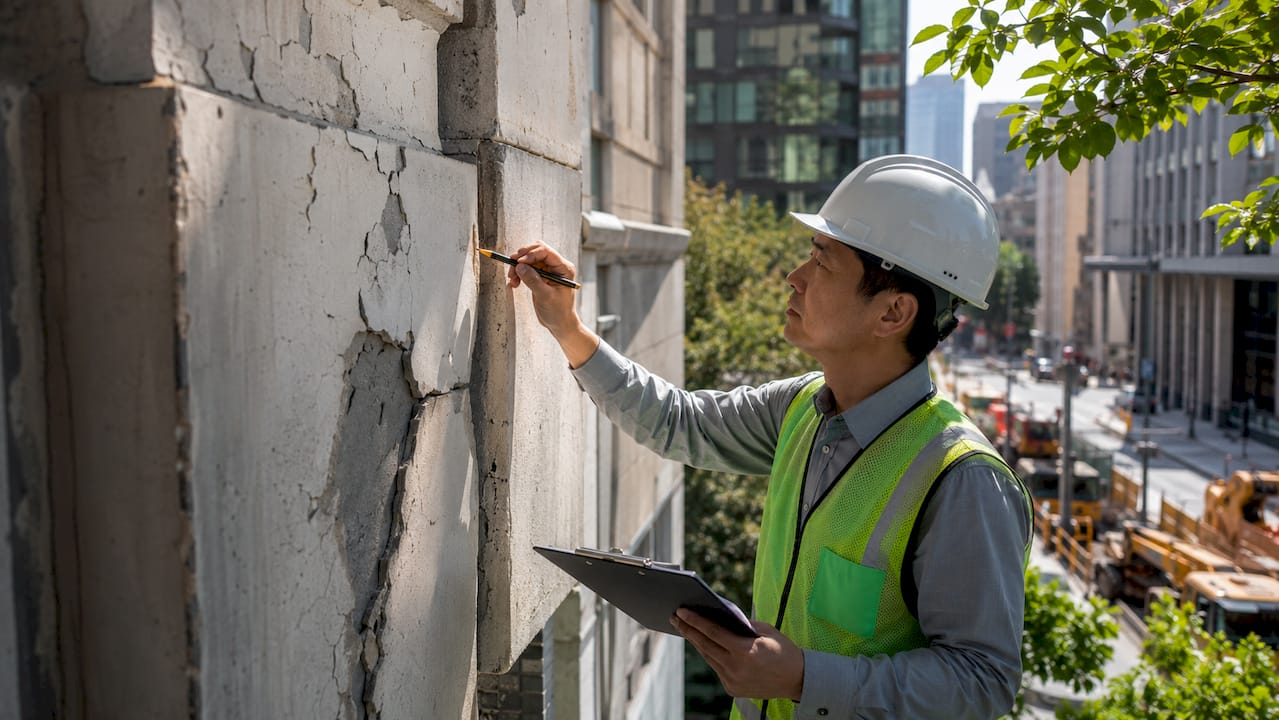
The economic stakes are direct. Structural defects identified during design development cost a fraction of what they cost to remediate post-occupancy. Cracks in load-bearing concrete, misaligned rebar, and inadequate waterproofing details are all detectable at the drawing stage with the right diagnostic infrastructure. Modish’s Cinematic Intelligence™ engine identifies structural, environmental, and code compliance failure points in commercial and federal facilities before construction commits, then renders corrective solutions in federal submission-grade visualization. That is defect detection operating at its highest leverage point.
How defect detection methods work: traditional and modern approaches
Traditional building defect identification relies on three core practices: visual inspection by qualified field personnel, peer review of construction documents, and systematic documentation against project specifications. These methods are proven and legally defensible. They are also slow, inconsistent across reviewers, and unable to scale across large facility portfolios.
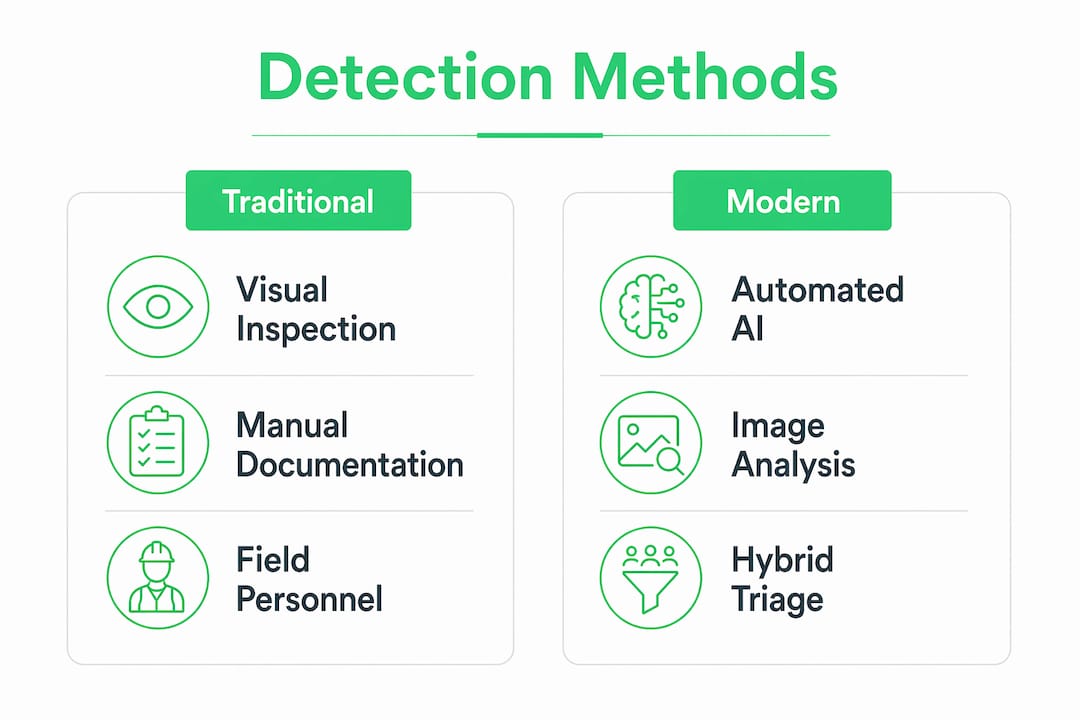
AI-powered detection closes that gap. Convolutional neural networks (CNNs) and YOLO-architecture models process photographic and scan data to identify defect signatures with 96.5% average precision across 20 distinct defect types, with detection latency of 0.3 seconds per image on standard GPU hardware. That speed means a facility that once required days of manual inspection can be assessed in hours. Deep learning ensemble models have reached 98.18% accuracy detecting casting surface defects, while unsupervised methods achieve 88.52% accuracy without requiring large labeled training datasets, which reduces the cost of deploying detection systems in new building typologies.
The detection workflow follows a consistent logic regardless of the tool. Images or scan data enter the system, the model segments regions of interest, classifies defect type and severity, and outputs a ranked, metadata-tagged report. Modish’s AI-driven architectural review infrastructure applies this logic to design documents and facility Spaces, producing 192 corrective visualization options per submission.
- Visual inspection: baseline field assessment, high human variability
- Peer document review: catches design-stage errors, limited to reviewer expertise
- CNN and YOLO models: image-based automated classification at scale
- Drone-assisted AI inspection: GPS-tagged, severity-ranked defect catalogs
- Modish Architectural Diagnostic Intelligence™: pre-construction failure point identification with Cinematic Intelligence™ rendering
Pro Tip: Combine automated first-pass detection with a structured human triage layer. AI finds the candidates; experienced engineers determine structural significance. Neither alone delivers the accuracy both achieve together.
Common types of architectural defects and their implications
Structural defects are the highest-urgency category. Cracks in concrete members, spalling surfaces, and exposed rebar signal compromised load capacity and active corrosion pathways. These defects require immediate severity assessment because their progression is nonlinear: a 2mm crack in a post-tensioned slab behaves very differently from the same crack width in a non-structural partition wall.
Surface defects carry lower immediate structural risk but significant long-term cost. Efflorescence indicates water migration through masonry. Staining from mineral deposits or biological growth signals envelope failures. Sealant joint failures at curtain wall interfaces are among the most common and most expensive defects in commercial construction, because they allow water infiltration that degrades insulation, framing, and interior finishes simultaneously.
Corrosion and water-related damage occupy a category of their own because they are both symptom and cause. Corrosion of embedded steel is often invisible until spalling reveals it. Water damage behind cladding systems can progress for years before interior evidence appears. AI drone inspection compresses building inspection timelines from days or weeks to hours, with AI classifying structural, surface, corrosion, water-related, and mechanical defects with detailed metadata attached to each finding.
| Defect category |
Detection difficulty |
Urgency for repair |
| Structural cracks and spalling |
Moderate (requires trained assessment) |
Critical |
| Rebar exposure and corrosion |
High (often subsurface) |
Critical |
| Efflorescence and staining |
Low (visually apparent) |
Moderate |
| Sealant and joint failures |
Moderate (requires probing) |
High |
| Water infiltration damage |
High (concealed systems) |
High |
Automated AI detection vs. manual inspection: which approach wins?
Speed and scalability favor automated systems without qualification. A single AI inspection pass processes thousands of image frames in the time a field inspector covers one floor plate. AI drone inspection delivers GPS-tagged, severity-ranked defect reports in hours rather than days. For portfolio-scale facility management or federal pre-bid evaluation across multiple sites, manual inspection simply cannot match that throughput.
The limitation of automated detection is false positives. Every AI system flags candidates that are not true defects: shadows, surface texture variations, and construction artifacts all trigger classification models. Triage processes that separate genuine finds from false positives before senior review are what determine whether an AI detection program saves time or creates new workload. Human judgment remains indispensable for assessing structural significance, interpreting contextual factors, and making the professional determinations that carry legal weight.
Cost-benefit analysis favors a hybrid model for most architectural practices. Automated tools handle the volume; experienced engineers handle the judgment. A pre-QC workflow structured around drawing freeze, automated first-pass review, peer triage, correction loop, and curated senior handoff at 30%, 60%, and 90-100% design milestones captures the efficiency of automation without sacrificing the professional rigor that QA documentation requires.
Pro Tip: Design your triage layer before deploying any AI detection tool. Define what constitutes a “Good Find” versus a “Bad Find” for your project type, and assign triage responsibility to a mid-level reviewer, not a senior engineer. That single decision determines whether AI detection saves or costs time.
Practical applications of defect detection in architectural workflows
Defect detection integrates into architectural practice at four distinct workflow stages, each with different tools and stakes.
- Design validation and BIM review. Automated checks against code requirements, clearance standards, and structural logic catch design-stage flaws before they enter construction documents. Modish’s Multiplicity Modeling™ infrastructure applies this logic at the pre-bid and master planning stage for federal A&E pursuits.
- Construction monitoring. Field inspection data, drone imagery, and photographic documentation feed AI classification models to track defect emergence in real time. This creates a defensible audit trail for contractual compliance and insurance documentation.
- Maintenance planning and facility management. Periodic defect detection surveys establish condition baselines, prioritize repair sequencing, and support capital planning. The architectural audit process formalizes this into a repeatable professional practice.
- Federal contracting and pre-bid evaluation. Federal contracting officers and A&E primes use pre-construction defect analysis to identify risk before proposals commit. Modish’s diagnostic intelligence solutions deliver 192 corrective visualization options per Space, purpose-built for this stage.
Quality Control Manuals, as the AIA Trust specifies, must balance detailed procedures with disclaimers that prevent unjustified reliance, covering organization, budgets, staffing, checking procedures, peer reviews, and AI protocols. Internal design reviews do not substitute for this documented infrastructure.
Key takeaways
Defect detection in architecture requires a structured combination of AI-powered classification, human triage, and documented QA protocols to deliver defensible, actionable results.
| Point |
Details |
| Define defects precisely |
Classify by category (structural, surface, corrosion, water) to prioritize repair urgency accurately. |
| AI detection sets the speed standard |
Systems like CNNs and YOLO models achieve 96.5% precision at 0.3 seconds per image. |
| Triage determines AI program success |
Separating true defects from false positives before senior review is what saves time and cost. |
| QA documentation carries legal weight |
Documented QC processes influence insurance outcomes and professional standard-of-care determinations. |
| Proactive detection reduces rework |
Shifting detection to the design stage costs far less than post-construction remediation. |
Why defect detection needs to move upstream, not downstream
The industry still treats defect detection as a construction-phase activity. That is the wrong frame. By the time a crack appears in poured concrete or a sealant joint fails in a curtain wall, the design decision that caused it was made months earlier. I have reviewed federal facility submissions where water infiltration defects were traceable directly to a detail that never received a proper QC pass. The construction team executed the drawing perfectly. The drawing was wrong.
Shifting defect detection upstream into the modeling and design development phase is where the real leverage lives. A pre-QC pass at the 30% design milestone catches coordination failures before they propagate through 60% and 90% drawing sets. The cost of correction at 30% is a fraction of what it costs at construction administration. AI detection tools make this upstream shift practical at scale, but only if the triage and review workflow is designed before the tool is deployed.
The risk management implication is equally significant. Firms that document their QA processes, including AI-assisted audit trails, are in a fundamentally different insurance position than those that rely on informal peer review. That is not a theoretical benefit. It is a measurable difference in professional liability exposure.
— Ben
How Modish delivers defect detection at the design stage
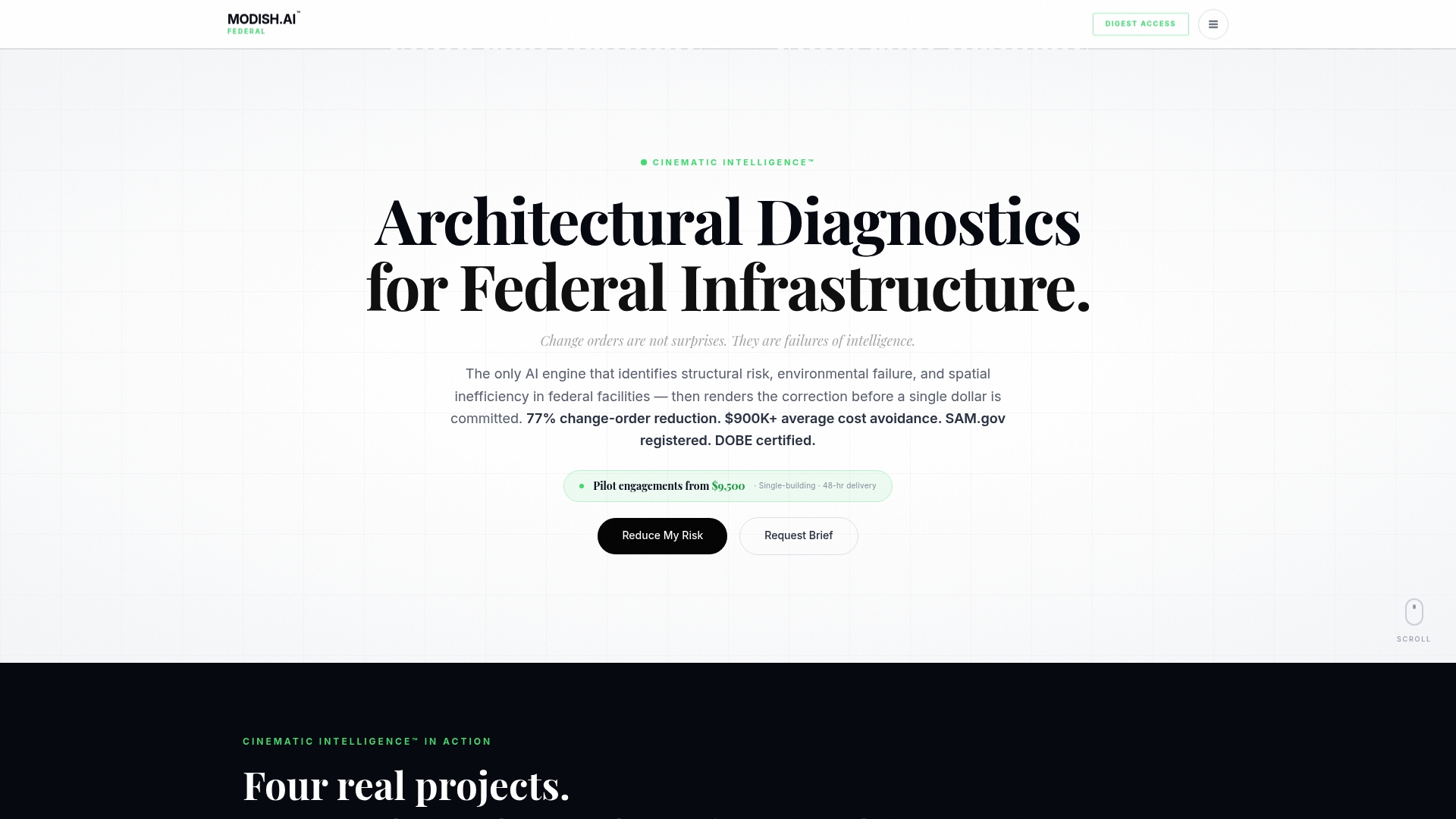
Modish Global Inc. is the only Disability:IN-certified DOBE architectural diagnostic intelligence firm in the United States. The Cinematic Intelligence™ engine identifies structural, environmental, and code compliance failure points before construction commits, then renders corrective solutions in federal submission-grade visualization. For federal A&E primes and Fortune 500 procurement teams, every Modish engagement delivers Tier 1 diverse spend credit alongside a diagnostic capability that no other supplier database can source. Engagements begin at $9,500 for single-facility pilots. Explore diagnostic intelligence solutions or review engagement pricing to scope your next project.
FAQ
What is defect detection in architecture?
Defect detection in architecture is the systematic identification and classification of structural, material, and surface imperfections in buildings and construction documents. It covers cracks, spalling, corrosion, water infiltration, and design-stage coordination failures.
What are the most common architectural defects?
The most common architectural defects include concrete cracking and spalling, rebar corrosion, efflorescence, sealant joint failures, and water infiltration through building envelope assemblies. Each category carries different urgency and detection difficulty.
How accurate is AI-based defect detection?
AI-based systems achieve 96.5% detection precision across 20 defect types at 0.3 seconds per image. Deep learning ensemble models reach 98.18% accuracy on surface defect classification tasks.
Why does defect detection matter for architecture quality control?
Documented defect detection processes directly influence insurance outcomes and professional standard-of-care determinations. The AIA Trust identifies QA documentation as a risk management tool, not merely an error-catching procedure.
How do automated and manual defect detection methods compare?
Automated AI systems deliver speed and scalability that manual inspection cannot match, but false positive triage and structural significance assessment still require experienced human judgment. A hybrid workflow combining both methods produces the most defensible and accurate results.
Recommended