What Is Architectural Supplier Diversity? 2026 Guide
What Is Architectural Supplier Diversity? 2026 Guide

TL;DR:
- Architectural supplier diversity involves intentionally including underrepresented-owned firms in federal and corporate procurement chains. Engaged early in project planning and properly certified with aligned NAICS codes, diverse firms enhance compliance, innovation, and competitiveness. Prioritizing Tier 1 and Tier 2 spend tracking and building pre-qualified vendor lists ensures successful implementation and maximizes economic benefits.
Architectural supplier diversity is defined as the deliberate inclusion of architecture and engineering firms owned by underrepresented groups, including women, minorities, veterans, LGBTQ+ individuals, and people with disabilities, within federal and corporate procurement supply chains. This practice is not charity. It is a strategic business initiative designed to level the playing field while driving innovation, supply chain resilience, and competitive advantage. The construction and trades industry awarded over $45 billion to diverse contractors in the last fiscal year alone. That number signals the scale of opportunity procurement leaders and A&E primes can no longer afford to ignore.
What is architectural supplier diversity and who qualifies?
Architectural supplier diversity is the recognized industry practice of sourcing architecture and engineering services from firms that meet specific ownership, control, and certification criteria tied to underrepresented identity groups. The standard threshold is 51% ownership and control by individuals from those groups. Ownership alone is not sufficient. The qualifying individual must also exercise day-to-day operational control of the firm.

Certification is the mechanism that makes diversity status legible to procurement systems. The most recognized certifications in federal and corporate contexts include:
| Certification |
Issuing Body |
Primary Sector |
| 8(a) Business Development |
SBA |
Federal |
| HUBZone |
SBA |
Federal |
| SDVOSB (Service-Disabled Veteran) |
VA / SBA |
Federal |
| WBENC (Women-Owned) |
Women’s Business Enterprise National Council |
Corporate |
| NMSDC (Minority-Owned) |
National Minority Supplier Development Council |
Corporate |
| Disability:IN DOBE |
Disability:IN |
Federal and Corporate |
Federal opportunities require SAM.gov registration in addition to any third-party certification. Without an active SAM.gov record, a firm cannot receive federal contract awards regardless of its diversity status.
Pro Tip: Verify that your firm’s SAM.gov profile lists the correct NAICS codes for architectural services, specifically codes in the 541310–541340 range. A certification as a general business without proper NAICS alignment may not count toward architectural procurement diversity goals during bid evaluation.
How does supplier diversity shape federal and private sector procurement?
Architectural supplier diversity reshapes procurement at two distinct levels: Tier 1 direct spend and Tier 2 indirect spend. Tier 1 spend occurs when a federal agency or Fortune 500 company contracts directly with a diverse A&E firm. Tier 2 spend occurs when a prime contractor engages diverse firms as subcontractors and reports that spend toward its own diversity goals.
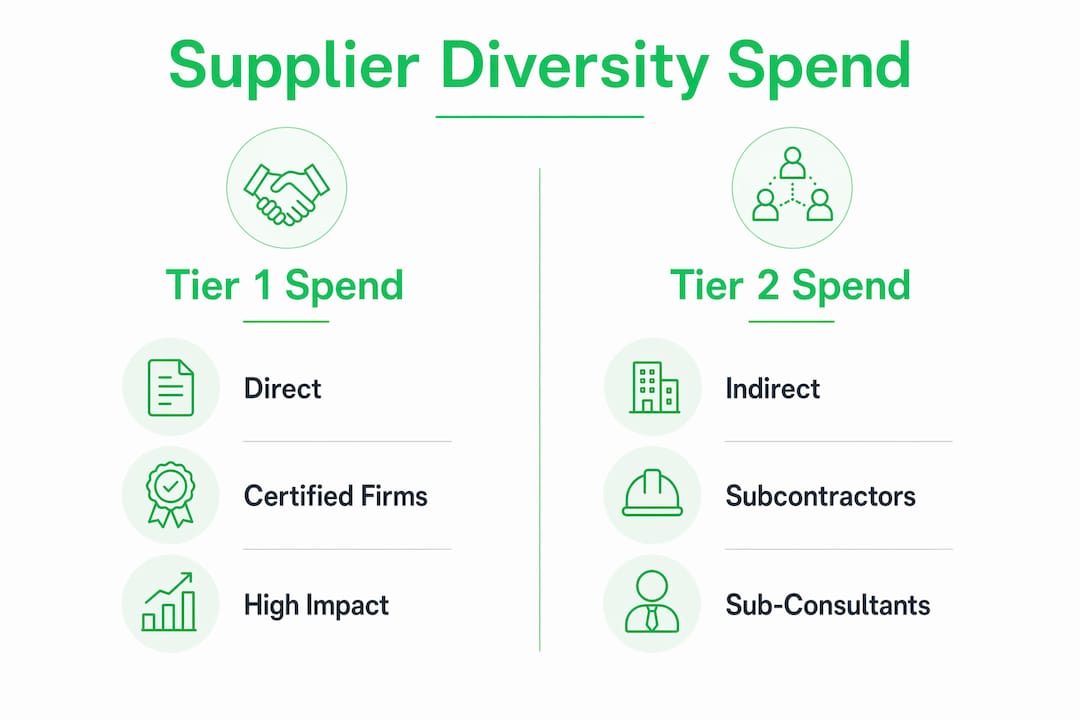
Federal contracting standards now mandate that prime contractors report diversity participation beyond their direct contracts. This requirement pushes diverse A&E firms deeper into the supply chain, making them critical assets at the sub-consultant layer, not just at the prime level.
The strategic implications for procurement leaders are significant:
- Diverse A&E firms engaged during pre-design and master planning phases contribute to compliance scoring before a single bid is submitted.
- Prime contractors with documented Tier 2 diversity spend receive higher evaluation scores on competitive federal proposals.
- Diverse architectural firms bring specialized technical capabilities that improve project resilience and design outcomes.
- The economic multiplier effect is real. Diversely owned A&E firms engage their own sub-vendors, amplifying equity and economic impact across the full project ecosystem.
For Fortune 500 procurement teams, every dollar spent with a certified diverse A&E firm counts as Tier 1 diverse spend credit on annual supplier diversity scorecards. That credit directly affects corporate ESG reporting, board-level diversity commitments, and in some cases, regulatory compliance obligations.
What are the common pitfalls in architectural supplier diversity programs?
The most expensive mistake in architectural supplier diversity is timing. Successful procurement requires setting diverse participation goals at the project brief and scope stage, not at the bid stage. Organizations that wait until solicitation release to identify diverse A&E partners consistently underperform on diversity metrics and miss the deeper integration value those firms provide.
The second major pitfall is NAICS code misalignment. Many firms hold diversity certifications that do not map to architectural or engineering service codes. When a procurement officer searches for certified diverse A&E firms, a misaligned NAICS code makes a qualified firm invisible. This is a documented challenge specific to architectural procurement that generic supplier diversity programs rarely address.
Here are the four most common failures procurement leaders encounter:
- Late engagement. Bringing diverse firms in at bid stage rather than during pre-design eliminates their ability to shape scope, reduce risk, or add diagnostic value.
- Certification without NAICS alignment. A WBENC or NMSDC certification means nothing to an A&E procurement officer if the firm’s codes do not match the technical scope.
- Checkbox compliance. Listing a diverse firm on a team roster without meaningful scope assignment does not satisfy federal reporting requirements and creates legal exposure.
- Ignoring sub-consultant layers. Prime A&E firms often overlook diversity in their own sub-consultant selections, leaving Tier 2 spend unreported and unearned.
Pro Tip: Build a pre-qualified diverse A&E vendor list before any project brief is issued. Review each firm’s SAM.gov profile, active certifications, and NAICS codes annually. This single practice eliminates the most common compliance failures before they occur.
What best practices help firms succeed with supplier diversity programs?
Effective architectural supply chain inclusion requires a structured approach that begins before the project scope is written. The firms that consistently outperform on diversity metrics treat supplier diversity as a procurement design decision, not a reporting obligation.
The most effective practices follow a clear sequence:
- Set goals at project initiation. Define target diversity spend percentages in the project brief. Attach those targets to specific scopes such as facility diagnostics, visualization, or code compliance review.
- Build teaming relationships before bids open. Diverse A&E firms that are already integrated into a prime’s delivery model perform better and generate more credible diversity documentation than last-minute additions.
- Track Tier 1 and Tier 2 spend separately. Use Architectural Diagnostic Intelligence™ tools to capture sub-consultant diversity spend at the project level, not just the contract level.
- Align certification strategy to contract type. Federal set-asides require SBA certifications. Corporate supplier diversity scorecards weight NMSDC, WBENC, and Disability:IN DOBE certifications differently. Know which certification drives value in each context.
The importance of early-stage diversity goal definition cannot be overstated. Firms that define participation targets during master planning consistently achieve higher diverse spend percentages and stronger proposal evaluation scores than those that address diversity at solicitation. You can explore how architectural diversity drives design outcomes beyond compliance to understand the full strategic case.
For federal A&E primes, teaming with a DOBE-certified firm adds a diversity scoring category that most proposals cannot access through any other means. Disability:IN certification is the rarest credential in the A&E supply chain. It fills a gap that SDVOSB, WBENC, and NMSDC certifications cannot cover simultaneously.
Key takeaways
Architectural supplier diversity is a procurement design decision that must be built into project initiation, not retrofitted at bid stage, to deliver compliance value and competitive advantage.
| Point |
Details |
| Definition and scope |
Architectural supplier diversity requires 51% ownership by underrepresented groups and third-party certification to qualify for federal and corporate programs. |
| Certification alignment |
NAICS codes must match architectural service categories or diversity certifications will not count toward A&E procurement goals. |
| Tier 1 and Tier 2 spend |
Both direct and sub-consultant diversity spend count toward federal reporting; track them separately from project initiation. |
| Timing is the critical variable |
Diverse A&E firms engaged at pre-design deliver more compliance value and stronger proposal scores than those added at bid stage. |
| DOBE certification fills a unique gap |
Disability:IN DOBE certification is the rarest credential in A&E supply chains and cannot be replicated by any other diversity category. |
Why supplier diversity in architecture is an economic argument, not a moral one
I have watched procurement teams treat supplier diversity as a line item to satisfy rather than a strategy to deploy. That approach costs them twice: once in missed evaluation points, and again in the innovation they never accessed.
The firms I have seen succeed treat diverse A&E partners the way they treat any high-value sub-consultant. They bring them in early, assign them meaningful scope, and track their contribution at the project level. The result is not just better diversity scores. It is better buildings, stronger proposals, and supply chains that hold under pressure.
Federal procurement cycles taught me one uncomfortable truth. The diversity categories that generate the highest scoring premiums are the ones that are hardest to source. DOBE certification sits at the top of that list. Most supplier databases contain zero DOBE-certified A&E firms. That scarcity is not a problem for the procurement leader who plans ahead. It is an advantage. You can read more about DOBE partnership benefits for compliance and scoring to see how that advantage translates to contract outcomes.
Supplier diversity in architecture is an economic multiplier, not a concession. The firms that understand this earliest will hold the strongest positions in federal and Fortune 500 procurement for the next decade.
— Ben
How Modish supports architectural supplier diversity goals
Modish is the only Disability:IN-certified DOBE architectural diagnostic intelligence firm in the United States. Every engagement generates Tier 1 diverse spend credit for Fortune 500 procurement teams while delivering Cinematic Intelligence™ facility diagnostics that no other certified firm can provide.
For federal A&E primes, Modish operates as a teaming subcontractor that adds DOBE diversity scoring to proposals and delivers 192 corrective visualization options per Space, purpose-built for pre-bid evaluation and master planning. Engagements begin at $9,500 for single-facility pilots. Modish is SAM.gov registered and teamed under READIGOV (SDVOSB/WOSB prime) for complete federal execution. Explore Modish’s federal capabilities to see how Architectural Diagnostic Intelligence™ and DOBE certification combine into a sourcing advantage your competitors cannot replicate.
FAQ
What is the definition of architectural supplier diversity?
Architectural supplier diversity is the deliberate inclusion of architecture and engineering firms that are at least 51% owned and controlled by underrepresented groups, including women, minorities, veterans, LGBTQ+ individuals, and people with disabilities, within federal and corporate procurement programs.
Which certifications qualify a firm for architectural supplier diversity programs?
The primary certifications are SBA 8(a), HUBZone, SDVOSB, WBENC, NMSDC, and Disability:IN DOBE. Federal opportunities also require active SAM.gov registration with correctly aligned architectural NAICS codes.
Why does NAICS code alignment matter for diverse A&E firms?
A diversity certification without the correct architectural service NAICS codes will not appear in procurement searches for A&E-specific opportunities. NAICS misalignment is one of the most common reasons qualified diverse firms are excluded from bids they should win.
What is Tier 2 diversity spend in architectural procurement?
Tier 2 diversity spend is the diverse subcontractor and sub-consultant spend reported by a prime contractor toward its own diversity goals. Federal standards require primes to track and report this spend, making diverse A&E firms valuable at every layer of the supply chain.
How early should diverse A&E firms be engaged in a project?
Diverse A&E firms should be identified and integrated during the project brief and master planning phase. Early engagement produces stronger compliance documentation, higher proposal evaluation scores, and more meaningful design contributions than late-stage additions.
Recommended