Boost compliance and diversity scores with DOBE partners
Boost compliance and diversity scores with DOBE partners

TL;DR:
- Treating all diversity certifications as interchangeable risks costly proposal errors.
- DOBE and federal DBE certifications operate in separate ecosystems with distinct criteria and uses.
- Understanding these differences maximizes supplier impact and avoids qualification failures across federal and corporate projects.
Treating all diversity certifications as interchangeable is one of the most costly assumptions a procurement team can make. A DOBE certification from Disability:IN and a federal DBE designation under 49 CFR Part 26 operate in entirely separate ecosystems, each with distinct acceptance criteria, scoring implications, and compliance obligations. When contracting officers and supplier diversity managers confuse the two, proposals fail qualification screens, diversity benchmarks go unmet, and real scoring opportunities are left on the table. This guide cuts through that confusion and shows exactly how to leverage DOBE-certified architecture partners for maximum impact across both federal and Fortune 500 engagements.
Table of Contents
Key Takeaways
| Point |
Details |
| Certification distinctions matter |
Federal and corporate diversity certifications, such as DOBE and DBE, have separate requirements and impact proposal compliance. |
| DOBE boosts diversity scores |
DOBE-certified partners can improve supplier diversity benchmarks for Fortune 500 proposals when properly onboarded. |
| Portal design affects accessibility |
Corporate supplier diversity portals must operationalize DOBE acceptance for maximum impact and conversion. |
| Ongoing compliance is essential |
Regular renewal tracking, scope alignment, and documentation are critical to maintaining compliance and proposal eligibility. |
| Integrate, don’t just check a box |
To achieve true supplier diversity value, incorporate DOBE partners strategically throughout the proposal cycle. |
What DOBE certification means in federal and corporate contexts
The certification landscape looks deceptively simple until a proposal gets rejected for using the wrong credential. Two programs dominate the conversation, and they do not overlap.
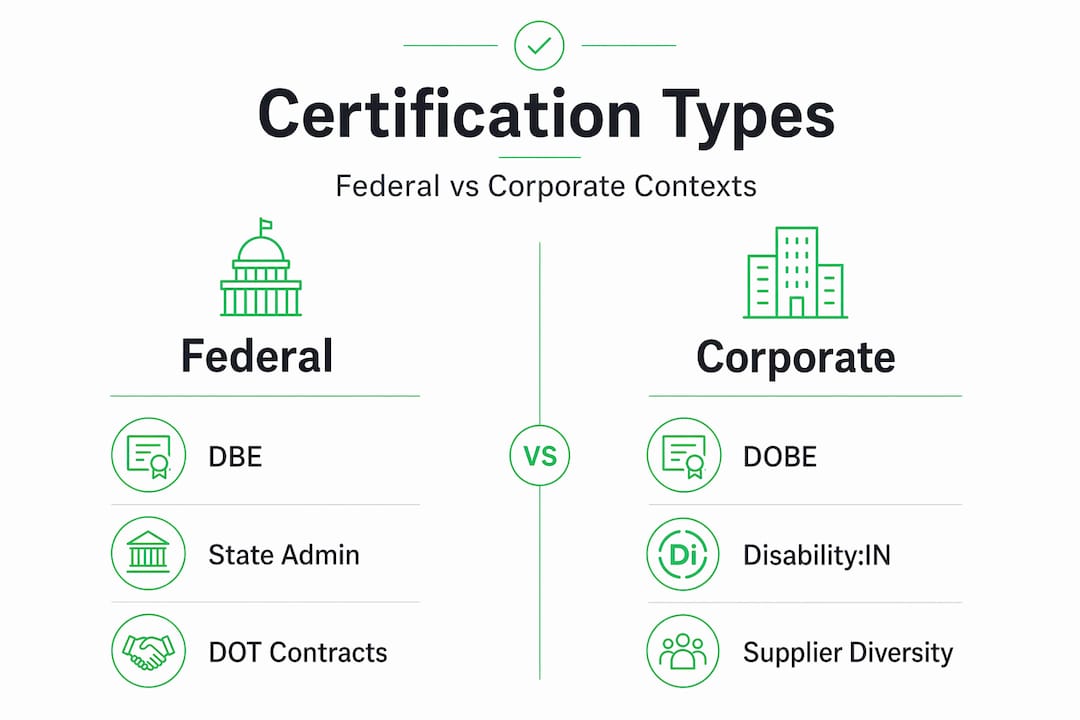
For federal transportation contracts, DBE certification under 49 CFR Part 26 is administered through each state’s Unified Certification Program (UCP), which allows recognition across the state regardless of the certifying partner. This is a federally mandated standard tied to DOT funding eligibility. It is not interchangeable with a Disability:IN credential.
In corporate procurement environments, the picture is different. Fortune 500 supplier diversity programs rely on third-party certifications such as the Disability:IN DOBE designation for supplier diversity scoring and eligibility pipelines, separate from federal DBE certifications entirely. A DOBE-certified firm brings measurable value to corporate diversity metrics, counts as Tier 1 diverse spend, and strengthens an organization’s inclusion index performance.
Certification comparison at a glance
| Certification |
Governing body |
Primary use case |
Accepted by |
| DBE (49 CFR Part 26) |
U.S. DOT / State UCP |
Federal transportation contracts |
Federal agencies, DOT primes |
| DOBE (Disability:IN) |
Disability:IN |
Corporate supplier diversity scoring |
Fortune 500, enterprise procurement |
| MBE (NMSDC) |
NMSDC |
Minority business diversity spend |
Corporate supplier programs |
| WOSB (SBA) |
U.S. SBA |
Federal small business set-asides |
Federal agencies |
Understanding where each certification applies prevents three critical proposal errors:
- Mismatched certification submissions on federal A&E solicitations that require specific small business designations
- Uncredited diverse spend when DOBE partners are engaged but not properly categorized in corporate reporting
- Missed scoring points when procurement teams don’t recognize that DOBE fills a certification category no other designation covers
Engaging the right certification alignment services early in the proposal development process eliminates these gaps before they become compliance liabilities.
Supplier diversity scoring: How DOBE-certified partners impact your benchmarks
Once the certification distinction is clear, the strategic value of a DOBE-certified partner becomes immediately apparent. Supplier diversity benchmarks are not scored on a simple pass/fail basis. They reward depth.

According to supplier diversity benchmarks tracked in the 2026 State of Supplier Diversity report, supplier diversity scoring frequently depends on measurable dimensions including transparency, supplier accessibility, certification breadth, public reporting, and outcomes. A DOBE-certified partner directly enriches several of those dimensions simultaneously, particularly when the engagement is properly documented and reported.
Here is how DOBE-certified architecture partnerships move the needle on scoring:
- Certification breadth gains — Most supplier databases are saturated with MBE, WBE, and VOSB registrations. DOBE-certified architecture firms represent a category gap, which means adding one to your supplier base increases breadth scores without cannibalizing spend already allocated to other diversity categories.
- Accessibility dimension credit — Disability:IN certification signals that a firm meets inclusion standards, which maps directly to accessibility dimensions in corporate supplier diversity indexes.
- Tier 1 spend attribution — Direct engagement with a DOBE-certified subcontractor like Modish counts as Tier 1 diverse spend, which carries stronger weight in reporting than Tier 2 pass-through arrangements.
- Outcome documentation — DOBE partners with documented deliverables, such as AI-driven facility diagnostics, provide auditable outcomes that strengthen public reporting scores.
Pro Tip: When onboarding a DOBE-certified partner, request their Disability:IN certificate number and expiration date immediately. Log it in your supplier portal before the engagement begins so the spend is captured correctly from day one.
The firms that outperform their peers on supplier diversity benchmarks don’t just collect diverse certifications. They build procurement workflows that translate certifications into reportable, scored outcomes at every stage.
Common workflow barriers: Portal design and certification friction
Certification alone doesn’t guarantee scoring. The operational layer matters just as much, and this is where well-intentioned procurement programs quietly underperform.
A significant supplier diversity edge case involves corporate portal friction when a company nominally accepts DOBE but designs its workflow around other certification ecosystems, such as NMSDC MBE workflows. This misalignment reduces accessibility and proposal conversion even when the supplier holds valid certification.
The problem shows up in predictable ways:
- Portal classification fields that have no DOBE category, forcing diversity managers to manually override or incorrectly categorize the supplier
- Onboarding documentation checklists that request certification types DOBE firms don’t hold, creating artificial compliance failures
- Spend reporting templates not configured to capture disability-owned business spend as a separate reportable line
- Proposal submission platforms that apply MBE or WBE scoring logic to DOBE certifications, producing inaccurate diversity scores
“Even a fully certified, highly capable DOBE partner delivers zero diversity scoring value if your procurement portal cannot recognize, classify, and report the engagement correctly. The bottleneck is rarely the supplier. It’s the system.”
Addressing these workflow gaps requires a deliberate audit of your supplier portal infrastructure before the proposal season begins. Teams that conduct architectural compliance checks and pre-bid evaluations as a standard practice apply that same disciplined thinking to procurement workflows. The principle is identical: find the failure points before commitment, not after.
Ensuring compliance: Documentation, scope, and renewal best practices
With operational challenges identified, maintaining ongoing compliance is the next discipline. Certification is not a one-time event. Proposals require ongoing compliance behavior and documented qualified status matched to the scope of the work being proposed. This is a standard that many supplier diversity programs underestimate until an audit reveals gaps.
Follow these steps to maintain proposal-ready DOBE partner compliance:
- Track renewal dates proactively. Disability:IN certifications require annual renewal. Build a calendar reminder 90 days before expiration and confirm updated certificates are stored in your supplier management system.
- Match scope to proposal requirements. A DOBE-certified architecture firm must be engaged for work that falls within its stated scope. Don’t list a diagnostic intelligence firm as a structural engineering prime. The scope mismatch will fail a compliance review.
- Maintain audit-ready documentation. Store the original certificate, engagement letter, SOW, invoices, and proof of payment in a single accessible folder organized by contract number. Auditors look for this package.
- Verify portal acceptance before submission. Confirm that your supplier portal reflects the DOBE certification status, not a generic “diversity” flag. Inaccurate classification affects both scoring and audit defense.
- Align reporting cadence to contract milestones. Don’t wait until year-end to report diverse spend. Quarterly reporting against contract milestones keeps documentation current and supports master planning for compliance across multi-year engagements.
Pro Tip: Use a shared compliance tracker that both your procurement team and the DOBE-certified partner can access. When both sides maintain records in parallel, discrepancies are caught before they become audit findings. Platforms that streamline compliance documentation reduce this friction significantly.
For federal contracting officers managing facility audits for compliance on A&E pursuits, the same documentation standards apply. Consistent, organized records are the foundation of both a clean audit and a competitive proposal. More supplier compliance best practices from OpenGov confirm that ongoing documentation behavior is what separates compliant programs from reactive ones.
Why the standard approach to supplier diversity misses the mark
Most organizations treat supplier diversity as a certification collection exercise. Find a certified supplier, add them to the portal, check the box, move on. This approach technically satisfies minimum requirements and produces minimum results.
The real competitive advantage comes from integrating DOBE-certified partners early in the proposal development cycle, not after the team is assembled. When a DOBE-certified architecture intelligence firm is brought in at the pre-bid evaluation stage, its work directly shapes the technical narrative of the proposal. The diversity score and the capability score move together. That is a fundamentally different outcome than tagging a certified subcontractor to an already-complete proposal to satisfy a diversity threshold.
We’ve observed this pattern repeatedly: organizations that onboard DOBE partners for submission-grade intelligence during the proposal strategy phase produce more defensible, higher-scoring submissions than teams that treat certification as a last-mile add-on.
The contrarian truth is this: the firms winning on supplier diversity aren’t just more diverse. They are more strategically organized. Diversity is embedded in how they think about capability, not layered on top of it as an afterthought.
Connect with innovative DOBE-certified architecture partners
Modish Global Inc. is the only Disability:IN-certified DOBE architectural diagnostic intelligence firm in the United States, and every engagement generates Tier 1 diverse spend credit while delivering 192 corrective visualization options per facility upload. For procurement teams building competitive proposals, that combination fills a category gap that no other firm in any supplier database can match.
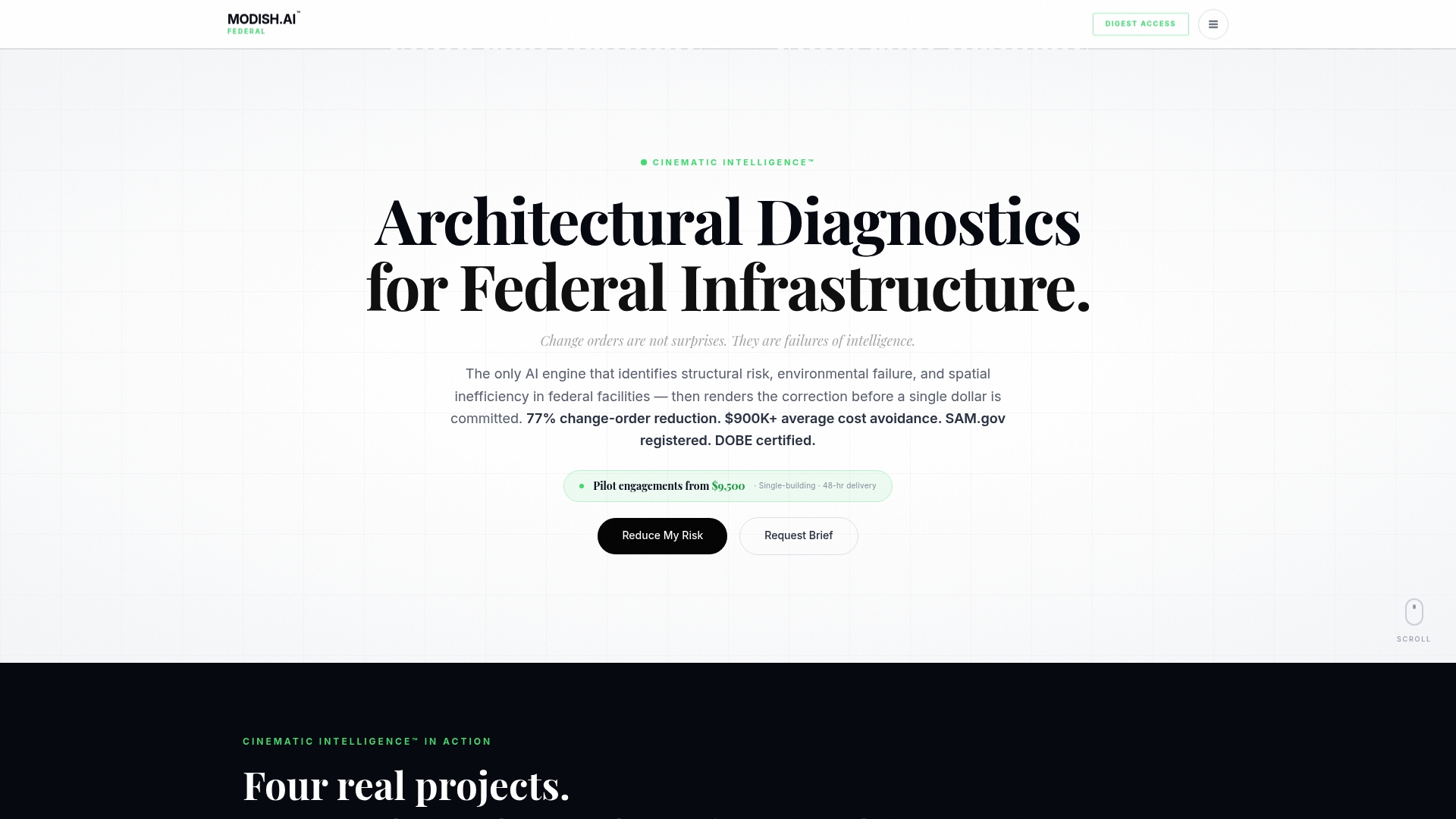
Explore our federal past performance to understand how Modish performs as a teaming subcontractor on A&E pursuits. Review our architectural diagnostic services to see how pre-bid facility intelligence supports both compliance and proposal scoring. For federal-specific engagements, our federal architectural intelligence platform is purpose-built for pre-design risk identification and master planning support. Engagements start at $9,500 for single-facility pilots. Reach out to explore what a DOBE partnership looks like for your next submission.
Frequently asked questions
Is DOBE certification accepted in federal DOT contracting?
DOBE certification from Disability:IN is primarily suited for Fortune 500 supplier diversity programs, not federal DOT contracts that require DBE certification under 49 CFR Part 26 administered through a state’s Unified Certification Program.
How does DOBE certification affect proposal scoring in Fortune 500 supplier diversity programs?
DOBE certification enriches supplier diversity scores by improving certification breadth and accessibility dimensions when properly onboarded, as scoring benchmarks measure transparency, public reporting, and outcomes alongside certification status.
What are the operational risks of relying solely on DOBE certification?
Corporate portals often built around other certification workflows can create friction that reduces proposal conversion even when a supplier holds valid DOBE certification, making portal configuration just as important as the credential itself.
Which compliance best practices help maximize proposal success with DOBE-certified partners?
Track renewals annually, match supplier scope to proposal work, and maintain organized audit-ready documentation because ongoing compliance behavior and proof of qualified status are required beyond simple certification submission.
Recommended