Types of Accessible Design Standards: 2026 Guide
Types of Accessible Design Standards: 2026 Guide
TL;DR:
- Accessible design standards encompass legal, philosophical, digital, and federal requirements that ensure spaces, products, and content serve people of all abilities. Architects must understand and integrate ADA, Universal Design, WCAG, and Section 508 standards from the project’s outset to guarantee compliance and inclusivity. Failure to consider all categories leads to costly revisions, legal issues, and facilities that exclude rather than serve diverse users.
Accessible design standards are defined as the legal, technical, and philosophical frameworks that govern how buildings, environments, and digital content must perform for people across the full spectrum of human ability. For architects, engineers, and designers, understanding the distinct types of accessible design standards is not optional. ADA compliance standards, Universal Design principles, WCAG digital guidelines, and federal technical standards like Section 508 each address a different layer of accessibility. Knowing which standard governs which project context is the difference between a facility that passes inspection and one that actually serves everyone.
1. what are accessible design standards?

Accessible design standards are the codified rules and guiding philosophies that define how spaces, products, and communications must function for people with disabilities and diverse abilities. They divide into four primary categories: legal mandates, design philosophies, digital technical guidelines, and federal procurement requirements. Each category carries different enforcement mechanisms, different scopes, and different consequences for non-compliance. Architects and engineers who treat these categories as interchangeable routinely produce facilities that satisfy one standard while failing another.
2. ADA compliance standards for physical spaces
The ADA Standards for Accessible Design are a legal mandate for all U.S. commercial and public facilities, specifying exact physical requirements to prevent discrimination against people with disabilities. They are not aspirational guidelines. They are enforceable federal law.
Core ADA requirements for new construction and significant renovations include:
- Accessible routes: Continuous, unobstructed paths connecting all facility elements
- Door hardware: Lever-style handles operable with a closed fist, no tight grasping required
- Toilet rooms: Specific turning radius clearances, grab bar placement, and fixture heights
- Signage: Raised characters, Grade 2 Braille, and mounting height specifications
- Curb ramps: Required at all pedestrian crossings, with slope and width tolerances defined to the inch
Non-compliance carries real financial exposure. Court settlements routinely cite Level AA conformance as the minimum threshold for non-discrimination, and retrofit costs after construction always exceed design-phase corrections. For federal A&E compliance, ADA violations can trigger project disqualification entirely.
Pro Tip: Document every ADA design decision during the schematic phase. A written compliance record is your first line of defense in any enforcement action.
3. universal design principles: beyond minimum compliance
Universal Design is defined as a proactive design philosophy that creates environments usable by all people, to the greatest extent possible, without adaptation or specialized design. It originated at North Carolina State University with seven core principles that go well beyond what ADA requires.
The seven principles are:
- Equitable Use: The design is useful to people with diverse abilities
- Flexibility in Use: Accommodates a wide range of individual preferences and abilities
- Simple and Intuitive Use: Easy to understand regardless of experience or cognitive ability
- Perceptible Information: Communicates necessary information effectively to the user
- Tolerance for Error: Minimizes hazards and adverse consequences of accidental actions
- Low Physical Effort: Can be used efficiently and comfortably with minimum fatigue
- Size and Space for Approach and Use: Appropriate space regardless of body size or mobility
The practical gap between ADA and Universal Design is significant. ADA requires a 32-inch clear door opening. Universal Design recommends 36 inches because it serves wheelchair users, parents with strollers, and workers moving equipment simultaneously. Lever door handles, adjustable-height counters, and step-free entrances are Universal Design solutions that also satisfy ADA, but they were conceived for everyone, not just for compliance.
Applying Universal Design upstream in the design process reduces the need for expensive retrofits later. It also expands market reach. A facility that works for a 75-year-old and a 25-year-old with a broken arm serves more people and commands stronger long-term value.
Pro Tip: Introduce Universal Design criteria at the programming phase, before floor plans are drawn. Retrofitting a non-compliant entry costs 10 to 20 times more than designing it correctly from the start.
4. WCAG standards and their reach into physical design
WCAG 2.2 is the current international benchmark for digital accessibility, and it extends further into architectural practice than most designers realize. It includes 9 new success criteria beyond WCAG 2.1, covering target size minimums and accessible authentication. Level AA is the common legal compliance target.
Most architects encounter WCAG through building signage, wayfinding systems, and interactive kiosks. The standard’s reach is direct and measurable.
| WCAG Criterion |
Digital Application |
Architectural Application |
| 1.4.3 Contrast (Minimum) |
On-screen text vs. background |
Signage text vs. sign background |
| 1.4.4 Resize Text |
Browser text scaling |
Wayfinding legibility at distance |
| 2.5.8 Target Size (Minimum) |
Clickable button dimensions |
Touchscreen kiosk control sizing |
| 3.3.8 Accessible Authentication |
Login interface design |
Secure entry system usability |
The 4.5:1 contrast ratio applies to both on-screen text and physical signage, creating a direct link between digital and environmental design standards. A building directory that fails WCAG contrast requirements fails both digital and physical accessibility simultaneously.
WCAG 2.2 standards extend beyond digital interfaces into architectural considerations, requiring designers to apply contrast and readability principles to physical signage and environmental cues. This is a 2026 compliance reality, not a future consideration.
5. section 508 and federal technical standards
Section 508 mandates accessibility for all U.S. federal government electronic and information technology systems. Failure to meet Section 508 standards can disqualify projects from federal contracting entirely. For any A&E firm pursuing federal work, this is a threshold requirement, not a preference.
Key federal technical standards affecting architectural documentation and digital deliverables include:
- Section 508: Governs all electronic and information technology procured or developed by federal agencies
- PDF/UA (ISO 14289): Defines the standard for accessible PDF documents, including construction drawings and specifications submitted to federal clients
- WCAG 2.2 Level AA: Referenced directly in Section 508 for web-based content and interactive systems
- ADA Standards for Accessible Design: Remain the physical construction baseline for all federally funded facilities
PDF/UA compliance is particularly relevant for architects. Construction documents, specifications, and submittals delivered as PDFs to federal clients must meet ISO 14289 requirements. A non-compliant PDF is not just a formatting issue. It is a contractual failure. The benefits of architectural diagnostics for A&E teams include catching these documentation failures before submission.
6. comparing standards: which applies to your project?
Selecting the right standard for a given project requires understanding what each framework governs and where the standards overlap.
| Standard |
Scope |
Enforcement |
Best Applied When |
| ADA Standards |
Physical buildings and facilities |
Federal law, DOJ enforcement |
All U.S. commercial and public construction |
| Universal Design |
All environments and products |
No legal mandate, design philosophy |
Early design phases, all project types |
| WCAG 2.2 |
Digital content, signage, interfaces |
ADA Title III case law, Section 508 |
Any project with digital or interactive elements |
| Section 508 |
Federal electronic systems and documents |
Federal procurement law |
All federal agency projects and contracts |
| PDF/UA |
Accessible document formatting |
Section 508 and federal contract terms |
Federal submittals and construction documentation |
Most projects require more than one standard. A federally funded transit facility triggers ADA physical requirements, WCAG standards for digital wayfinding displays, Section 508 for all electronic systems, and PDF/UA for submitted documentation. Architectural visualization for compliance in federal A&E projects must account for all four simultaneously.
Pro Tip: Build a standards matrix at project kickoff. List every applicable standard, its enforcement authority, and the design phase where it must be addressed. This single document prevents the majority of costly late-stage corrections.
Key takeaways
Accessible design standards span legal mandates, design philosophy, digital technical guidelines, and federal procurement requirements. Architects and engineers who integrate all four categories from project inception eliminate the most common and expensive compliance failures.
| Point |
Details |
| ADA is a legal floor, not a ceiling |
ADA compliance is mandatory for U.S. facilities, but it sets minimum requirements only. |
| Universal Design reduces retrofit costs |
Applying all seven Universal Design principles at the programming phase prevents expensive late-stage modifications. |
| WCAG reaches physical environments |
The 4.5:1 contrast ratio and target size criteria apply to building signage and kiosks, not just websites. |
| Section 508 governs federal deliverables |
PDF/UA and Section 508 compliance are contractual requirements for all federal A&E submittals. |
| Standards overlap on most projects |
Federal facilities typically require ADA, WCAG, Section 508, and PDF/UA compliance simultaneously. |
Where most architects get this wrong
The most persistent misconception I encounter is treating ADA compliance as the finish line. It is not. ADA tells you the minimum a building must do to avoid a lawsuit. Universal Design tells you what a building should do to serve everyone well. Those are fundamentally different goals, and conflating them produces facilities that are technically legal but practically exclusionary.
I have reviewed federal facility submittals where the physical construction met every ADA dimension requirement, but the wayfinding kiosks failed WCAG 2.2 contrast standards and the submitted PDFs were not PDF/UA compliant. The project passed physical inspection and failed federal procurement review. That is an entirely preventable outcome.
The design-in mindset is the correct frame. Accessibility is not a checklist you run at the end of design development. It is a constraint you build into every phase, from programming through construction documents. WCAG 2.2’s 2026 criteria for authentication and target sizing are already affecting how interactive building systems must be designed. Architects who are not reading W3C updates are designing to yesterday’s standard.
What Modish’s Architectural Diagnostic Intelligence™ surfaces consistently is that the most expensive accessibility failures are not the obvious ones. They are the documentation failures, the signage contrast misses, and the accessible route interruptions that no one caught because no one was looking at all four standard categories simultaneously.
— Ben
How Modish addresses every layer of accessible design
Modish Global Inc. is the only Disability:IN-certified DOBE architectural diagnostic intelligence firm in the United States. That distinction matters for federal procurement, Fortune 500 supplier diversity scorecards, and the quality of the compliance analysis itself.
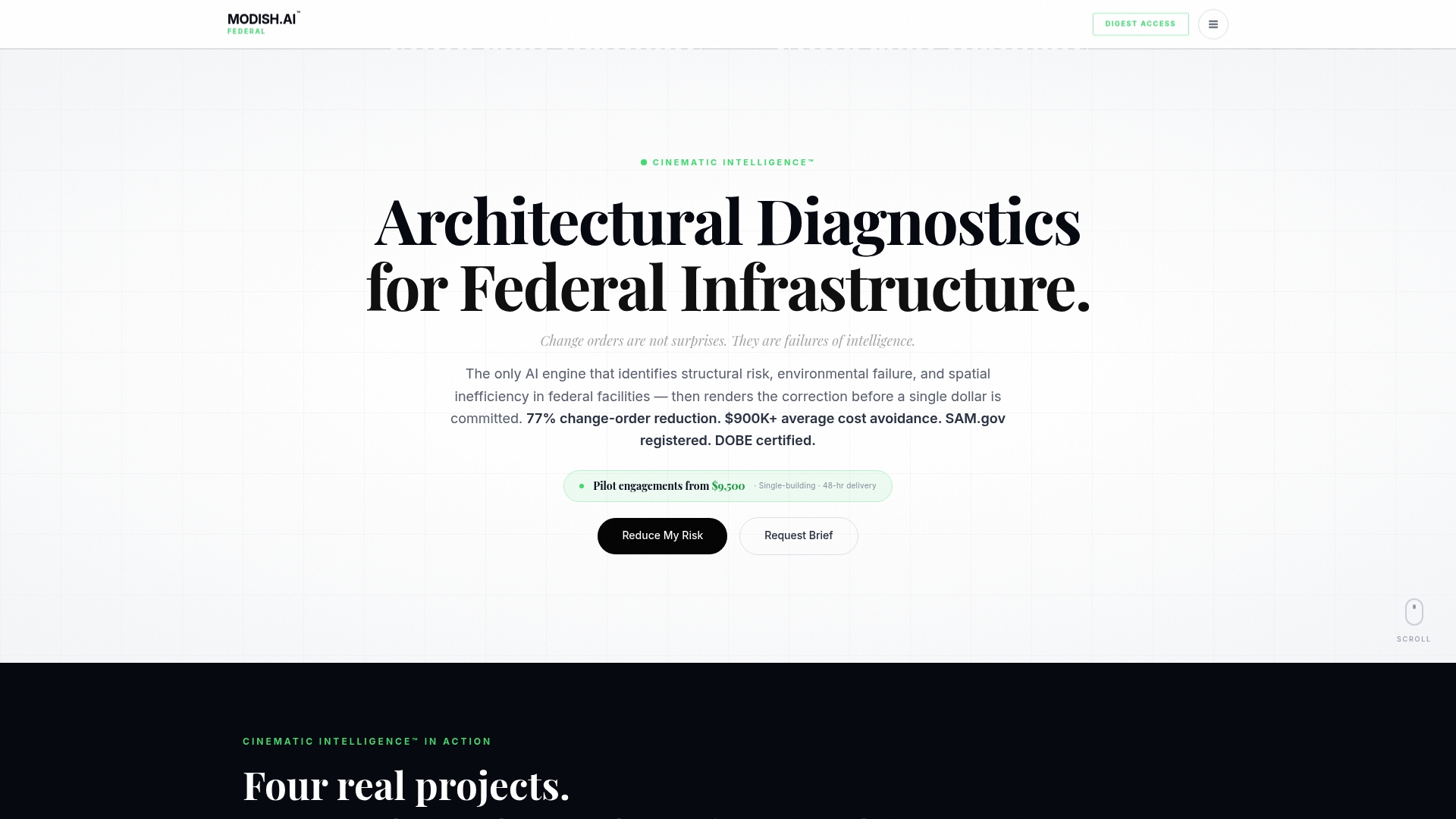
Modish’s Architectural Diagnostic Intelligence™ engine identifies structural, environmental, and code compliance failure points across all four standard categories before construction commits. Every Space analyzed generates 192 corrective visualization options, rendered in federal submission-grade quality. For A&E primes pursuing federal contracts, Modish adds DOBE diversity scoring to proposals while delivering the diagnostic depth that prevents the compliance failures described above. Engagements start at $9,500 for a single-facility pilot. Explore Modish’s full capability to see how Architectural Diagnostic Intelligence™ integrates into your next federal or commercial pursuit.
FAQ
What are the main types of accessible design standards?
The primary types are ADA compliance standards for physical buildings, Universal Design principles as a design philosophy, WCAG digital accessibility guidelines, and federal technical standards including Section 508 and PDF/UA.
Is universal design the same as ADA compliance?
No. ADA compliance sets legally enforceable minimum requirements for physical facilities. Universal Design is a proactive philosophy with seven principles that guide inclusive design for all users, with no legal enforcement mechanism.
Does WCAG apply to physical architecture?
Yes. WCAG 2.2 criteria including the 4.5:1 contrast ratio apply directly to physical signage, wayfinding systems, and interactive kiosks in buildings, not only to websites.
What is section 508 and when does it apply?
Section 508 is a federal law requiring accessibility for all electronic and information technology systems procured or developed by U.S. federal agencies. It applies to any project involving federal contracts, including construction documentation submitted as PDFs.
Level AA is the enforceable legal minimum cited in ADA court settlements and Section 508 requirements. Level AAA is the highest standard but is generally impractical as a full-project target.
Recommended