Facility Diagnostic Intelligence: A Guide for A&E Teams
Facility Diagnostic Intelligence: A Guide for A&E Teams
TL;DR:
- Facility Diagnostic Intelligence utilizes AI to continuously monitor and diagnose building systems, enabling proactive maintenance and energy savings. It emphasizes the importance of data quality, integration, and explainability, especially for complex or compliance-sensitive facilities. Implementing this system improves operational efficiency, extends equipment lifespan, and meets evolving governance requirements.
Facility Diagnostic Intelligence is defined as a continuous, AI-driven process that monitors building systems in real time, detects anomalies, identifies root causes automatically, and delivers prioritized repair guidance to facility teams. The industry term for this process is Fault Detection and Diagnostics, or FDD, though Architectural Diagnostic Intelligence™ extends that foundation into code compliance, structural assessment, and federal visualization workflows. For facility managers, architects, and engineering professionals, understanding this discipline is no longer optional. Buildings that lack diagnostic intelligence accumulate deferred failures, misattributed costs, and compliance exposure that no inspection schedule can catch in time.
What is facility diagnostic intelligence and how does it work?
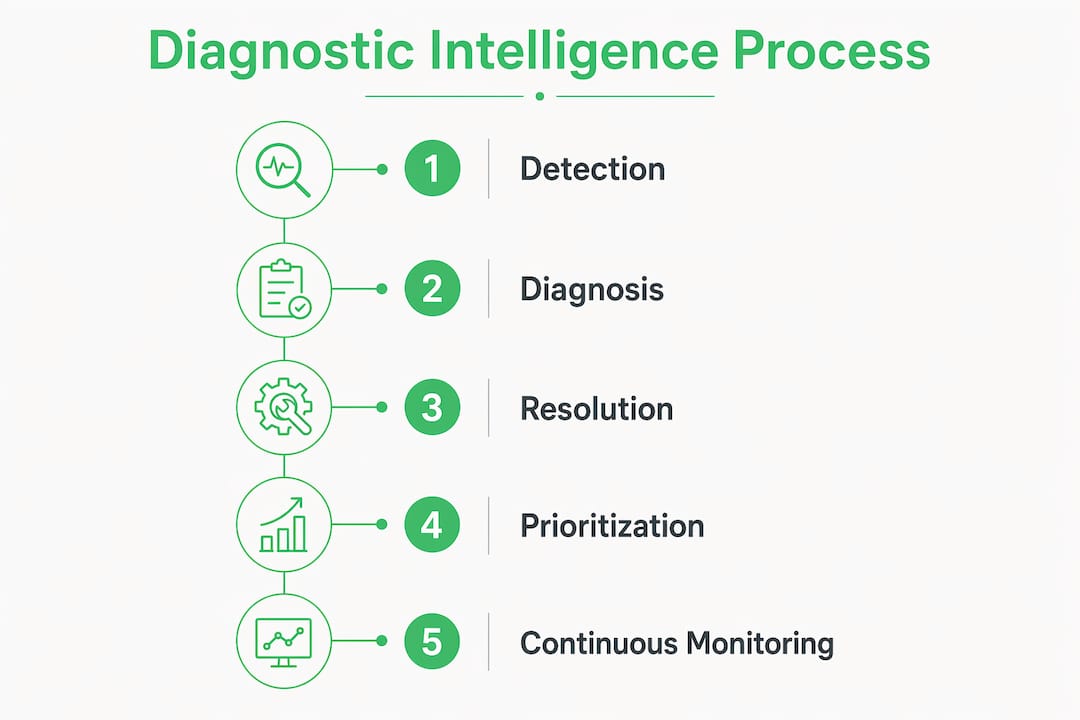
Facility Diagnostic Intelligence operates across three sequential phases: detection, diagnosis, and resolution. Each phase builds on the last, and skipping any one of them reduces the system to passive monitoring.

Detection begins with sensor data from HVAC, lighting, electrical, and envelope systems. Algorithms benchmark live readings against ideal operating conditions. With over 2,500 algorithms processing data continuously, the system flags deviations that would be invisible to a human operator reviewing weekly reports.
Diagnosis applies machine learning to determine why a deviation occurred. This is where AI-enhanced FDD separates from traditional rule-based systems. Rule-based systems trigger alerts when a threshold is crossed. AI-enhanced systems learn the building’s unique operating patterns and detect subtle anomalies that static rules miss entirely. The result is fewer false positives and higher confidence in every alert generated.
Resolution converts the diagnosis into a prioritized work order. The system weighs energy impact, occupant comfort, and equipment longevity simultaneously. Maintenance teams receive ranked actions, not an undifferentiated list of alerts. Integration with Building Management Systems and CMMS workflows closes the loop, converting passive monitoring into automated proactive maintenance.
Pro Tip: Require your diagnostic vendor to demonstrate relational modeling before signing any contract. Without it, the system flags symptoms rather than causes, and your team spends labor chasing the wrong component.
What are the benefits of facility diagnostic intelligence?
The operational and financial case for diagnostic intelligence is well documented. The benefits extend across energy performance, maintenance efficiency, compliance governance, and occupant experience.
- Energy savings: AI-powered FDD delivers a median 10% annual energy reduction, with some portfolios reporting 20–40% through optimized building performance analytics. Payback typically occurs within two years, making the financial argument straightforward for capital planning.
- Reduced alert fatigue: Intelligent prioritization ranks faults by operational and financial impact. Maintenance teams address the highest-value issues first instead of triaging an undifferentiated alarm queue.
- Single source of truth: Integrating static drawings, spatial data, and live telemetry into one unified view accelerates decisions across multi-site portfolios. Fragmented data is the primary reason facility managers make expensive reactive calls. Unified data eliminates that gap.
- Governance and compliance: Diagnostic intelligence now functions as a governance tool by enabling AI systems to explain their reasoning, preventing misattributed failures and maintaining operational trust. For federal facilities and ADA compliance assessments, explainability is not a feature. It is a requirement.
- Equipment lifecycle extension: Catching faults early reduces thermal stress, mechanical wear, and premature component failure. Buildings managed with diagnostic intelligence consistently report longer equipment service intervals and lower capital replacement frequency.
The benefits of architectural diagnostics compound over time. A facility that runs diagnostic intelligence for three years has a performance baseline that informs every future capital project, master plan, and pre-bid evaluation.
How do you implement facility diagnostic intelligence?
Implementation fails most often not because the technology is wrong, but because the data feeding it is unreliable. Sensor drift, legacy system incompatibility, and inconsistent naming conventions across building systems create noise that degrades diagnostic accuracy before the AI has a chance to learn.
The most common barriers include:
- Sensor drift and calibration gaps: Uncalibrated sensors produce readings that look like anomalies. The system generates false positives, trust erodes, and teams begin ignoring alerts. Proactive data normalization and sensor calibration before deployment are the single most effective steps to prevent this outcome.
- Legacy system integration: Older BMS infrastructure often lacks the API connectivity that modern diagnostic engines require. A phased deployment strategy, starting with the highest-impact systems, reduces integration risk and demonstrates value before full commitment.
- Workflow disconnection: Diagnostic intelligence that does not connect to a CMMS generates insights that no one acts on. Active CMMS integration automates work orders and closes the feedback loop for continuous improvement.
Best practices for successful deployment follow a clear sequence. Begin with a data audit. Validate sensor accuracy and normalize naming conventions across all connected systems. Train stakeholders on how to read prioritized alerts and what the AI reasoning behind each fault means. Deploy in phases, starting with HVAC, which typically delivers the fastest measurable ROI. Then expand to lighting, electrical, and envelope systems as confidence builds.
Pro Tip: Insist on algorithms tailored to your building type. A federal courthouse and a commercial office tower have fundamentally different operating profiles. Generic algorithm libraries produce generic results.
Ai-powered vs. rule-based diagnostic systems: which is right for you?
The choice between AI-powered and rule-based FDD depends on portfolio complexity, compliance demands, and the organization’s tolerance for ongoing configuration work.
| Attribute |
Rule-Based FDD |
AI-Powered FDD |
| Detection method |
Threshold triggers |
Pattern learning and anomaly modeling |
| Scalability |
Requires manual rule updates per building |
Learns and scales across portfolio automatically |
| False positive rate |
Higher without constant tuning |
Lower after initial learning period |
| Integration complexity |
Moderate |
Higher upfront, lower ongoing |
| Compliance documentation |
Manual reporting |
Automated, explainable audit trails |
| Best fit |
Single-site, stable operations |
Multi-site, complex, or federal portfolios |
AI-powered systems like those built on Cinematic Intelligence™ and Multiplicity Modeling™ infrastructure outperform rule-based tools on every dimension that matters at scale. The upfront integration investment is real, but the long-term cost per fault detected drops significantly as the model matures.
For federal A&E teams evaluating pre-bid risk, the compliance documentation column is decisive. Automated, explainable audit trails satisfy FAR documentation requirements in ways that manual threshold reports cannot.
Pro Tip: Evaluate vendor support depth before evaluating feature lists. A diagnostic engine with 2,500 algorithms and no implementation support delivers less value than a focused system with a dedicated engineering team behind it.
Key takeaways
Facility Diagnostic Intelligence requires continuous sensor integration, machine learning diagnosis, and active CMMS connection to move building operations from reactive to genuinely proactive.
| Point |
Details |
| Define the process correctly |
Facility Diagnostic Intelligence monitors, diagnoses, and prioritizes faults in real time across all building systems. |
| Quantify the financial case |
AI-powered FDD delivers a median 10% energy savings with payback typically within two years. |
| Prioritize data quality first |
Sensor calibration and data normalization before deployment prevent false positives that destroy team trust. |
| Connect diagnostics to maintenance |
CMMS integration converts diagnostic insights into automated work orders and closes the performance feedback loop. |
| Match the solution to your portfolio |
AI-powered systems outperform rule-based tools for multi-site, federal, or compliance-intensive facilities. |
The governance gap nobody talks about
I have spent years watching facility teams invest in diagnostic infrastructure and then underuse it because the AI could not explain itself. The alert fires. The technician asks why. The system offers a confidence score and a fault code. That is not an explanation. That is a number.
The governance imperative for explainable AI in building systems is real, and it is arriving faster than most facility managers realize. Federal contracting officers already ask for documented reasoning trails on compliance assessments. Fortune 500 procurement teams are beginning to require the same from their supplier networks.
What Cinematic Intelligence™ and Multiplicity Modeling™ do differently is render the diagnostic reasoning visually, in federal submission-grade output. The fault is not just identified. It is shown, contextualized, and corrected in a format that a contracting officer, a design review board, or a facilities director can read without a data science degree.
The diagnostic intelligence workflow for A&E teams is not a technology adoption question. It is a professional practice question. The firms that build explainable diagnostic reasoning into their pre-design and pre-bid workflows will hold a structural advantage over those still relying on post-construction punch lists.
— Ben
How Modish delivers architectural diagnostic intelligence™
Modish Global Inc. is the only Disability:IN-certified DOBE architectural diagnostic intelligence firm in the United States. Its Cinematic Intelligence™ engine identifies structural, environmental, and code compliance failure points in commercial and federal facilities before construction commits, then renders 192 corrective visualization options per Space in federal submission-grade output.
For federal contracting officers and A&E primes, Modish adds DOBE diversity scoring to proposals while delivering AI-driven diagnostics purpose-built for pre-bid evaluation, master planning, and pre-design risk identification. Engagements begin at $9,500 for single-facility pilots and scale to $150,000+ annual enterprise licenses. Modish is SAM.gov registered and teamed under READIGOV and Green America for complete federal A&E execution. Explore Architectural Diagnostic Intelligence™ or review the full federal division capabilities to begin a conversation.
FAQ
What is facility diagnostic intelligence?
Facility Diagnostic Intelligence is a continuous, AI-driven process that monitors building systems, detects anomalies, identifies root causes, and delivers prioritized repair guidance. The industry standard term for this process is Fault Detection and Diagnostics, or FDD.
How much energy can diagnostic intelligence save?
AI-powered FDD delivers a median 10% annual energy savings, with some portfolios reporting reductions of 20–40%. Most implementations reach payback within two years.
Why does CMMS integration matter for diagnostics?
Without CMMS integration, diagnostic insights remain passive observations. Active integration automates work orders and closes the feedback loop, which is what converts monitoring into proactive maintenance.
What is the difference between rule-based and ai-powered FDD?
Rule-based FDD triggers alerts when preset thresholds are crossed. AI-powered FDD learns building-specific operating patterns and detects subtle anomalies that rule-based systems miss, with lower false positive rates at scale.
How does diagnostic intelligence support compliance?
Diagnostic intelligence provides explainable AI reasoning that prevents misattributed failures and generates documented audit trails. For federal facilities and ADA assessments, that transparency satisfies documentation requirements that manual reporting cannot meet.
Recommended