Architectural Diagnostic Intelligence Explained for A&E Teams
Architectural Diagnostic Intelligence Explained for A&E Teams
TL;DR:
- Architectural diagnostic intelligence involves embedding evidence-based compliance checks within design and asset management workflows, not a single technology category. It enables continuous, element-specific verification during design, shifting error detection earlier and improving regulatory defensibility, especially in federal projects. Certification and human interpretation remain essential, with AI accelerating detection but not replacing licensed engineering judgment.
Most architects and engineers encounter the phrase “architectural diagnostic intelligence” and assume it refers to a single, well-defined technology category. It does not. As the concept currently stands, architectural diagnostic intelligence lacks a widely adopted standard industry definition. Operationally, it is best understood as diagnostic, evidence-backed rule checking and condition intelligence embedded within architectural design and asset management workflows. For federal contracting professionals and A&E primes, that distinction carries real consequences. The gap between marketing language and operational reality is where project risk accumulates and compliance defensibility collapses.
Key takeaways
| Point |
Details |
| No standard definition exists |
Treat architectural diagnostic intelligence as an operational practice, not a product category with fixed boundaries. |
| Model-based compliance shifts enforcement earlier |
Catching code violations during BIM modeling prevents costly redesigns at the coordination and construction phases. |
| AI accelerates detection, not certification |
Engineers must still interpret AI-generated condition outputs and certify reports for regulatory defensibility. |
| Federal contexts require clause-level traceability |
Multi-standard compliance on secured-facility contracts demands audit trails linked to specific code references per flagged element. |
| Data orchestration creates living design records |
Connecting field markups, inspection data, and BIM updates in real time reduces reconciliation cost and governance exposure. |
Architectural diagnostic intelligence explained: the operational definition
The closest recognized industry analog to architectural diagnostic intelligence is model-based building code compliance, a practice where machine-executable code logic runs inside a BIM model to validate design decisions continuously. According to model-based compliance research, these checks evaluate element-level conditions against code requirements in roughly 30 seconds, flagging issues with cited clause references rather than producing a general red/green report.
That specificity matters. When a wall assembly violates an egress width requirement, the diagnostic output names the element, the violated clause, and the severity. Design teams do not guess where the problem lives. They resolve it inside the model before the drawing set is even coordinated.
This is what separates diagnostic intelligence from traditional plan review:
- Continuous verification. Checks run iteratively throughout design, not once at permit submission.
- Element-level precision. Each flagged condition is traceable to a specific model component and code reference.
- Proactive enforcement. Anchoring compliance checks in BIM shifts error discovery from post-drawing review to the design phase itself, where corrections cost a fraction of what they cost during construction.
- Governance repeatability. Tools operating within this framework, such as rule-based model checkers, make quality assurance consistent across projects through governance matrices and reusable rule templates.
Think of it as the difference between a smoke detector and a fire marshal visiting after the building opens. One catches the condition in time to act. The other documents what went wrong.
AI inspection and condition diagnostics
Beyond the design phase, diagnostic intelligence extends into the physical condition of existing and in-construction facilities. Here, the industry term is structural health monitoring, and AI has changed its economics dramatically.
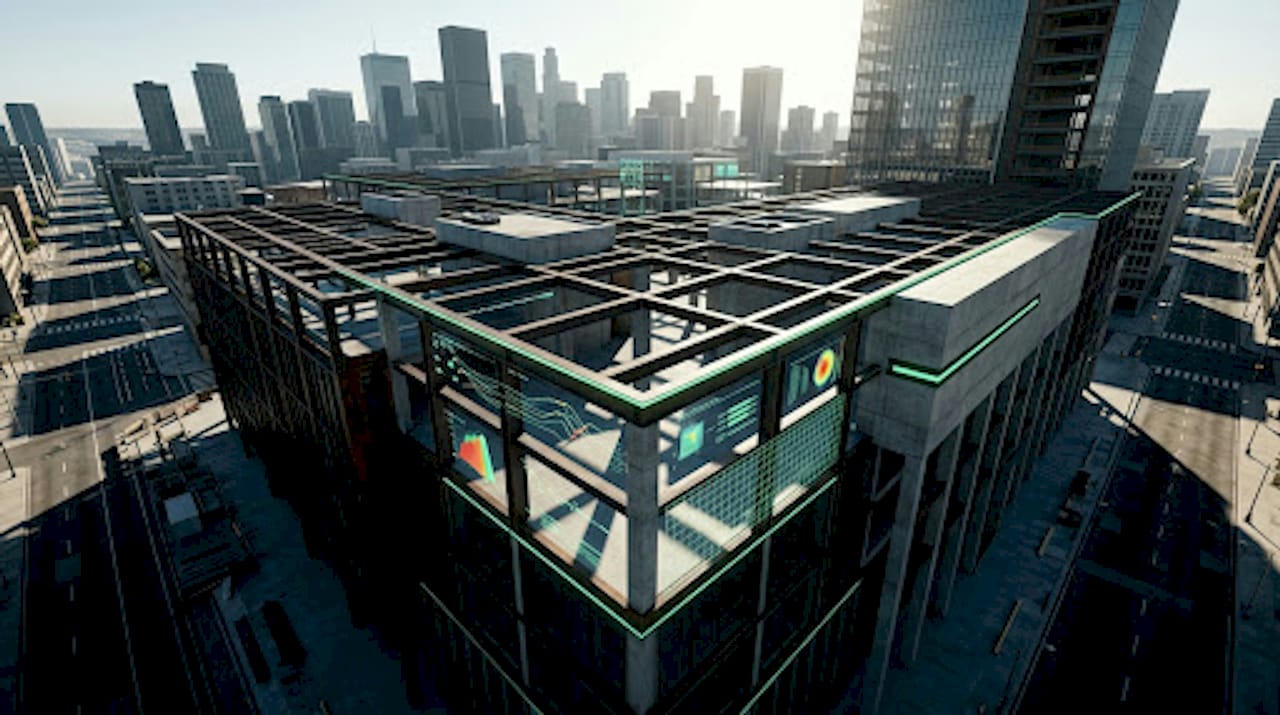
Traditional inspections produce point-in-time snapshots reviewed manually over days or weeks. AI-enabled inspection converts sensor streams and drone imagery into continuously updated condition intelligence. The Structural Condition Index (SCI), a normalized 0 to 100 score updated in real time, represents this shift precisely. Asset health becomes a live number rather than a periodic report.
Drone-based defect detection adds another layer of precision. AI trained on building imagery classifies up to 20 defect types using pixel-level convolutional neural network scanning, assigns confidence scores and severity ratings, and calculates dimensions using GPS and image scale. A defect inventory that once took weeks to compile now arrives within hours.
| Capability |
AI-driven detection |
Manual inspection |
| Defect classification speed |
Hours |
Days to weeks |
| Consistency across inspectors |
High (model-based) |
Variable |
| Defect types classified |
Up to 20 types |
Dependent on inspector training |
| Condition score update frequency |
Real time |
Periodic |
| Certification authority |
Professional engineer required |
Professional engineer required |
The table above makes one point unmistakable: the certification column does not change. AI accelerates detection and data collection, but professional engineers must still interpret structural significance and sign off on reports. Any architecture diagnostic framework that positions AI as a replacement for licensed engineering judgment is misrepresenting both the technology and the law.
Pro Tip: Embed your AI defect inventory review as a formal agenda item in project OAC meetings. Presenting a classified, severity-ranked defect list instead of raw inspection photos elevates the quality of field conversations and creates a documented record of team response for every flagged condition.
Federal and secured-facility applications
Federal A&E work does not operate on general commercial compliance standards. Secured-facility contracts like NAVFAC Atlantic IDIQ require diagnostic intelligence systems to be configurable across multiple standards simultaneously. ICD/ICS 705 for Sensitive Compartmented Information Facilities, TEMPEST mitigation requirements, UFC criteria, and agency-specific accreditation standards must all be traceable within a single diagnostic workflow.
That is not a technology problem. It is a governance architecture problem. The diagnostic engine must:
- Map each check to a specific contractual or regulatory clause.
- Write results back into BIM and PLM records with stable element identifiers linking field evidence to model components.
- Maintain audit trails that survive multi-year project timelines and agency reviews.
- Produce outputs that support accreditation packages, not just construction coordination.
Compliance defensibility depends equally on auditability and human judgment alongside AI output. Federal reviewers do not accept AI reports. They accept engineer-certified documentation backed by traceable, clause-level evidence. The diagnostic workflow must produce that evidence automatically as a byproduct of normal design activity, not as a separate compliance exercise performed at the end.
Modish Global Inc. operates in this space as the only Disability:IN-certified DOBE architectural diagnostic intelligence firm in the United States. Its Cinematic Intelligence™ engine is purpose-built for federal A&E compliance at this level of specificity. For A&E primes teaming on federal pursuits, that DOBE certification adds measurable diversity scoring to proposals under FAR small business goaling frameworks.
Pro Tip: When teaming for federal A&E bids, verify that your diagnostic intelligence subcontractor is SAM.gov registered and can produce clause-referenced audit outputs formatted for agency submission. A clean AI report that fails agency defensibility standards creates more project risk than no diagnostic at all.
Data orchestration and the digital thread
The final layer of architectural diagnostic intelligence is the one most teams discover too late: the question of where all the diagnostic data actually lives after it is generated. Field markups, sensor feeds, inspection imagery, BIM change histories, and code compliance records exist in separate systems on most projects. Reconciling them manually costs weeks and creates governance gaps that surface at the worst possible moments.
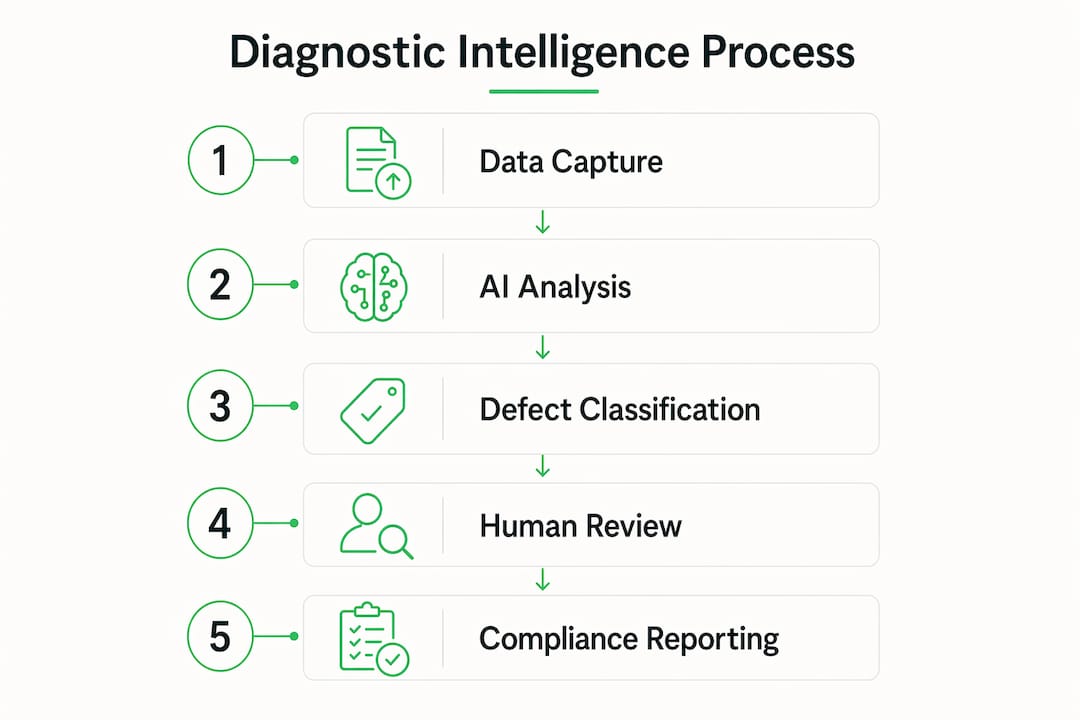
AI orchestration stacks can ingest field markups autonomously, classify issues, generate work orders, and update BIM and PLM records with full audit trails in minutes rather than days. The result is a living design record that mirrors field conditions throughout construction rather than diverging from them.
For project teams, the benefits of a fully orchestrated diagnostic workflow include:
- Reduced reconciliation costs between field and model records.
- Real-time visibility into open issues, resolution status, and compliance exposure.
- Traceable intelligence that supports owner reporting, agency submittals, and post-occupancy audits.
- A defensible compliance record that grows throughout the project lifecycle rather than being assembled at closeout.
Modish’s Multiplicity Modeling™ and DesignVault 3D™ frameworks are built around this orchestration logic. Every diagnostic output generated through a Modish engagement writes back into a structured record accessible to project stakeholders, formatted to federal submission standards.
My take on where diagnostic intelligence actually breaks down
I’ve seen this technology misapplied often enough to have a clear view of where the failure points cluster. The most common one is timing. Teams that wait until the 75% construction documents phase to run their first model-based compliance checks are not using diagnostic intelligence. They are using an expensive red-line markup generator. The value of embedding diagnostics early in design cannot be overstated, and in my experience, it is the single decision that separates projects that deliver on their compliance promises from those that do not.
The second failure is confusing AI output with engineering judgment. I’ve watched firms present AI-generated defect inventories to federal clients as certified deliverables. That is a liability event waiting to happen. The technology earns its place when it accelerates the work of engineers, not when it attempts to replace their professional accountability.
What Modish’s position as a certified DOBE makes possible is something I find genuinely rare: a firm that holds both the technical depth and the contractual standing to deliver diagnostic intelligence in federal contexts where most competitors simply cannot operate. That combination of capability and certification is not marketing language. It is a structural advantage in federal procurement.
— Ben
See Architectural Diagnostic Intelligence™ in a federal context
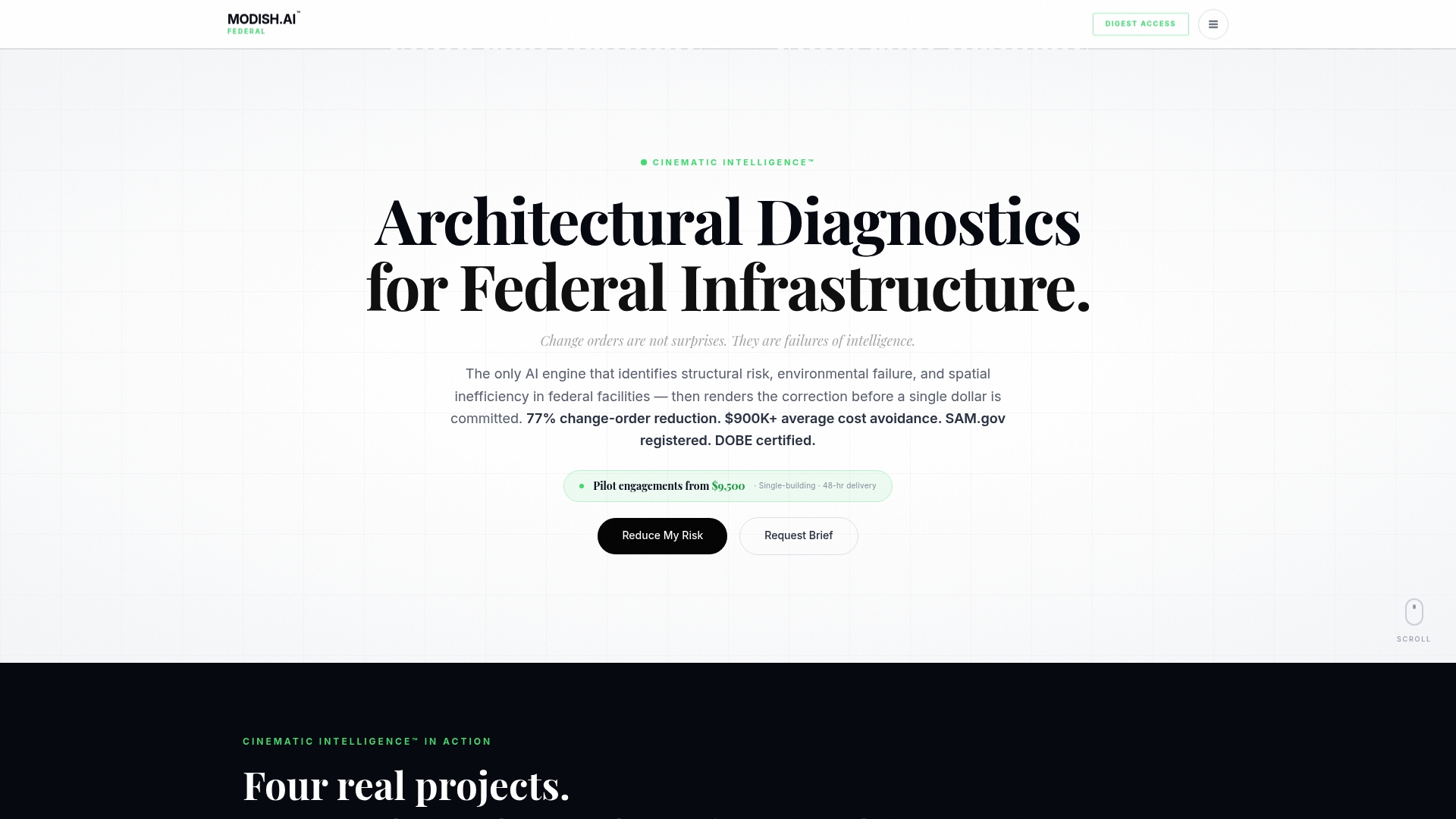
Modish Global Inc. delivers Architectural Diagnostic Intelligence™ for federal and complex commercial projects through its Cinematic Intelligence™ engine, generating 192 corrective visualization options per Space to identify structural, environmental, and code compliance failure points before construction commits. As the only DOBE-certified firm in this category, Modish qualifies for FAR 6.302-1 sole-source consideration and adds Tier 1 diverse spend credit to every engagement. Explore the full capability at Modish Federal Division, or review the complete federal A&E intelligence suite at Modish.ai for pricing starting at $9,500.
FAQ
What is architectural diagnostic intelligence?
Architectural diagnostic intelligence is the practice of embedding evidence-backed, rule-based condition and compliance checks within architectural design and asset management workflows. It draws from model-based building code compliance and AI-driven structural health monitoring rather than a single standardized product category.
How does model-based compliance differ from traditional plan review?
Model-based compliance runs checks inside BIM continuously during design, flagging element-level violations with cited code references in roughly 30 seconds. Traditional plan review occurs after drawings are completed, making corrections far more costly.
Do AI diagnostics replace the need for a licensed engineer?
No. AI accelerates defect classification and data collection, but professional engineer interpretation and certification remain legally required for structural significance determinations and regulatory submittals.
Why does federal A&E require a different diagnostic approach?
Federal secured-facility projects map to multiple compliance standards simultaneously, including ICD/ICS 705 and TEMPEST, requiring diagnostic outputs with clause-level traceability and audit trails formatted for agency accreditation review.
What makes Modish’s approach distinctive in this category?
Modish is the only Disability:IN-certified DOBE in architectural diagnostic intelligence, combining Cinematic Intelligence™ with federal submission-grade visualization and DOBE diversity scoring under FAR small business goaling frameworks.
Recommended