Enterprise License in A&E: What Professionals Must Know
Enterprise License in A&E: What Professionals Must Know
TL;DR:
- An enterprise license agreement in A&E is a multi-year contract that offers company-wide software rights for a fixed yearly fee. This model streamlines procurement, provides cost predictability, and allows seat transfer flexibility. Firms must define scope carefully and manage renewals to avoid unexpected costs and compliance issues.
An Enterprise License Agreement (ELA) is a negotiated, multi-year contract granting an entire organization unlimited or high-volume software usage rights for a fixed annual fee. In architecture and engineering, this model consolidates hundreds of individual licenses into a single agreement, simplifying procurement, budgeting, and compliance across project teams. The ELA consolidates licenses into a unified structure that replaces fragmented per-user purchases with one governed contract. For A&E firms managing federal pursuits, master planning cycles, and multi-office teams, that consolidation is not a convenience. It is a structural advantage.
What is enterprise license in A&E, and how does it work?
An enterprise license in A&E is the industry term for an organization-wide software rights agreement, typically spanning three to five years, that covers all qualifying users under a single negotiated contract. The standard industry term is Enterprise License Agreement, or ELA. Both phrases describe the same instrument, and A&E professionals use them interchangeably when discussing software procurement at scale.

The core mechanics are straightforward. A firm negotiates directly with a software vendor to define the scope of use, the number of authorized users or sites, the term length, and the annual fee. Once executed, the firm deploys the software across departments without purchasing individual seats each time a new hire joins or a new project kicks off. That predictability matters enormously on federal A&E pursuits, where budget certainty across a multi-year base period plus options is a procurement requirement, not a preference.
ELAs also allow seat reassignment when employees depart. Enterprise licenses permit transfer of seats to new users, unlike consumer licenses that prohibit it. For A&E firms with high project-driven turnover, that flexibility reduces administrative friction and prevents license waste.
How does an enterprise license compare to traditional A&E licensing models?
Traditional software licensing in A&E falls into two categories: perpetual per-user licenses and floating licenses. Per-user licenses assign one seat to one named individual. Floating licenses allow multiple users to share access through a central server, with the software checking out and returning seats as needed. Floating license renewals can range from $100 to $320 depending on the software edition. That range signals how quickly per-seat costs accumulate across a 50-person project team.
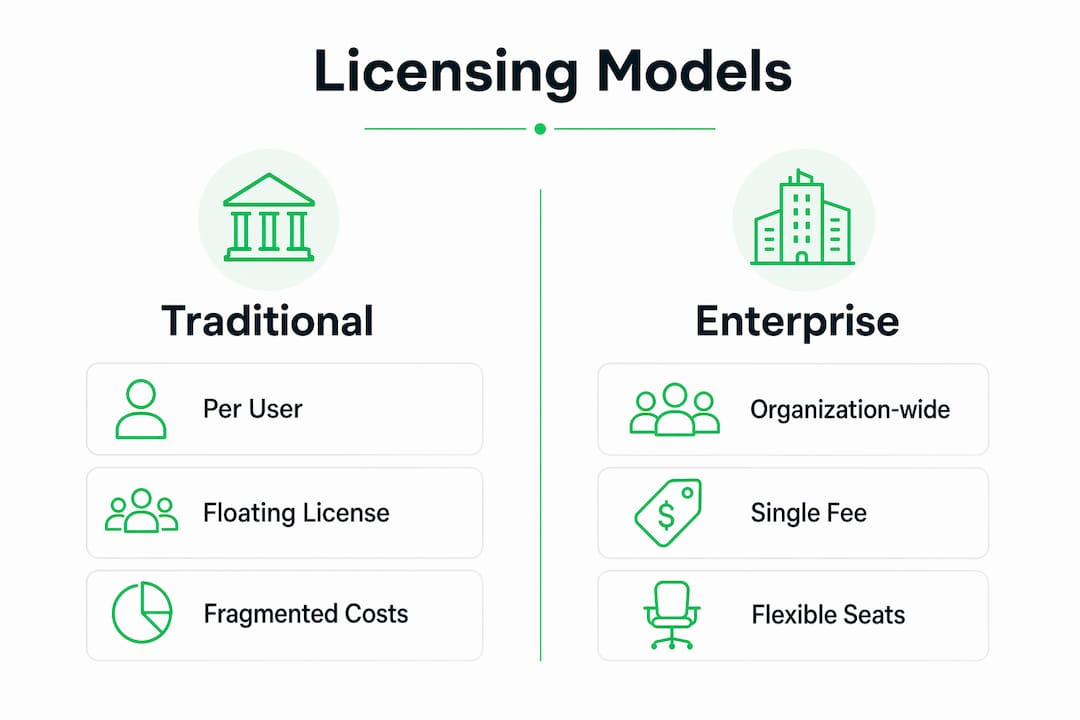
Enterprise licenses replace that fragmented math with a single annual fee covering the entire organization. The table below compares the two models across the dimensions that matter most to A&E procurement leads.
| Feature |
Traditional licensing |
Enterprise licensing |
| Cost structure |
Per user or per device |
Fixed annual fee, org-wide |
| Scalability |
Manual seat additions required |
Covered under agreement scope |
| License tracking |
Individual seat management |
Centralized administration |
| Seat reassignment |
Often restricted |
Permitted on departure |
| Negotiation leverage |
Minimal |
Strong, including liability and data terms |
Pro Tip: Assess your firm’s peak concurrent user count before negotiating an ELA. If fewer than 40% of your staff use the software simultaneously, a floating license structure may cost less than a full enterprise agreement.
Architectural project managers must weigh team mobility and fluctuating project demands when choosing between these models. The right choice depends on actual usage patterns, not headcount alone.
What specialized license types are emerging in A&E?
Three license structures now define the A&E software market: floating licenses, traditional ELAs, and the emerging Agentic Enterprise License Agreement (AELA).
- Floating licenses assign access dynamically from a shared pool. They suit firms with variable project staffing, where not every licensed user works in the software on the same day. Cost savings are real, but concurrent user limits can create bottlenecks during peak design phases.
- Traditional ELAs cover a defined number of human seats or an entire organization for a fixed term, typically three to five years. They work best for firms with stable headcounts and predictable software demand across multiple offices.
- Agentic Enterprise License Agreements (AELAs) represent the 2026 frontier. AELAs license AI agent capacity rather than human seats, allowing firms to scale autonomous workflows independently of headcount. Terms typically run two to three years. For A&E firms deploying AI-driven diagnostic workflows, such as Modish’s Architectural Diagnostic Intelligence™ engine, AELAs remove the per-seat ceiling that would otherwise cap AI throughput on large federal facility assessments.
The AELA model is particularly relevant for firms using AI to process facility Spaces at volume. When the work is performed by an AI agent rather than a human operator, a human-seat license structure creates an artificial constraint. AELAs resolve that constraint by pricing on capacity, not headcount.
What are the common pitfalls in managing A&E enterprise licenses?
License scope definition is the single most common failure point in ELA management. Improper scope definition causes audit risks and unexpected expenses. A&E firms must define coverage precisely across departments, project types, and geographic boundaries before signing.
The most frequent pitfalls include:
- True-up provisions: ELAs require annual reconciliation of license counts against actual usage. True-up provisions trigger unexpected costs when firms underestimate user growth. Forecast conservatively and build a buffer into your initial seat count.
- Geographic and subsidiary gaps: Many A&E agreements restrict licenses geographically or to named subsidiaries. International staff and subcontractors are often excluded unless explicitly added. Review territorial clauses before execution.
- Contractor exclusions: Standard ELAs rarely cover third-party contractors or joint-venture partners. Firms that assume coverage for their full project team often discover gaps during audits.
- Confusing ELAs with SLAs: An ELA governs usage rights and pricing. A Service Level Agreement governs support response times and uptime guarantees. Separating ELAs from SLAs is critical. Negotiate both concurrently to ensure financial remedies exist for downtime, not just support tickets.
Pro Tip: Assign a dedicated license administrator within your firm before the ELA executes. That person owns the true-up calendar, the user roster, and the vendor relationship. Without a named owner, compliance gaps accumulate silently.
How does enterprise licensing reshape A&E procurement strategy?
ELAs shift software acquisition from transactional purchasing to strategic vendor governance. That shift creates negotiation opportunities that per-user purchases never offer.
The procurement advantages are concrete:
- Liability caps: ELAs allow firms to negotiate limits on vendor liability for data loss or service failure, terms that are fixed and non-negotiable in standard per-user agreements.
- Data handling terms: Enterprise contracts define how vendor systems store, process, and retain firm data. For federal A&E work, those terms must align with FAR data security requirements.
- Renewal pricing protection: Multi-year ELAs lock in pricing or cap annual increases, protecting firms from mid-project cost escalation.
- Dedicated account management: Enterprise clients receive named account managers and prioritized support, which matters when a software failure threatens a federal submission deadline.
Modish operates within this governance model as a teaming subcontractor and diagnostic intelligence partner for federal A&E primes. Modish’s Architectural Diagnostic Intelligence™ engine delivers 192 corrective visualization options per Space, purpose-built for pre-bid evaluation and master planning. Understanding ELA structure helps procurement leads scope that engagement correctly from the start.
Key takeaways
An enterprise license in A&E is a multi-year, organization-wide software agreement that replaces fragmented per-user purchasing with centralized governance, predictable costs, and negotiated vendor terms.
| Point |
Details |
| ELA definition |
A negotiated, multi-year contract granting org-wide software rights for a fixed annual fee. |
| Floating vs. enterprise |
Floating licenses suit variable teams; ELAs suit stable, multi-office firms needing full coverage. |
| AELA emergence |
Agentic ELAs license AI agent capacity, not human seats, enabling scalable diagnostic workflows. |
| Scope management |
Define departments, geographies, and subsidiaries precisely to avoid audit risk and true-up surprises. |
| Procurement shift |
ELAs enable liability cap negotiations, data handling terms, and renewal price protections unavailable in per-user models. |
Why most A&E firms sign ELAs before they are ready
The firms I have seen struggle most with enterprise licenses share one trait: they signed before defining scope. They treated the ELA as a volume discount, not a governance instrument. The true-up bill arrived twelve months later, and the audit conversation that followed was expensive and avoidable.
The firms that get it right engage legal counsel and procurement simultaneously during negotiation, not sequentially. They map actual usage patterns before the first vendor call. They identify which subsidiaries, contractors, and international offices need coverage, and they put those names in the contract. They also negotiate the SLA in the same session as the ELA, because a software outage during a federal submission window is a financial event, not just an inconvenience.
Modish’s Architectural Diagnostic Intelligence™ is a useful benchmark here. The compliance checks Modish performs on federal facilities require consistent, governed access to diagnostic infrastructure across the project lifecycle. That kind of workflow demands an ELA structured for AI capacity, not a floating seat pool. The AELA model exists precisely because AI-driven architectural work does not map to human headcount. Firms that recognize that early negotiate better contracts and avoid the governance gaps that surface during federal audits.
Treat your ELA as a living relationship, not a signed document filed in a drawer. Review it annually. Adjust scope as your firm grows. And never let the vendor be the only party who understands what the contract actually covers.
— Ben
Modish and enterprise licensing for federal A&E teams
Modish Global Inc. is the only Disability:IN-certified DOBE in architectural diagnostic intelligence in the United States. For federal contracting officers and A&E primes, that status adds DOBE diversity scoring to proposals while delivering a diagnostic capability built for enterprise-scale deployment.
Modish’s Cinematic Intelligence™ engine identifies structural, environmental, and code compliance failure points in commercial and federal facilities before construction commits. Engagements range from $9,500 single-facility pilots to $150,000+ annual enterprise licenses. For procurement leads evaluating enterprise licensing options or federal teams assessing Modish’s service scope, the next step is a direct conversation with the Modish team.
FAQ
What is an enterprise license agreement in A&E?
An Enterprise License Agreement (ELA) is a negotiated, multi-year contract granting an entire A&E organization unlimited or high-volume software usage rights for a fixed annual fee. It replaces individual per-user or per-device purchases with a single governed agreement.
How long do A&E enterprise license agreements typically last?
Most ELAs run three to five years. Agentic Enterprise License Agreements, which license AI agent capacity rather than human seats, typically run two to three years given the faster pace of AI infrastructure change.
What is a true-up provision in an enterprise license?
A true-up provision requires annual reconciliation of actual user counts against the licensed amount. A&E firms that underestimate user growth face unexpected costs at each true-up cycle.
How does an ELA differ from a Service Level Agreement?
An ELA governs software usage rights and pricing. An SLA governs support response times and uptime guarantees. A&E firms must negotiate both concurrently to ensure financial remedies exist for service failures, not just support escalation paths.
Are contractors and international staff covered under A&E enterprise licenses?
Standard ELAs typically exclude third-party contractors and international staff unless explicitly named in the agreement. Firms must review territorial and subsidiary clauses carefully before execution to avoid compliance gaps.
Recommended