Submission-grade architectural intelligence explained
Submission-grade architectural intelligence explained

TL;DR:
- “Submission-grade architectural intelligence” is a practice-driven term describing structured, auditable AI outputs suitable for federal procurement and regulatory submissions. It requires structured ADRs, severity rankings, and compliance alignment, enabling transparent evaluation and supporting supplier diversity efforts. Adopting these standards transforms process quality, levels the playing field, and prepares firms for future federal AI evaluation benchmarks.
Federal procurement professionals and supplier diversity managers are hearing the term “submission-grade architectural intelligence” with increasing frequency, yet no formal definition exists anywhere in procurement standards, industry literature, or architectural diagnostics frameworks. That gap creates real risk. When evaluators, contracting officers, and A&E prime partners cannot agree on what submission-grade means, proposals stall, diverse suppliers get filtered out by vague criteria, and compliance documentation falls short of what selection panels actually need. This article cuts through that fog and builds a working definition from the ground up.
Table of Contents
Key Takeaways
| Point |
Details |
| Emergent terminology |
Submission-grade architectural intelligence is a new and informal term, lacking an official industry definition. |
| Key system features |
Systems must provide structured, auditable, and procurement-ready outputs to be considered submission-grade. |
| Impact on procurement |
AI diagnostics help standardize and streamline Federal submissions, improving fairness and compliance. |
| Scoring and standards |
Maturity models and scorecards are critical for evaluating readiness and performance in procurement contexts. |
| Diversity implications |
While not designed for diversity inclusion, standardized tools can help level the field for diverse suppliers. |
Tracing the origins and context
The term did not emerge from a standards body or a federal regulation. It emerged from practice. As AI tools began appearing in architecture and engineering workflows, procurement teams needed shorthand for a specific quality tier: outputs that are structured, auditable, and ready to drop into a formal bid or regulatory submission without extensive reformatting.
Understanding architectural diagnostics as a discipline helps place the term correctly. Diagnostics refers to the systematic identification of structural, environmental, and code compliance failure points in a facility or design. When those findings need to survive scrutiny from a contracting officer, a GSA evaluator, or a congressional auditor, the output must meet a higher bar than a typical internal review report.
The phrase likely refers to AI-driven tools for evaluating architectures to a standard suitable for formal submission in procurement bids, regulatory filings, or tenders, with particular relevance for federal contexts where compliance benchmarks are enforced. That framing is practical rather than theoretical, which is exactly why the term is gaining traction.
Several conditions have accelerated the conversation:
- Increased federal investment in AI-augmented A&E services through GSA Schedule 541 and agency-specific IDIQ vehicles
- Supplier diversity mandates that require diverse-owned firms to demonstrate technical parity in submissions
- Rising demand for pre-bid facility analysis before construction funding is committed
- Tighter integration between construction document management platforms and AI diagnostic engines
“The compliance floor is no longer a checklist. It is a live diagnostic system that must produce evidence chains an evaluator can follow from raw data to corrective recommendation without interpretation gaps.”
That shift from static documentation to dynamic, auditable intelligence output is what the term “submission-grade” is really signaling.
What makes architectural intelligence “submission-grade”?
Not every AI diagnostic tool qualifies. The distinction between generic AI review and submission-grade intelligence comes down to four specific characteristics. Getting these right is the difference between a visualization deck that impresses in a kickoff meeting and a findings package that actually supports a federal selection.
Related concepts in adjacent fields offer useful benchmarks. Systems designed around structured findings and architecture decision records, or ADRs, represent one end of this spectrum. On the regulatory side, diagnostic tools built for FDA submission readiness establish another model: outputs must be reproducible, traceable, and expressed in formats evaluators already know how to process.
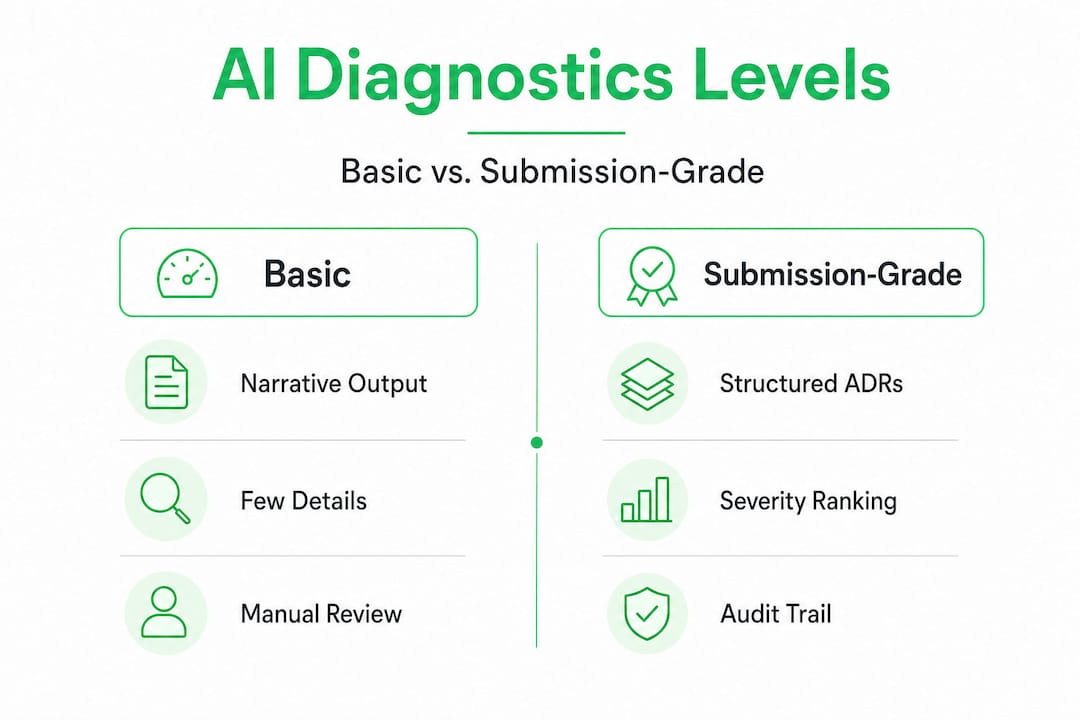
The expert consensus is clear. Unlike basic AI reviews, submission-grade outputs require structured ADRs, severity rankings, active feedback loops for iterative improvement, and direct integration with procurement standards including GSA AI clauses.
Here is how the two tiers compare in practice:
| Feature |
Basic AI diagnostic |
Submission-grade intelligence |
| Output format |
Narrative summary |
Structured ADRs with severity rankings |
| Compliance alignment |
General best practices |
GSA/NIST benchmark integration |
| Visualization options |
Single rendering |
Multiple corrective visualization paths |
| Auditability |
Limited traceability |
Full evidence chain from input to finding |
| Feedback mechanism |
One-time report |
Iterative improvement loop |
| Procurement integration |
Manual reformatting required |
Native submission-ready format |
The table above makes the operational cost visible. A team using basic AI diagnostics must translate findings into submission language manually. That process introduces interpretation gaps, delays, and often requires outside legal or compliance review. Submission-grade systems eliminate that translation layer.
Pro Tip: When evaluating AI diagnostic vendors for a federal pursuit, ask for a sample output package and verify it includes an ADR section, a severity ranking table, and a clear mapping to at least one federal compliance standard. If those three elements are missing, the tool is not submission-grade regardless of how the vendor markets it.
Ensuring compliance for AI-generated outputs in federal A&E work is not optional. Contracting officers are increasingly issuing proposals with AI clause requirements embedded at the solicitation stage.
How these systems support Federal procurement and supplier diversity
The value proposition here runs in two directions simultaneously. For procurement professionals, submission-grade intelligence standardizes how facility findings are expressed, making comparative evaluation across vendors more defensible. For supplier diversity managers, it creates an auditable framework that removes one of the most persistent barriers diverse-owned firms face: the perception that their technical deliverables lack the polish of larger incumbents.
GSA and NIST have formally partnered to advance AI evaluation science in federal procurement, emphasizing standardized testing and benchmark-aligned submissions. That partnership signals where the evaluation bar is moving. Firms that adopt submission-grade diagnostic tools now will be positioned ahead of that curve when agencies begin requiring it explicitly.
The phrase is emerging as jargon for high-assurance AI diagnostics in government A&E submissions, specifically because standardized and auditable tools level the playing field for diverse firms. That leveling effect is not accidental. When output formats are standardized, selection panels evaluate findings on merit rather than on presentation sophistication.
Here is how the impact unfolds across the procurement cycle:
- Pre-RFQ stage: Facility diagnostic outputs inform go/no-go decisions and scope development, reducing costly surprises after award.
- RFP preparation: Submission-grade visualizations slot directly into proposal packages, reducing preparation time and formatting risk.
- Vendor evaluation: Standardized scoring and severity rankings allow contracting officers to compare findings across competing submissions on consistent criteria.
- Award and execution: Documented evidence chains support past performance claims and strengthen future capability statements for procurement pursuits.
- Post-award audit: Auditable diagnostic outputs serve as contemporaneous records if scope disputes or compliance questions arise during execution.
Each step reduces friction for smaller and diverse-owned firms that lack the administrative infrastructure of large primes but can now produce technically equivalent submission packages.
Benchmarks, scoring models, and standardization frameworks
If submission-grade intelligence is to mean something consistent across procurements, it needs scoring models that translate findings into comparable metrics. The closest established frameworks come from adjacent disciplines.
The Agentic Architecture Maturity Model and similar scorecards use 0 to 100 scales or Level 1 through Level 5 progressions to express AI system readiness. In the AAMM framework, lower levels indicate reactive and manually driven processes while higher levels represent autonomous, self-correcting systems operating across complex interdependencies.
Applying that logic to AI review systems for architecture suggests a practical tier structure:
- Level 1 to 2: Basic AI flagging of code compliance issues with no structured output
- Level 3: Structured output with severity rankings but manual compliance mapping
- Level 4: Fully structured ADRs with automated GSA/NIST alignment and multiple corrective visualization paths
- Level 5: Autonomous iterative improvement with procurement integration, evidence chain generation, and submission-ready packaging
Key insight: Most AI diagnostic tools sold to A&E firms today operate at Level 2 or 3. Genuine submission-grade capability requires Level 4 or above.
Applying quality control in construction principles to these scoring models reinforces that point. Quality control in construction is not about finding defects; it is about preventing them before they are embedded in the structure. Submission-grade diagnostics operate the same way: they identify failure points before construction commits, not after.
Why “submission-grade” is more than compliance and what most teams miss
Here is the part most procurement teams get wrong. They treat submission-grade intelligence as a compliance checkbox. Once the output hits the required format and references the right standards, the work is done. That framing wastes most of the available value.
The deeper opportunity is process transformation. When a diagnostic system can identify structural and compliance failures before a project enters schematic design, it changes what your team is capable of proposing. You stop reacting to problems found during construction documents and start structuring scopes around evidence that already exists.
There is also an inclusion dimension that federal standards are only beginning to address. Research on racial equity in federal AI procurement identifies fairness as a core procurement value, but stops short of connecting it to diagnostic tool standardization. That gap is where diversity-forward firms can lead. When a DOBE or WOSB brings submission-grade diagnostic intelligence to a teaming arrangement, they are not just filling a diversity scorecard requirement. They are contributing a capability the prime may not have internally.
The teams that treat submission-grade diagnostics as a minimum standard will stay competitive. The teams that treat it as an upskilling catalyst and a fairness mechanism will define the next generation of federal A&E work.
Explore submission-grade diagnostics with Modish.ai
If this article clarified what submission-grade architectural intelligence means in practice, the next step is seeing it applied to a real federal facility.
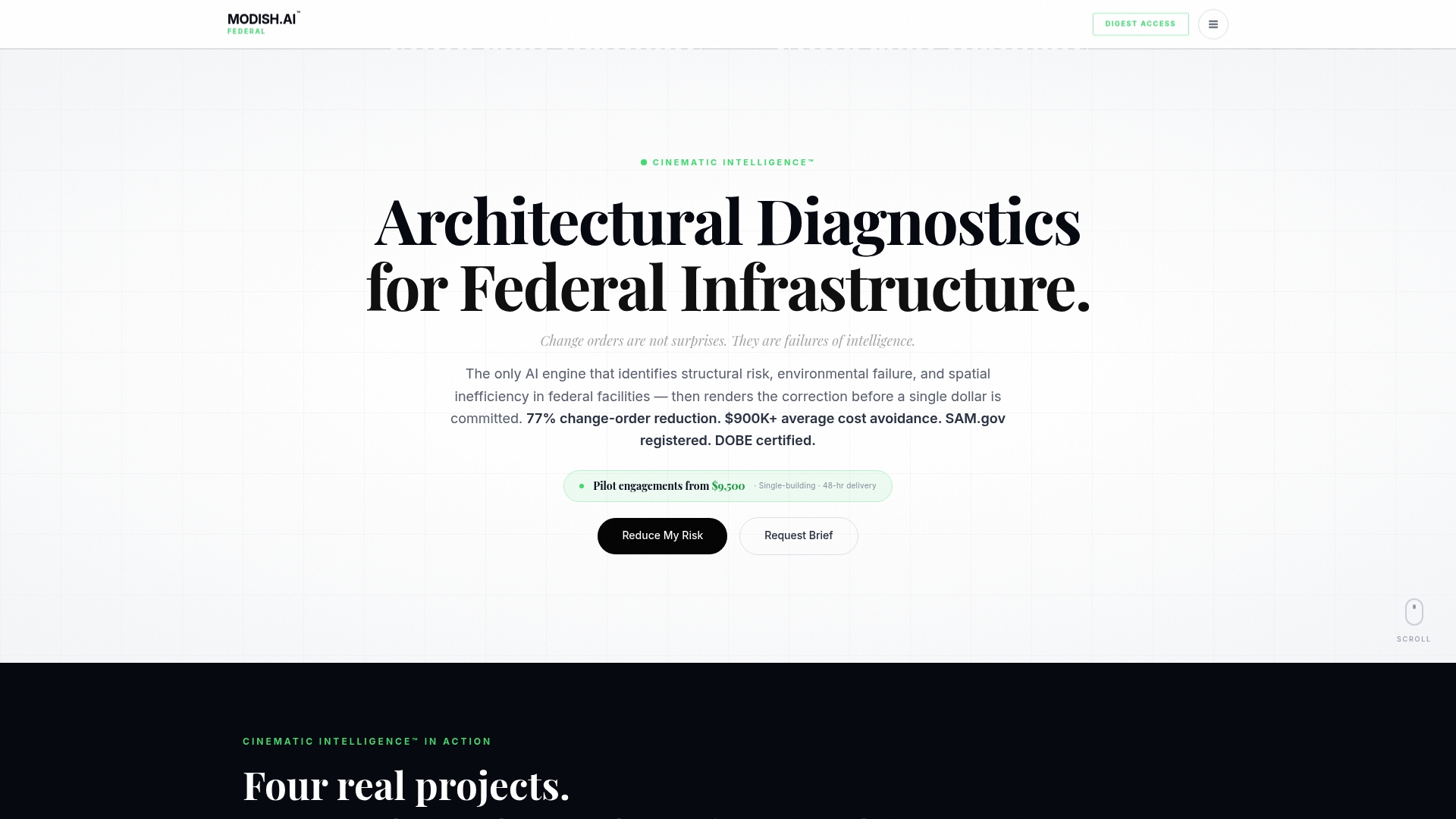
Modish Global Inc. is the only Disability:IN-certified DOBE firm delivering AI-driven architectural diagnostic solutions at the submission-grade tier, with 192 corrective visualization options per upload and native alignment with GSA and NIST benchmarks. Every engagement generates Tier 1 diverse spend credit and adds DOBE scoring to federal proposals. Whether your team needs a $9,500 single-facility pilot or an enterprise license, Modish fits directly into your procurement workflow. Review our Federal past performance documentation and connect with the team to scope your first engagement.
Frequently asked questions
Is there an official definition for submission-grade architectural intelligence?
No, as of 2026 there is no established definition for the term in industry literature or procurement standards; it is emerging practice-driven language.
What features should submission-grade diagnostics include?
Key features are structured outputs, compliance-ready reporting, feedback loops, and direct integration with procurement standards; specifically, GSA AI clause integration and ADRs with severity rankings are baseline requirements.
By standardizing submissions, AI diagnostics reduce presentation-bias advantages held by large incumbents and provide auditable frameworks that allow diverse suppliers to compete on technical merit.
What scoring models are typically used?
Common models include agentic architecture maturity models and repo readiness scorecards, often expressed as Level 1 through Level 5 progressions or 0 to 100 scales.
Is diversity inclusion a built-in feature of these AI diagnostics?
No direct diversity inclusion features exist in current tools; however, federal AI procurement standards increasingly emphasize fairness, and standardized output formats create indirect equity benefits.
Recommended