What Is Cinematic Intelligence for A&E Professionals
What Is Cinematic Intelligence for A&E Professionals
TL;DR:
- Cinematic Intelligence™ is an AI system that replicates filmmaking storytelling to produce federal-grade architectural visualizations. It combines perceptual, environmental, and authorial layers to ensure spatial accuracy, environmental plausibility, and narrative intent. This technology enables better compliance communication and offers a competitive advantage in federal architecture and engineering projects.
Cinematic Intelligence™ is defined as an AI engine that replicates the visual language and storytelling craft of professional filmmaking by integrating perceptual coherence, environmental causality, and authorial intent into a unified output system. For architecture and engineering professionals, understanding cinematic intelligence means recognizing it as far more than image generation. Modish Global Inc., the only Disability:IN-certified DOBE firm in Architectural Diagnostic Intelligence™, applies this engine to federal facility design, compliance visualization, and pre-bid risk identification. The result is federal submission-grade output that thinks like a director and performs like a diagnostic instrument.
What is cinematic intelligence and how is it defined?
Cinematic Intelligence™ is an AI system trained to apply filmmaker logic, not just pixel generation, to produce outputs that carry spatial, narrative, and environmental truth. The AICR framework defines realism as arising from the interplay of three strata rather than from photorealistic image fidelity alone. That distinction matters enormously for architecture and engineering teams who need outputs that communicate design intent, not just visual approximation.

The framework covers over 800 individual cinematic frameworks addressing camera technique, lighting behavior, material physics, and narrative coherence. Generic AI video tools address none of these at depth. Cinematic Intelligence™ addresses all of them by design, which is why its outputs hold up under federal review and procurement scrutiny.
What are the core components and features of Cinematic Intelligence™?
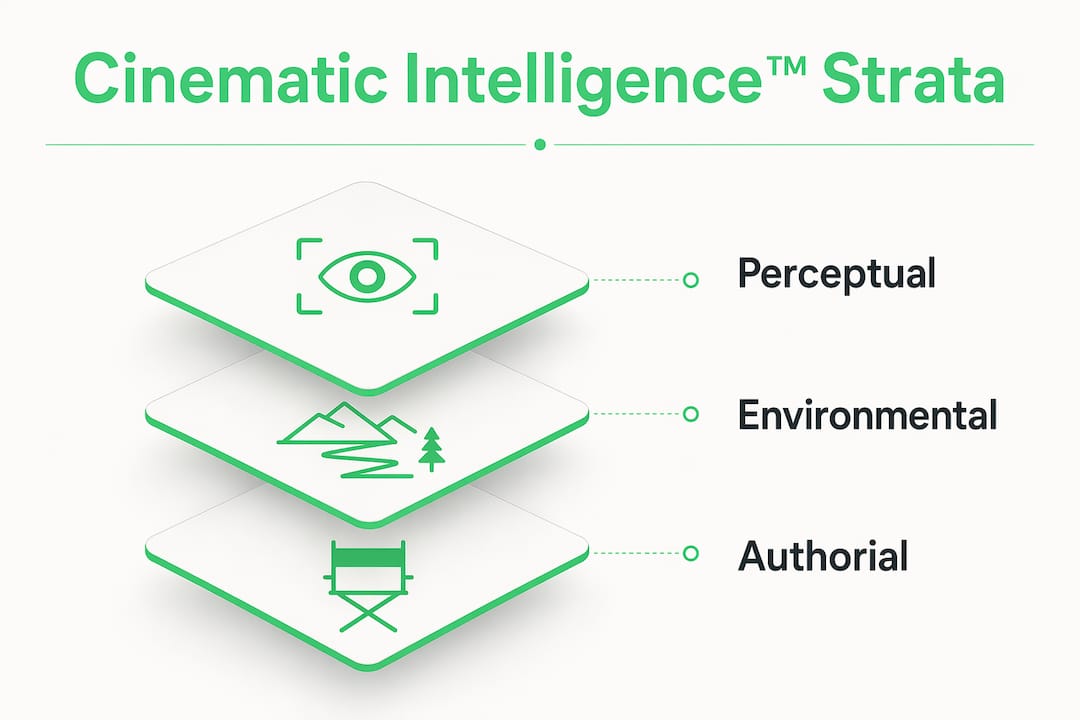
Cinematic Intelligence™ operates across three strata: Perceptual, Environmental, and Authorial. Each stratum handles a distinct layer of output quality, and the absence of any one reduces both image credibility and emotional impact.
Perceptual covers optical coherence: spatial logic, depth of field, temporal stability, and material behavior including cloth and hair physics. Environmental governs causality: how light interacts with surfaces, how weather affects material appearance, and whether ecological conditions read as plausible. Authorial encodes intent: narrative causality, stylistic identity, and ethical awareness of what the image communicates beyond its surface.
The three strata combine in specific pairings to produce distinct results. Perceptual plus Environmental yields physical believability. Environmental plus Authorial drives narrative worldbuilding. Perceptual plus Authorial establishes stylistic identity. All three together produce full cinematic realism.
| Visual Criterion |
Stratum |
Function |
| Spatial logic |
Perceptual |
Ensures objects relate correctly in 3D space |
| Depth of field |
Perceptual |
Replicates lens behavior for visual hierarchy |
| Temporal stability |
Perceptual |
Prevents flicker and inconsistency across frames |
| Material physics |
Perceptual |
Simulates cloth, hair, and surface behavior |
| Lighting causality |
Environmental |
Matches light source to surface response |
| Weather interaction |
Environmental |
Applies atmospheric conditions to materials |
| Ecological plausibility |
Environmental |
Grounds scenes in believable natural context |
| Shadow coherence |
Environmental |
Aligns shadow direction and intensity with light source |
| Narrative causality |
Authorial |
Ensures visual choices serve the story logic |
| Stylistic identity |
Authorial |
Maintains consistent visual voice across sequences |
| Ethical awareness |
Authorial |
Screens outputs for cultural and representational accuracy |
| Emotional truth |
Authorial |
Prioritizes meaning over surface realism |
Pro Tip: When reviewing AI-generated facility visualizations, test all three strata. If a rendering looks photorealistic but the lighting contradicts the building’s orientation, the Environmental stratum has failed. That failure will surface in a federal review.
How does Cinematic Intelligence™ differ from traditional AI video?
The industry has shifted from asking “Is it real?” to asking “Is it true?” That shift defines the gap between generic AI video and Cinematic Intelligence™. Generic tools produce images. Cinematic Intelligence™ produces meaning.
Agentic AI workflows automate post-production processes including script management, budgeting, and editing, integrated with non-linear editing systems to maintain professional pace and storytelling integrity. Platforms like CineSmith enable story-aware automation rather than simple generative AI application. For architecture and engineering teams, this means the output arrives pre-organized for presentation, compliance submission, or master planning review.
Systems like Runway’s Gen-3 Alpha and Google DeepMind’s Veo allow prompt-driven cinematic specifications such as “slow dolly in” or “shot on 35mm lens at T2.” That level of control is absent from generic image generators. Cinematic Intelligence™ integrates with non-linear editing systems including Premiere Pro and Avid, enabling human-led decisions alongside AI automation to preserve stylistic and narrative integrity at scale.
| Capability |
Cinematic Intelligence™ |
Generic AI video |
| Narrative coherence |
Encoded across all three strata |
Absent |
| Post-production automation |
Agentic workflow integration |
Manual or none |
| NLE compatibility |
Premiere Pro, Avid |
Not standard |
| Camera specification |
Prompt-driven lens and move control |
Limited or absent |
| Compliance-grade output |
Federal submission ready |
Not applicable |
| Authorial intent |
Embedded ethical and stylistic logic |
Not present |
Pro Tip: For federal A&E submissions, specify camera angle, lighting condition, and material finish in your Cinematic Intelligence™ prompts. Vague prompts produce generic outputs. Specific prompts produce submission-grade visualizations.
What practical applications does Cinematic Intelligence™ offer A&E teams?
Cinematic Intelligence™ supports architectural diagnostic intelligence by generating digital twins and design presentations that carry the visual authority of professional film production. For architecture and engineering professionals, this means compliance reviews that communicate clearly to non-technical stakeholders, including federal contracting officers and procurement boards.
Modish applies Cinematic Intelligence™ to identify structural, environmental, and code compliance failure points before construction commits. Each Space submitted through the Modish engine returns 192 corrective visualization options, each rendered at federal submission grade. That output volume is not possible with generic AI tools or traditional rendering pipelines.
The benefits for A&E decision-makers are concrete and measurable:
- Pre-bid risk identification: Visualize compliance failures before design is committed to construction documents.
- Master planning support: Generate multiple design scenarios with consistent visual quality across all options.
- Compliance accuracy: Reduce errors in code review by presenting conditions in film-quality visual context.
- Stakeholder communication: Deliver presentations that non-technical audiences read immediately and accurately.
- Supplier diversity credit: Every Modish engagement qualifies as Tier 1 diverse spend under Fortune 500 supplier-diversity scorecards.
The role of AI in pre-design has expanded significantly in 2026. Cinematic Intelligence™ sits at the center of that expansion, connecting visualization quality to compliance outcomes in ways that traditional rendering cannot.
What trends are shaping Cinematic Intelligence™ in 2026 and beyond?
The true value of cinematic intelligence lies in integrated pipelines rather than surface-level content creation. In 2026, the leading development is the shift from visual novelty to narrative and workflow intelligence. Agentic systems now manage script continuity, budget modeling, and post-production sequencing as a single connected operation.
Content intelligence engines trained on large title libraries, such as those used in European film and TV production with six specialized AI agents supporting workflow management, demonstrate what full agentic integration looks like at scale. Architecture and engineering firms adopting comparable infrastructure gain a structural advantage in proposal quality and compliance documentation speed.
For federal contracting, Modish’s DOBE certification under Disability:IN creates a category that no other firm occupies. FAR 6.302-1 sole-source authority applies where no other DOBE-certified architectural diagnostic intelligence firm exists in the supplier database. That regulatory position strengthens as Cinematic Intelligence™ becomes a recognized standard in federal A&E visualization. Ethical and cultural dimensions embedded in the Authorial stratum also position Cinematic Intelligence™ outputs for environments where representation and accessibility are scored criteria, not afterthoughts.
Key takeaways
Cinematic Intelligence™ is the only AI engine that combines perceptual coherence, environmental causality, and authorial intent to produce federal submission-grade architectural visualizations with compliance accuracy built in.
| Point |
Details |
| Three-stratum architecture |
Perceptual, Environmental, and Authorial strata must all be present for full cinematic realism. |
| Narrative truth over realism |
The standard has shifted from photorealism to emotional and narrative authenticity. |
| Agentic workflow advantage |
Cinematic Intelligence™ automates post-production and compliance documentation, not just image output. |
| Federal-grade application |
Modish delivers 192 corrective visualization options per Space for federal A&E submissions. |
| DOBE procurement value |
Every Modish engagement counts as Tier 1 diverse spend under Fortune 500 supplier-diversity programs. |
Why I believe most A&E firms are misreading this technology
The most common mistake I see architecture and engineering teams make is treating Cinematic Intelligence™ as a rendering upgrade. It is not. It is a diagnostic and communication infrastructure that happens to produce film-quality images as its output format.
Federal projects fail at the visualization stage not because the design is wrong, but because the presentation does not communicate the design’s compliance logic to the reviewing authority. Cinematic Intelligence™ solves that problem at the authorial level, encoding intent into every frame. Firms that adopt it as a rendering tool will capture a fraction of its value. Firms that integrate it into their compliance review workflows will hold a position that competitors cannot replicate without the same infrastructure. Modish built that infrastructure specifically for federal A&E, and the DOBE certification means no other firm can occupy the same procurement category.
— Ben
Modish Global Inc. and federal-grade Cinematic Intelligence™
Modish Global Inc. is the only Disability:IN-certified DOBE firm delivering Architectural Diagnostic Intelligence™ at federal submission grade. Its Cinematic Intelligence™ engine, combined with Multiplicity Modeling™ and DesignVault 3D™, produces 192 corrective visualization options per Space, purpose-built for pre-bid evaluation, master planning, and compliance documentation on federal A&E pursuits.
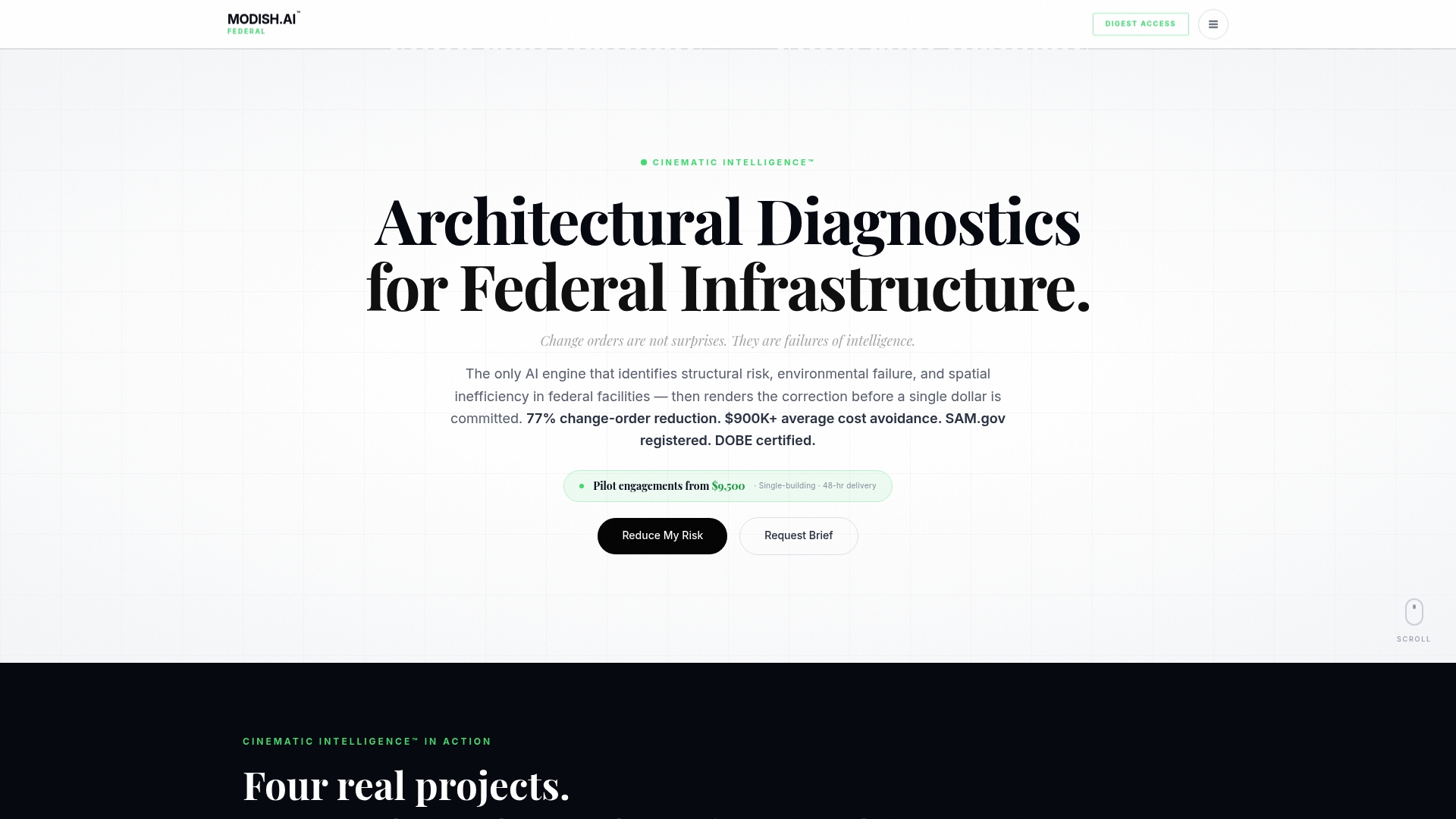
Engagements begin at $9,500 for single-facility pilots and scale to $150,000 or more for annual enterprise licenses. Modish is SAM.gov registered and teamed under READIGOV and Green America for complete federal execution. For architecture and engineering primes seeking DOBE diversity scoring alongside diagnostic-grade visualization, Modish’s federal solutions represent a procurement category with no direct competition. Review engagement options and pricing to identify the right entry point for your next federal pursuit.
FAQ
What is cinematic intelligence in architecture?
Cinematic Intelligence™ in architecture is an AI engine that applies filmmaker logic, including camera behavior, lighting causality, and narrative intent, to produce federal submission-grade facility visualizations. Modish Global Inc. uses it to identify compliance failure points before construction commits.
How does Cinematic Intelligence™ differ from standard AI rendering?
Standard AI rendering produces images. Cinematic Intelligence™ produces outputs structured across three strata, Perceptual, Environmental, and Authorial, ensuring spatial accuracy, environmental plausibility, and authorial intent are all present in every frame.
What are the features of Cinematic Intelligence™ that matter for compliance?
The 12 core visual criteria within the AI Cinematic Realism framework, including spatial logic, lighting causality, and temporal stability, directly support compliance visualization by ensuring outputs read accurately to federal reviewers and non-technical stakeholders.
Can Cinematic Intelligence™ integrate with existing A&E workflows?
Cinematic Intelligence™ integrates with non-linear editing systems including Premiere Pro and Avid, and agentic platforms automate post-production and documentation sequencing alongside human-led design decisions.
What is Modish’s DOBE status and why does it matter for federal procurement?
Modish Global Inc. holds Disability:IN certification as a Disability-Owned Business Enterprise, making it the only DOBE-certified firm in architectural diagnostic intelligence. That status activates FAR 6.302-1 sole-source authority and qualifies every engagement as Tier 1 diverse spend.
Recommended