What Is Architectural Peer Review and Why It Matters
What Is Architectural Peer Review and Why It Matters
TL;DR:
- Architectural peer review is an independent, essential quality assurance process that evaluates design intent, constructability, and compliance before construction begins. Scheduling reviews at key project phases minimizes costly revisions and enhances safety, code adherence, and stakeholder confidence through objective assessments. Embracing diagnostic technologies and collaborative practices, peer review reduces project risk and elevates design quality beyond regulatory or neighborhood standards.
Architectural peer review is a formal, independent evaluation performed by third-party experts to verify design intent, code compliance, constructability, and performance before construction begins. Unlike municipal plan checks or HOA approvals, this process is a professional quality assurance service with no regulatory authority and no conflict of interest. It exists to protect the project, not to gatekeep it. Tools like Cinematic Intelligence™ and Architectural Diagnostic Intelligence™ now extend what peer review can detect, surfacing failure points that traditional document review misses entirely.
What is the architectural review process and how does peer review fit within it?
The architectural review process moves through three primary phases: schematic design, design development, and construction documents. Each phase produces a progressively more detailed body of work, and each creates a natural checkpoint where independent scrutiny adds the most value. Scheduling peer reviews at the schematic, design development, and 90% construction documents stages minimizes costlier late-stage changes. That sequencing is not arbitrary. Catching a structural coordination conflict at schematic design costs a fraction of what it costs to resolve the same conflict during construction.
Within each gate, a peer review covers a defined set of activities:
- Documentation evaluation: Reviewers assess drawings, specifications, and narratives for internal consistency and completeness.
- Structural and envelope analysis: Load paths, waterproofing details, and thermal performance are examined against project-specific conditions.
- System coordination: Mechanical, electrical, plumbing, and structural systems are cross-checked for spatial and functional conflicts.
- Compliance verification: Accessibility standards, fire and life safety codes, and durability requirements are confirmed against the current code edition.
- Constructability assessment: Reviewers flag details that are theoretically correct but practically difficult or impossible to build as drawn.
The distinction between peer review and an internal design review is significant. Internal reviews are conducted by members of the same firm, which means shared assumptions, shared blind spots, and an inherent reluctance to challenge senior decisions. A peer reviewer carries none of that baggage.
Pro Tip: Engage your peer reviewer at schematic design, not at permit submission. Early intervention on a $50 million project can eliminate change orders that dwarf the cost of the review itself.

How does peer review differ from third-party and regulatory reviews?
The terminology in this space creates genuine confusion, and the confusion carries real consequences. Peer review, third-party review, and municipal architectural review are three distinct services with different scopes, different clients, and different outcomes.
Professional peer review is a quality assurance service aimed at reducing risk, distinct from municipal or HOA architectural reviews that focus on regulatory or neighborhood compliance. A municipal plan check confirms that a set of drawings meets minimum code thresholds. It does not evaluate design quality, constructability, or long-term performance. An HOA architectural review evaluates aesthetic compatibility with neighborhood standards. Neither process is designed to protect the owner’s investment or the design team’s professional reputation.
The table below clarifies the distinctions:
| Review type |
Primary purpose |
Timing |
Outcome |
| Architectural peer review |
Quality assurance and risk mitigation |
During design phases |
Findings report with recommendations |
| Third-party review |
Contract compliance or scope verification |
Varies by contract |
Compliance confirmation |
| Municipal plan check |
Minimum code compliance |
Pre-permit |
Permit approval or corrections |
| HOA architectural review |
Aesthetic and neighborhood standards |
Pre-application |
Approval or denial |
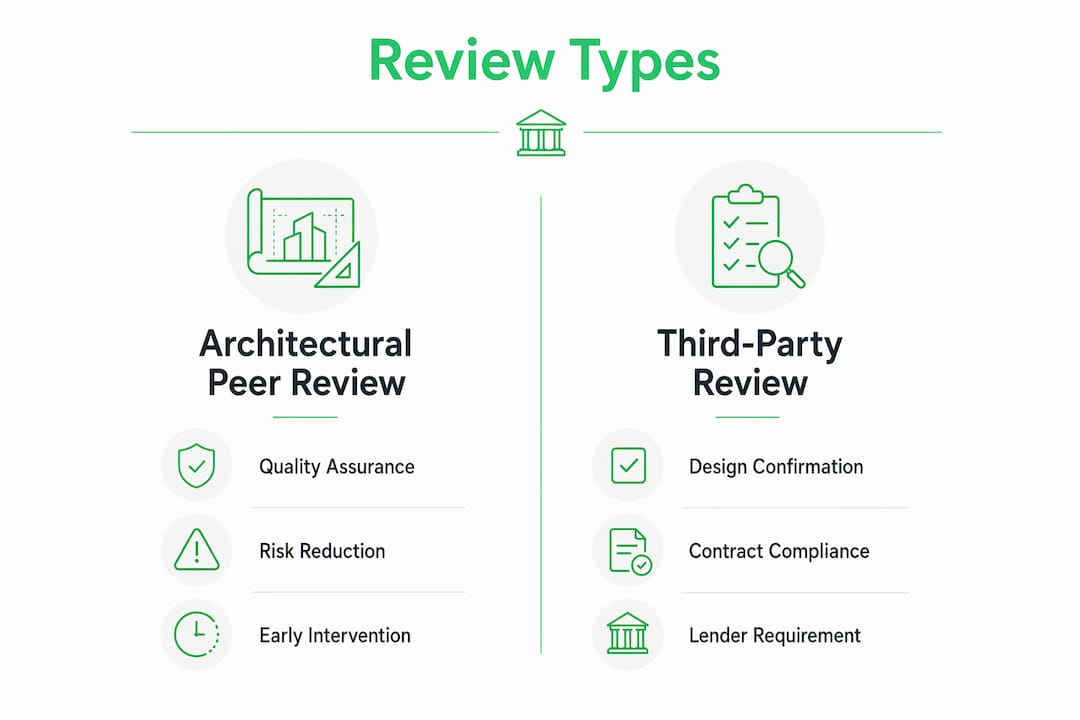
A third-party review, often contracted by a lender or owner’s representative, typically confirms that the design team is delivering what the contract requires. It is a scope verification exercise, not a quality evaluation. Peer review in architecture focuses on design, structural integrity, site challenges, and construction methods without assigning blame. That distinction matters when you are trying to build a culture of honest assessment rather than defensive documentation.
What are the benefits of architectural peer review for construction projects?
The benefits of peer review are most visible when a project avoids a problem that never appears in the final record because it was caught and corrected before it could materialize. Peer review identifies design conflicts, code issues, and constructability risks before construction begins, aligning the project with its goals and code requirements. That alignment has compounding value across the project lifecycle.
The core benefits include:
- Risk reduction: Design conflicts caught in review cost exponentially less to resolve than the same conflicts discovered during construction or, worse, after occupancy.
- Code and accessibility compliance: Reviews confirm adherence to ADA, IBC, and project-specific standards before permit submission, reducing correction cycles.
- Stakeholder confidence: Owners, lenders, and insurers respond differently to a project that has passed independent expert scrutiny. The review functions as a credibility signal.
- Communication quality: Successful peer review delivers stronger decisions, better communication, and fewer surprises in construction. Reviewers surface ambiguities that the design team has normalized and no longer sees.
- Scope and budget resilience: When projects face scope changes or budget pressure, peer review provides an objective baseline that prevents reactive decisions from compounding existing risks.
Pro Tip: Apply Architectural Diagnostic Intelligence™ during peer review to generate 192 corrective visualization options per facility Space. The visual output makes findings immediately legible to owners and contractors who do not read technical reports.
What steps should architects and project managers follow to implement peer review?
Effective peer review does not happen by scheduling a call with a colleague. It requires deliberate structure from reviewer selection through feedback integration.
- Select qualified, conflict-free reviewers. The reviewer must have no financial or professional relationship with the design team or the owner. Relevant licensure, project type experience, and geographic code familiarity are non-negotiable criteria.
- Define the peer review brief. Specify which systems, phases, and risk areas the review will address. A brief aligned with project goals prevents scope creep and keeps findings actionable.
- Coordinate timing with project milestones. Peer reviews scheduled outside of natural design gates generate findings that arrive too late to influence decisions without disrupting progress.
- Communicate findings clearly and constructively. Findings reports should distinguish between code violations, constructability concerns, and professional recommendations. Conflating these categories creates defensiveness and slows resolution.
- Integrate feedback without halting progress. Assign a single point of contact on the design team to triage findings, confirm responses, and track resolution. Untracked findings disappear.
- Use technology to extend review depth. Multiplicity Modeling™ enables thorough analysis and visualization across complex federal and commercial facilities, making remote peer reviews as rigorous as in-person document sessions.
The architectural risk assessment framework used on federal projects provides a replicable model for scoping peer reviews on commercial work. The discipline of defining risk categories before the review begins determines the quality of findings that come out of it.
What misconceptions make peer review harder to implement?
The most persistent misconception is that peer review is a pass/fail audit. It is not. Most project teams mistakenly view peer review as pass/fail critique, but it is a strategic risk mitigation tool that strengthens the design team through constructive collaboration. Framing it as an audit creates adversarial dynamics that undermine the entire exercise.
Several other challenges consistently surface:
- Treating reviewers as outsiders. Reviewers who are engaged as extensions of the design team produce findings that the team can act on. Reviewers who are treated as auditors produce findings that the team defends against.
- Delaying review to late design stages. A peer review at 95% construction documents can confirm compliance but cannot meaningfully improve design quality. The window for high-value intervention has already closed.
- Underestimating the cultural dimension. Peer review restores trust and provides clarity when projects face scope changes, budget constraints, or timeline concerns. Teams that resist review during pressure periods are the ones that need it most.
Overcoming these challenges requires leadership commitment to the process before the project starts, not after the first conflict appears.
Key takeaways
Architectural peer review is the single most cost-effective quality assurance intervention available to design and construction teams before a shovel enters the ground.
| Point |
Details |
| Definition and scope |
Peer review is an independent expert evaluation of design intent, compliance, and constructability before construction. |
| Optimal timing |
Schedule reviews at schematic design, design development, and 90% construction documents to maximize impact. |
| Distinct from regulatory review |
Municipal plan checks and HOA reviews confirm minimums; peer review protects quality and reduces risk. |
| Collaborative by design |
Peer review is a contribution to project success, not a fault-finding exercise or pass/fail audit. |
| Technology amplifies findings |
Tools like Multiplicity Modeling™ and Cinematic Intelligence™ extend review depth and make findings visually legible. |
I have watched peer review get scheduled, postponed, and eventually dropped on more projects than I can count. The justification is always the same: the timeline is tight, the budget is thin, and the team is confident in the work. That confidence is precisely the problem. Confidence is not a substitute for independent scrutiny, and the projects that skip peer review are rarely the ones that can afford the consequences.
What I find more interesting is how diagnostic technology is changing the conversation. When findings arrive as federal submission-grade visualizations rather than redlined PDFs, owners engage differently. The resistance drops. The decisions accelerate. Modish’s Architectural Diagnostic Intelligence™ infrastructure does not replace the human judgment at the center of peer review. It makes that judgment visible to every stakeholder in the room, including the ones who do not read drawings.
The cultural shift toward transparent, collaborative peer assessment is real, and it is accelerating on federal and Fortune 500 projects where the cost of a missed conflict is measured in eight figures. Teams that build peer review into their standard workflow are not being cautious. They are being precise.
— Ben
How Modish supports peer review with diagnostic intelligence

Modish Global Inc. is the only Disability:IN-certified DOBE architectural diagnostic intelligence firm in the United States, and its Cinematic Intelligence™ engine was purpose-built for the kind of pre-construction scrutiny that peer review demands. The DesignVault 3D™ infrastructure renders corrective solutions in federal submission-grade visualization, giving design teams and owners a shared visual language for acting on findings. For federal A&E primes and Fortune 500 procurement teams, every Modish engagement counts as Tier 1 diverse spend credit while delivering diagnostic intelligence services that no other supplier in any corporate database can replicate. Engagements begin at $9,500 for single-facility pilots. Review service and pricing details to scope your next peer review engagement.
FAQ
What is architectural peer review in simple terms?
Architectural peer review is an independent expert evaluation of a building design that checks for code compliance, constructability issues, and design conflicts before construction starts. It is a quality assurance service, not a regulatory requirement.
When should a peer review be scheduled on a project?
Peer reviews scheduled at schematic design, design development, and 90% construction documents stages produce the highest return. Reviews conducted after permit submission can confirm compliance but cannot meaningfully improve design quality.
How does peer review differ from a municipal plan check?
A municipal plan check confirms minimum code compliance for permit issuance. Architectural peer review evaluates design quality, constructability, and performance, and it is commissioned by the owner or design team rather than required by a jurisdiction.
Who qualifies to conduct an architectural peer review?
A qualified peer reviewer holds relevant licensure, has direct experience with the project type and scale, and has no financial or professional relationship with the design team or owner. Conflict of interest disqualifies a reviewer regardless of technical credentials.
Advanced modeling tools like Multiplicity Modeling™ make remote peer reviews as rigorous as in-person sessions by enabling thorough analysis and visualization of complex facility conditions across distributed teams.
Recommended