The Role of Intelligence in Pre-Bid Evaluation
The Role of Intelligence in Pre-Bid Evaluation

TL;DR:
- Early pre-bid intelligence significantly boosts winning chances by shaping relationships, solutions, and partnerships months before the RFP. Structured scoring and AI tools help teams evaluate opportunities efficiently, reducing waste and improving proposal quality. Consistently, deep, continuous intelligence drives more accurate bid decisions and higher success rates in federal contracting.
Pre-bid intelligence is defined as the structured collection and analysis of market, buyer, and competitive signals before a formal solicitation is released. The role of intelligence in pre-bid evaluation is to convert raw procurement signals into decisions that protect resources, sharpen proposals, and increase win rates on federal architecture and engineering pursuits. Contracting officers and project managers who treat intelligence as a continuous discipline, rather than a last-minute scan of bid alerts, consistently outperform teams that wait for the RFP to drop. The difference between a 20% win rate and a 40% win rate often traces back to what a team knew, and when they knew it.
How does early intelligence gathering before RFP release improve bid success?
Early intelligence gathering produces a measurable advantage. High-performing teams that build competitive intelligence 6 to 18 months before solicitation consistently surpass 40% win rates. That lead time is not a luxury. It is the window in which buyer relationships form, teaming partners are secured, and solution narratives are shaped before the evaluation criteria are even published.

Most contracting teams treat bid alerts as intelligence. That is a critical error. True pre-RFP intelligence requires monitoring capital plans, council agendas, prior information notices, and agency budget submissions, all of which signal procurement intent months before a formal package appears. A federal agency’s five-year capital plan, for example, often identifies facility modernization priorities that will not reach SAM.gov for 12 to 18 months.
The practical advantage of this lead time is threefold:
- Buyer engagement: Early contact with contracting officers and program managers allows your team to shape requirements, demonstrate capability, and establish credibility before competitors arrive.
- Partnership building: Teaming arrangements with SDVOSB, WOSB, or DOBE firms take time to negotiate and document. Reactive bidders assemble teams under deadline pressure, which shows in proposal quality.
- Solution development: Technical approaches written before the RFP drops are more coherent. Teams that start writing after release are always catching up.
Suppliers who apply early opportunity analysis achieve 25–40% higher win rates compared to those who respond reactively. That gap is not explained by proposal writing skill alone. It reflects the depth of intelligence behind the narrative.
Pro Tip: Set a weekly 30-minute research block dedicated to monitoring agency budget justifications, congressional appropriations markups, and pre-solicitation notices on SAM.gov. Compounding small inputs over months produces the kind of situational awareness that cannot be replicated in a 72-hour proposal sprint.
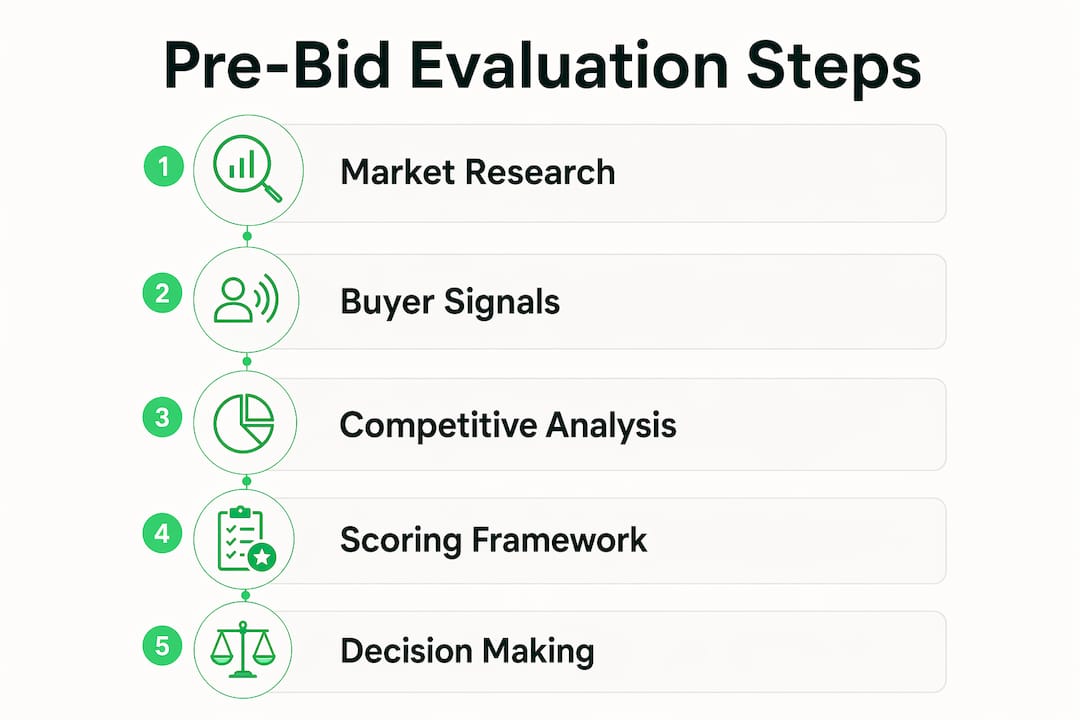
What frameworks and scoring methods work for pre-bid evaluation?
Structured scoring is the difference between a disciplined bid pipeline and a team that chases every opportunity until it runs out of estimating capacity. The most effective pre-bid assessment strategies use weighted scorecards that evaluate opportunities across four core dimensions:
- Strategic fit: Does this pursuit align with your firm’s core capabilities, past performance, and growth targets?
- Resource capacity: Do you have the personnel, subcontractor relationships, and bandwidth to execute if you win?
- Competitive position: Do you hold an incumbent advantage, a teaming edge, or a technical differentiator that rivals cannot match?
- Buyer relationship: Has your firm engaged this agency before? Is the contracting officer familiar with your work?
Each dimension receives a weighted score. The aggregate determines whether a pursuit advances. Best-in-class scorecards require a 65–70% threshold, reached within 24 to 72 hours after bid package receipt. That window is not arbitrary. Decisions made outside it tend to be driven by optimism rather than data.
Borderline scores, those falling between 55% and 65%, require formal escalation to executive review. This step exists to remove the confirmation bias that afflicts pursuit teams who have already invested weeks in a relationship. An executive reviewer who has not been close to the opportunity can assess risk mitigation plans without attachment.
Bid and no-bid checklists with formal scoring increase win rates to 25–40% while reducing wasted estimating effort. The checklist functions as a decision system, not a compliance document. Teams that treat it as a formality undermine its entire purpose.
Pro Tip: Assign scoring responsibility to a pursuit lead who was not involved in the initial opportunity identification. Separation of roles reduces the sunk-cost bias that inflates scores on marginal pursuits.
How does intelligence map to proposal strategy and risk mitigation?
Intelligence without application is just data storage. The real value of pre-bid analysis emerges when findings map directly to proposal sections, win themes, and risk registers. Experienced teams link intelligence to evaluation criteria, turning competitor weaknesses into proposal discriminators that evaluators can score.
A concrete example: if your competitive research reveals that the incumbent contractor has documented cost overruns on a prior task order, that finding belongs in your Management Approach section. You do not name the competitor. You describe your cost control methodology and cite your own track record of on-budget delivery. The evaluator draws the comparison without prompting.
Buyer history and past award data serve a parallel function in pricing strategy. USASpending.gov and FPDS-NG both publish award amounts, modification histories, and period-of-performance data for federal contracts. A project manager who reviews three prior awards for a given agency program office understands the realistic price range before writing a single cost line. That is the role of data in pre-bid analysis: replacing assumption with evidence at every proposal decision point.
Risk identification before submission protects the resource investment a firm makes in any serious pursuit. An architectural risk assessment conducted during pre-bid evaluation surfaces structural, environmental, and code compliance issues that would otherwise appear as costly surprises during design development. Identifying those risks early allows a team to price them accurately, propose mitigation measures, and demonstrate technical credibility to the evaluating agency.
Key intelligence inputs for proposal strategy include:
- Award history and modification patterns from FPDS-NG and USASpending.gov
- Incumbent performance records and any documented deficiencies
- Agency strategic plans and facility master plans
- Prior RFP structures and evaluation factor weightings from similar solicitations
- Teaming partner past performance on comparable federal projects
For federal A&E pursuits, bid accuracy methods that integrate pre-bid risk data into cost modeling consistently produce more defensible proposals. Accuracy at the pre-bid stage reduces the likelihood of scope creep, change orders, and margin erosion after award.
What role does AI play in pre-bid intelligence today?
Artificial intelligence now forms the foundational layer of procurement intelligence infrastructure. AI processes large volumes of procurement data, improves signal readability, and flags relevant opportunities faster than any manual review process. That speed matters when monitoring hundreds of agency programs simultaneously.
Robotic process automation handles the repetitive extraction tasks: pulling award data from FPDS-NG, scanning SAM.gov for pre-solicitation notices, and aggregating agency budget documents. Staff freed from those manual tasks can focus on the analysis that requires judgment, specifically the interpretation of buyer behavior, relationship mapping, and competitive positioning.
The critical distinction is this: technology enables the data layer, but client relationship intelligence remains the competitive edge that no algorithm replicates. An AI engine can tell you that an agency issued a similar contract three years ago. Only a relationship with the program manager tells you whether the agency is satisfied with the current contractor.
Modish applies Cinematic Intelligence™ and Architectural Diagnostic Intelligence™ to the pre-bid evaluation process for federal facilities. Each Space submitted through the Modish engine generates 192 corrective visualization options, giving contracting officers and A&E primes a documented, visual record of facility conditions before a single design dollar is committed. That level of pre-bid clarity is what separates a technically credible proposal from a generic one.
Pro Tip: Use AI tools to build your opportunity pipeline and automate data collection. Reserve human intelligence hours for buyer engagement, competitive analysis, and the nuanced interpretation of agency signals that machines cannot contextualize.
Key Takeaways
Pre-bid intelligence is the single most controllable variable in federal proposal win rates, and teams that treat it as a structured discipline consistently outperform those that treat it as a last-minute activity.
| Point |
Details |
| Start intelligence 6–18 months early |
Teams that engage buyers and map awards before RFP release consistently exceed 40% win rates. |
| Apply a weighted scorecard |
Use a 65–70% threshold within 24–72 hours of bid package receipt to make defensible bid decisions. |
| Map findings to proposal sections |
Link competitive intelligence directly to evaluation criteria and win themes, not just background research. |
| Use AI for data, humans for judgment |
Automate procurement data collection and reserve analyst time for relationship and competitive interpretation. |
| Conduct pre-bid risk assessment |
Identify structural and compliance risks before submission to protect cost accuracy and technical credibility. |
Intelligence is a discipline, not a deliverable
Federal contracting officers often ask me what separates the proposals that score in the 90th percentile from the ones that cluster around the minimum threshold. The answer is almost never writing quality. It is the depth of intelligence behind the narrative.
I have seen pursuit teams spend six weeks writing a technically flawless proposal for an opportunity they had no realistic chance of winning. The incumbent had a decade of past performance with the agency, the evaluation criteria were written around capabilities the incumbent already demonstrated, and the competitive field included two firms with existing BPA vehicles. None of that was unknowable. It was simply never researched.
The discipline of pre-bid assessment requires treating intelligence as a pipeline that compounds over time, not a deliverable that gets produced once the RFP lands. Weekly research, structured scoring, and honest bid decisions are not glamorous. They are the mechanics that separate firms with 35% win rates from firms with 18% win rates.
Architectural Diagnostic Intelligence™ adds a dimension to this discipline that most federal A&E teams have never had access to. When facility condition data, code compliance gaps, and structural risk factors are documented and visualized before the proposal is written, the technical approach section writes itself. The evaluator sees evidence, not assertions.
The firms that will dominate federal A&E procurement over the next decade are not the ones with the largest proposal teams. They are the ones that treat intelligence as infrastructure.
— Ben
Modish and the intelligence edge in federal A&E bids
Federal contracting officers and A&E primes working on facility-intensive pursuits need more than a proposal writer. They need documented pre-bid evidence that the technical approach is grounded in real facility conditions.
Modish is the only Disability:IN-certified DOBE architectural diagnostic intelligence firm in the United States. The Cinematic Intelligence™ engine and Multiplicity Modeling™ infrastructure generate 192 corrective visualization options per Space, giving proposal teams federal submission-grade visual documentation before design begins. Every Modish engagement counts as Tier 1 diverse spend and adds DOBE scoring to federal A&E proposals. Modish is SAM.gov registered and teamed under READIGOV (SDVOSB/WOSB prime) for complete federal execution. Explore Architectural Diagnostic Intelligence™ or visit the Modish Federal Division to request a pilot engagement starting at $9,500.
FAQ
What is pre-bid intelligence in federal contracting?
Pre-bid intelligence is the structured collection of buyer signals, competitive data, and market indicators before a formal RFP is released. It includes monitoring agency capital plans, prior information notices, and award histories to inform bid decisions.
How early should intelligence gathering begin for federal bids?
High-performing teams begin competitive intelligence 6 to 18 months before solicitation. That lead time enables buyer engagement, teaming arrangements, and solution development that reactive bidders cannot replicate under deadline pressure.
What score threshold triggers a bid authorization?
Best-in-class pre-bid scorecards require a 65–70% weighted score, reached within 24 to 72 hours after bid package receipt. Scores below that threshold should trigger a formal no-bid decision or executive escalation review.
How does AI support pre-bid evaluation?
AI automates data collection from sources like FPDS-NG and SAM.gov, improving signal readability and processing speed. Client relationship intelligence and competitive interpretation still require human judgment that AI cannot replace.
What makes Modish’s approach to pre-bid evaluation different?
Modish applies Cinematic Intelligence™ and Architectural Diagnostic Intelligence™ to generate 192 corrective visualization options per facility Space, giving federal proposal teams documented, visual pre-bid evidence. As the only DOBE-certified firm in this category, Modish also adds diversity scoring to every federal A&E proposal it supports.
Recommended