ISSN Accreditation in Architecture: What It Really Means
ISSN Accreditation in Architecture: What It Really Means

TL;DR:
- An ISSN is an administrative code that uniquely identifies serial publications but does not indicate quality or accreditation.
- It facilitates library cataloging, database indexing, and content preservation but does not guarantee scholarly credibility or peer review.
An ISSN is an 8-digit international code that uniquely identifies serial publications, including architecture journals and magazines, but it does not signify accreditation, quality endorsement, or professional standing. Governed by ISO 3297 and administered through a global network of National ISSN Centres, the International Standard Serial Number is a purely administrative identifier. Architects, academic researchers, and architecture students frequently confuse ISSN registration with formal accreditation systems like those operated by the National Architectural Accrediting Board (NAAB). Understanding what is ISSN accreditation in architecture, and why the phrase itself is a misnomer, protects researchers from misreading a publication’s scholarly credibility.
What is the ISSN accreditation process for architectural journals?
The ISSN application process is administrative, not evaluative. No editorial board reviews your content for quality. No peer-review panel assesses your methodology. A National ISSN Centre simply verifies that your publication is a legitimate serial and assigns a unique numeric code.
The steps for architectural publishers follow a consistent sequence:
- Prepare your journal’s core information. Gather the formal journal title, publication frequency, publisher name and contact details, and proof of content such as sample articles or a live website. For print journals, a physical sample issue may be required.
- Build a professional web presence. Applications submitted via national portals, including ISSN Uplink in the United States, require a functional journal website with an editorial board page, author guidelines, and at least one published article.
- Choose your publication management system. Open Journal Systems (OJS) is widely used by academic architectural publishers because its metadata structure aligns directly with ISSN application requirements.
- Submit through the correct national portal. Each country routes applications through its designated National ISSN Centre. U.S.-based architectural journals apply through the Library of Congress as the national center.
- Wait for assignment. Processing typically takes 1 to 4 weeks through official national centers, and the service is usually free of charge. Third-party ISSN services charge fees but offer no faster path to legitimacy.
One detail that trips up many architectural publishers: a print journal and its online edition each require a separate ISSN. The ISSN-L, or linking ISSN, then connects both formats under a single identifier for discovery purposes. Misusing these codes causes indexing errors in automated databases, which directly reduces a journal’s discoverability.
Pro Tip: Register your e-ISSN before applying to indexing databases like Scopus or DOAJ. Most databases require a valid ISSN as a prerequisite before they will even evaluate your journal’s editorial quality.

Why ISSN matters for discovery but not for quality
ISSN is a bibliographic tool, not an academic quality marker. Researchers should look for peer-reviewed indexing status to assess scholarly rigor, not the presence of an ISSN alone.
The functional benefits of ISSN for architectural publications are real and significant:
- Library cataloging. National and university libraries use ISSN to catalog serial publications without ambiguity. Two journals with similar titles remain distinguishable through their unique codes.
- Database indexing. Scopus, DOAJ, and Web of Science all require a valid ISSN before evaluating a journal for inclusion. ISSN is the entry ticket, not the prize.
- Interlibrary loans and citation tracking. Automated systems that route article requests between institutions depend on ISSN to locate the correct publication.
- Digital preservation. Archiving services like CLOCKSS and Portico use ISSN to track and preserve journal content over time.
What ISSN does not do is equally important to understand. The ISSN International Centre has stated clearly that ISSN assignment does not confer copyright, ownership, or content quality assurance. That statement carries direct implications for architectural researchers evaluating whether a journal is credible.
“ISSN assignment protocols uphold global stability and clarity but do not guarantee intellectual property rights or content quality. Credibility is established by editorial standards, not the possession of an ISSN.”
— ISSN International Centre, via NISO
Directories like DOAJ, Scopus, and Web of Science perform independent quality assessments that ISSN registration alone cannot replicate. An architecture journal with an ISSN but no peer review is still an unreviewed journal.
How does ISSN relate to NAAB accreditation and peer review?
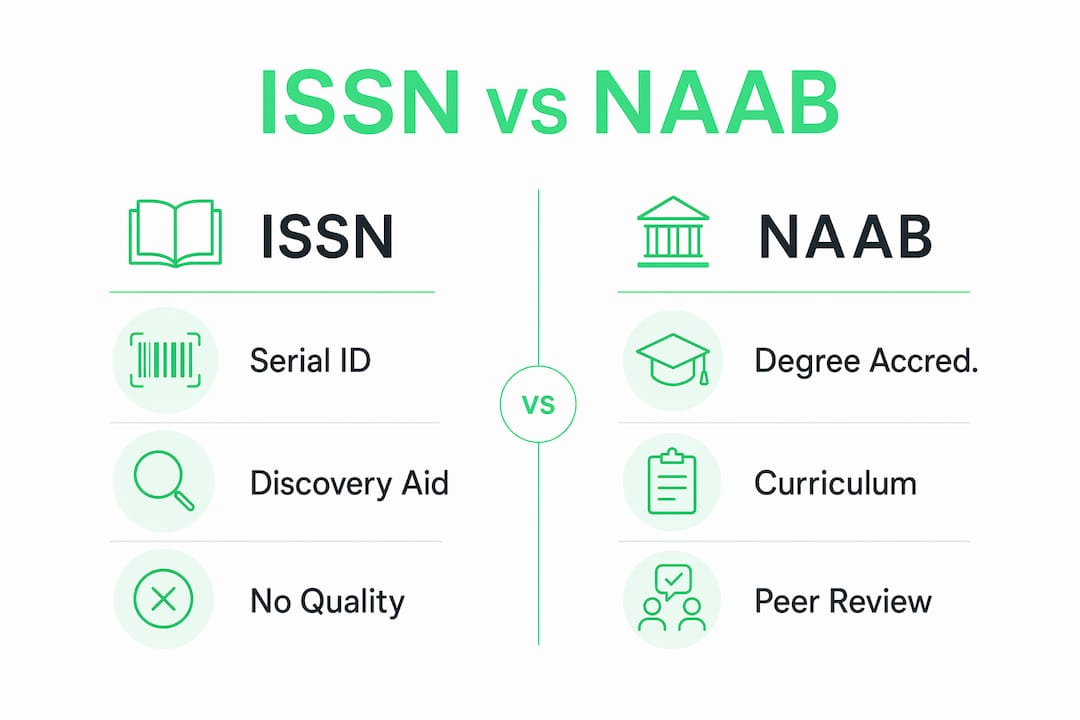
ISSN and NAAB accreditation operate in entirely separate systems with no overlap. Conflating them is the most common misconception among architecture students and early-career researchers.
NAAB accredits professional degree programs in architecture, not publications. Its standards govern curriculum, studio culture, faculty qualifications, and licensure eligibility. The Canadian Architectural Certification Board similarly focuses on degree-level standards and professional practice requirements. Neither body has any role in evaluating or assigning ISSNs. Neither body cares whether a journal holds an ISSN.
| Identifier or standard |
What it evaluates |
Who administers it |
| ISSN |
Serial publication identity |
National ISSN Centres under ISO 3297 |
| NAAB accreditation |
Architecture degree programs |
National Architectural Accrediting Board |
| Scopus indexing |
Journal editorial quality and citation impact |
Elsevier’s independent review committee |
| DOAJ listing |
Open-access journal quality and transparency |
Directory of Open Access Journals |
Peer review is the actual quality mechanism for architectural journals. A journal that publishes blind peer-reviewed research on building performance, urban morphology, or structural systems earns credibility through that editorial process, not through its ISSN. The architectural peer review process is the standard that separates scholarly publication from trade commentary.
Pro Tip: When evaluating a journal for submission or citation, check its DOAJ or Scopus listing first. An ISSN tells you the journal exists. An indexing listing tells you the journal meets editorial standards.
Practical guidance for architectural publishers and researchers
Proper ISSN use is the foundation of journal discoverability, but it requires attention to format and metadata discipline.
- Display your ISSN prominently. Place the print ISSN and e-ISSN on the journal’s homepage, masthead, and every article’s metadata. Automated indexing systems scan for these codes to confirm journal identity.
- Use ISSN-L correctly. The linking ISSN connects your print and online editions. Use it in cross-format citations and metadata records to prevent duplication errors in library catalogs.
- Register a DOI for each article. ISSN identifies the journal. A Digital Object Identifier (DOI) identifies the individual article. Both are required for full discoverability in academic databases.
- Apply to DOAJ before Scopus. DOAJ has a lower barrier to entry and its listing strengthens a Scopus application. Sequence your indexing applications strategically.
- Audit your metadata annually. Title changes, frequency shifts, or format additions each require ISSN updates. Outdated metadata causes indexing errors that reduce discoverability without any visible warning.
Architectural publishers navigating regulatory compliance workflows in construction and design contexts face analogous documentation discipline requirements. The same rigor that governs building code submissions applies to publication metadata management.
Modish’s 3D Transformative Digest™ demonstrates this discipline in practice. The publication holds a registered ISSN and distributes through ZINIO, PressReader, Magzter, SyndiGate, and Newstex to over 3 million readers in 150 countries. That reach is built on correct metadata infrastructure, not on the ISSN alone.
Pro Tip: If your journal changes its title, even slightly, apply for a new ISSN immediately. The ISSN system treats title changes as new publications. Failing to update creates catalog conflicts that persist for years.
Key Takeaways
ISSN is an administrative identifier that enables discovery. It is not a quality certification, and no architectural publication earns credibility from an ISSN alone.
| Point |
Details |
| ISSN is not accreditation |
An ISSN identifies a serial publication under ISO 3297 but does not evaluate editorial quality or professional standing. |
| Application is administrative |
Processing takes 1–4 weeks through national centers and is typically free of charge. |
| Format distinctions matter |
Print ISSN, e-ISSN, and ISSN-L serve different functions; misusing them causes indexing errors. |
| Quality requires indexing |
Scopus, DOAJ, and Web of Science perform independent quality reviews that ISSN registration cannot replace. |
| NAAB and ISSN are unrelated |
NAAB accredits architecture degree programs; ISSN identifies serial publications. The two systems do not intersect. |
Why the ISSN confusion costs architects more than they realize
The misreading of ISSN as accreditation is not a harmless semantic error. I have seen architecture researchers cite ISSN-registered journals as peer-reviewed sources in federal proposals and academic submissions, only to have reviewers flag the citations as unverified. That mistake does not just weaken a single document. It signals a gap in research methodology that follows a practitioner’s reputation.
The confusion runs deeper in architectural education. Students who learn to equate ISSN with credibility graduate into practice with a flawed filter for evaluating sources. They cite trade publications as if they carry the same weight as Scopus-indexed journals. They submit to unreviewed journals believing the ISSN on the masthead signals editorial rigor. Neither assumption holds.
What I find most telling is that the ISSN International Centre itself has had to issue formal clarifications reiterating that ISSN assignment does not confer quality assurance. That a governing body must publicly correct a widespread misconception tells you how deeply the confusion runs in professional communities, including architecture.
The path forward is straightforward. Treat ISSN as the catalog number it is. Evaluate journals by their indexing status, editorial board credentials, and peer-review transparency. Use Cinematic Intelligence™ frameworks to assess the accuracy and rigor of architectural information before it enters your research pipeline. The standard for architectural knowledge should be as exacting as the standard for architectural construction.
— Ben
Modish and the architecture of credible publication
Architectural researchers and journal publishers who want to move beyond ISSN registration toward genuine academic visibility need a different kind of infrastructure.
Modish’s Architectural Diagnostic Intelligence™ engine supports architectural publishers and federal A&E teams in building publication credibility that withstands peer scrutiny. As the only Disability:IN-certified DOBE in architectural diagnostic intelligence, Modish brings a category-defining perspective to how architectural knowledge is produced, verified, and distributed. The 3D Transformative Digest™ reaches over 3 million readers across 150 countries, built on the same metadata discipline and editorial rigor that indexing databases demand. Explore Modish’s full service infrastructure to see how Architectural Diagnostic Intelligence™ supports research impact from pre-design through federal submission.
FAQ
What does ISSN mean for an architecture journal?
ISSN stands for International Standard Serial Number. It is an 8-digit code that identifies a serial publication for cataloging and indexing purposes, governed by ISO 3297, and does not indicate editorial quality or professional accreditation.
How long does it take to get an ISSN?
Processing through a National ISSN Centre typically takes 1 to 4 weeks and is usually free of charge. Third-party services charge fees but do not accelerate the official assignment process.
Is ISSN the same as NAAB accreditation?
No. NAAB accredits professional architecture degree programs based on curriculum and licensure standards. ISSN identifies serial publications and has no connection to academic or professional accreditation systems.
Do I need both a print ISSN and an e-ISSN?
Yes, if your journal publishes in both formats. Each format requires its own ISSN, and an ISSN-L links them. Using the wrong code in metadata causes indexing errors that reduce discoverability in academic databases.
Does an ISSN guarantee my journal will be indexed in Scopus or DOAJ?
No. A valid ISSN is a prerequisite for indexing applications, but DOAJ and Scopus conduct independent quality reviews based on editorial standards, peer-review transparency, and publication ethics before granting listing status.
Recommended