Top 4 aiav.tech Alternatives Architectural Agencies 2026
Top 4 aiav.tech Alternatives Architectural Agencies 2026

Choosing architectural diagnostic intelligence services that deliver submission-grade, procurement-ready visualizations and compliance documentation is harder than it should be for federal programs and complex builds. Too many options hide standards alignment behind vague feature lists or push certification and scoring requirements into custom contract terms. This comparison covers diagnostic accuracy, compliance credentials, turnaround speed, and integration depth so you can select a provider that aligns with both procurement rigor and supplier diversity mandates.
Table of Contents
NUVARIS.AI
At a Glance
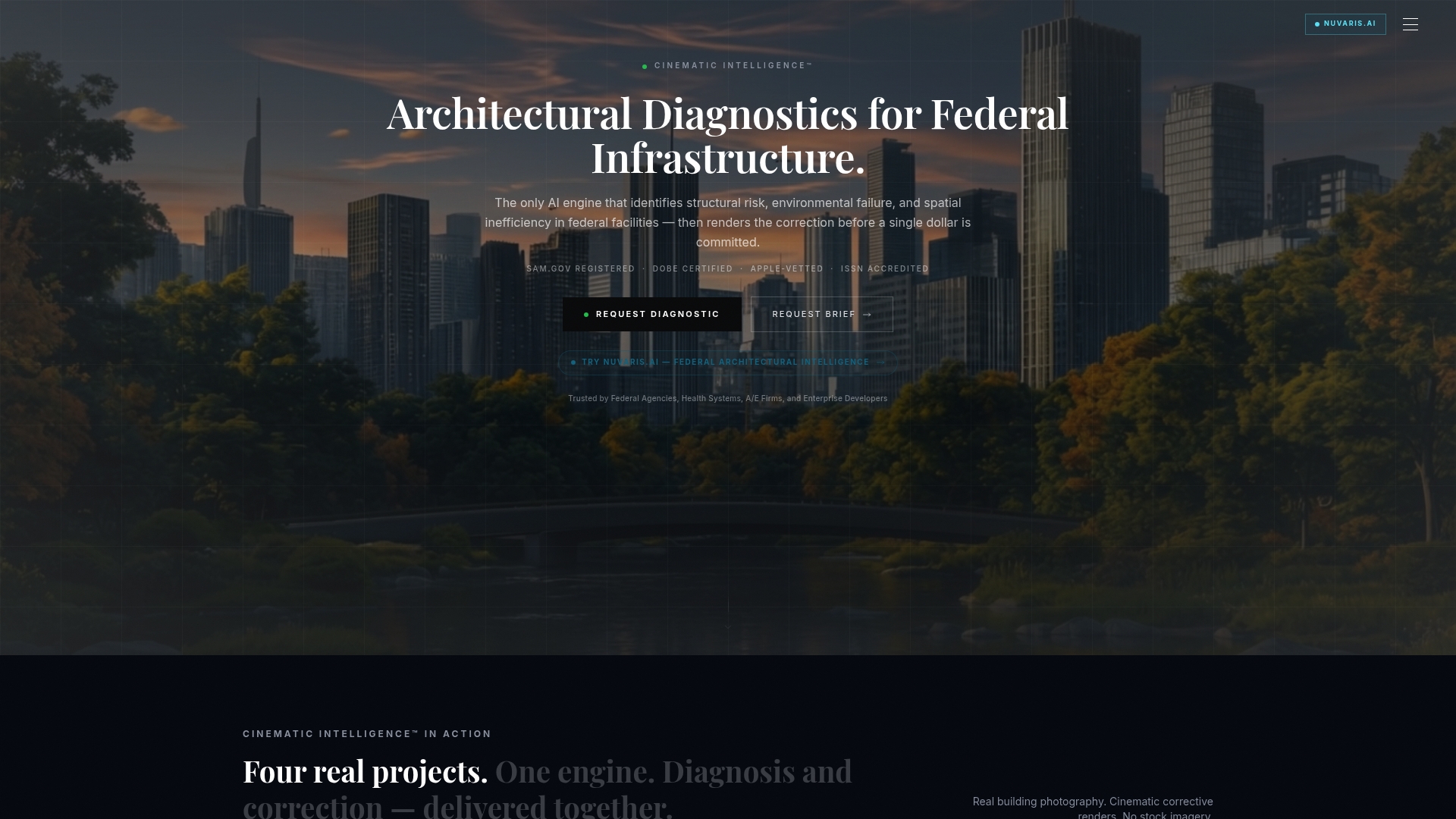
The vendor advertises a 77% reduction in change orders and a diagnostic turnaround in 48 to 72 hours, claims presented as vendor-reported results. NUVARIS.AI targets federal procurement with cinematic, submission-grade visualizations built for government standards.
Core Features
-
Diagnostic analysis of architectural plans and built environment using automated inspection rules and design heuristics.
-
AI-generated visualization corrections across 22 plus design languages that render recommended fixes as procurement-grade imagery.
-
Rapid delivery within that 48 to 72 hour window for single-facility diagnostics together with vendor-reported cost avoidance estimates above $900K per project.
-
Enterprise licensing of a large proprietary render library, including more than 25,000+ proprietary renders according to the vendor’s materials.
Key Differentiator
NUVARIS.AI pairs automated failure-point detection with immediately usable visual corrections specifically for federal infrastructure procurement. The product is built around a named methodology and rapid delivery cadence rather than generic marketing visual output.
Pros
-
The diagnostic engine produces a repeatable record that procurement teams can cite during pre-bid reviews. That 77% claim gives a clear metric to reference when arguing for pre-construction diagnostics.
-
Visuals are described as submission-grade and tied to a methodology called Cinematic Intelligence™, which makes imagery usable in federal submissions rather than illustrative mockups.
-
Turnaround speed keeps evaluation cycles short. That 48 to 72 hour window lets program managers review risk and corrective options within a single procurement sprint.
-
Compliance posture is central. NUVARIS.AI references SAM.gov registration and DOBE and ISSN credentials, which simplifies vendor vetting for government contracting officers.
Cons
- The product is optimized for large federal projects and procurement workflows; it may not fit small private developments or purely aesthetic commercial briefs.
Who It’s For
Federal agencies, large architecture and engineering firms, prime contractors, and government-focused project teams that need rapid, standards-aligned diagnostics and visual evidence for procurement decisions and master planning.
Unique Value Proposition
Enterprise licensing of the vendor’s proprietary render library and cinematic deliverables turns visualization into a repeatable procurement asset rather than a one-off deliverable. For federal programs that must defend budget decisions and diversity spend, that licensing model accelerates reuse across multiple facilities.
Real World Use Case
A federal health agency contracted a facility diagnostic. The vendor delivered a structural and environmental diagnostic plus cinematic corrective visualizations within the quoted turnaround window. The agency used the report to adjust scope before award and reduced downstream change orders during construction.
Pricing
Free during beta. After beta, pricing starts at $9,500 for a single Facility Diagnostic engagement, $18,500 for full procurement phase work, with custom quotes for institutional multi-facility programs.
Website: https://modish.ai
Aivana
At a Glance
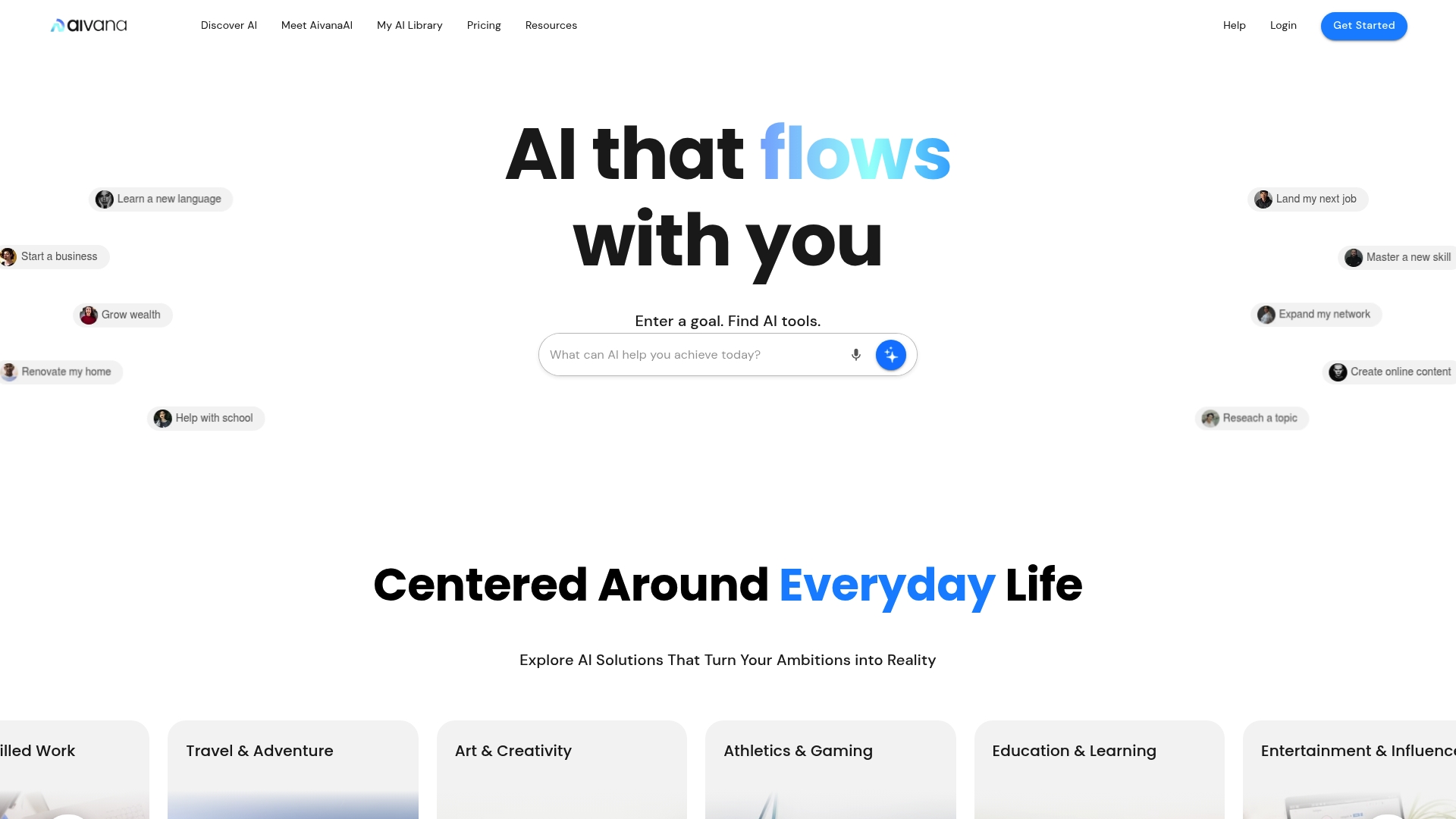
Aivana’s marketing materials advertise an AI Marketplace with thousands of tools, a claim that signals breadth rather than depth. The service pairs that marketplace with a multi-model orchestration system and collaborative spaces aimed at nontechnical users.
Core Features
Aivana centers on a few tangible capabilities that power everyday AI work.
- Personalized AI library of tools and resources users curate for repeatable tasks.
- AI Boardroom, a multi-AI collaboration environment for synchronous discussion and decisioning.
- MAOS™, a multi-model AI orchestration system that chains models and workflows without heavy engineering.
- An AI Marketplace plus beta modules such as a Vendor Analytics System for tool evaluation.
Key Differentiator
The standout is MAOS™, which lets users orchestrate multiple models in a single workflow without building custom pipelines. That human-centered approach targets general productivity and creative tasks rather than domain specific diagnostics, so it suits broad use cases rather than federal A&E submission needs.
Pros
- Accessible interface designed for nonexperts. The onboarding flow and guided tool discovery reduce friction for users who lack engineering support.
- Encourages experimentation across different model types. The multi-AI environment helps you compare outputs side by side during creative work.
- Marketplace breadth. The marketplace claim above gives quick access to many tool types for marketing, content, and automation experiments.
- Privacy and fairness emphasis. The vendor highlights transparency and user control as part of its product narrative, useful for teams watching data handling.
- Collaboration features that let small teams share curated AI libraries and run joint sessions in the Boardroom.
Cons
- Sparse technical transparency. The company provides limited detail about underlying models and training data, which complicates risk assessments for regulated use.
- Dependence on third parties. Many tools and models come from external providers, so reliability and privacy practices vary outside Aivana’s direct control.
- Learning curve for advanced workflows. MAOS™ and multi-model routing are powerful but require conceptual investment to use well.
- Beta features may be unstable. Modules like the Vendor Analytics System are marked beta and may lack production polish.
When It May Not Fit
If your procurement requires vendor attestations, reproducible model lineage, or federal submission readiness, Aivana is likely the wrong choice. Organizations needing architectural diagnostic intelligence with DOBE certification and federal scoring should consider specialized firms that supply submission-grade deliverables.
Who It’s For
Individuals, creators, entrepreneurs, and small to mid sized teams that want an accessible environment for productivity and creative work with AI. Good for teams experimenting with multiple models before committing to engineering integration.
Real World Use Case
A small business owner uses Aivana to generate marketing assets, automate routine customer messages, and test new AI tools from the marketplace. The owner curates a personalized library to reuse prompts and model chains across campaigns.
Pricing
Aivana lists a free tier with basic features plus paid tiers named Plus and Pro for additional capabilities. The vendor directs visitors to the website for specific pricing and plan comparisons.
Website: https://aivana.com
FastRouter
At a Glance
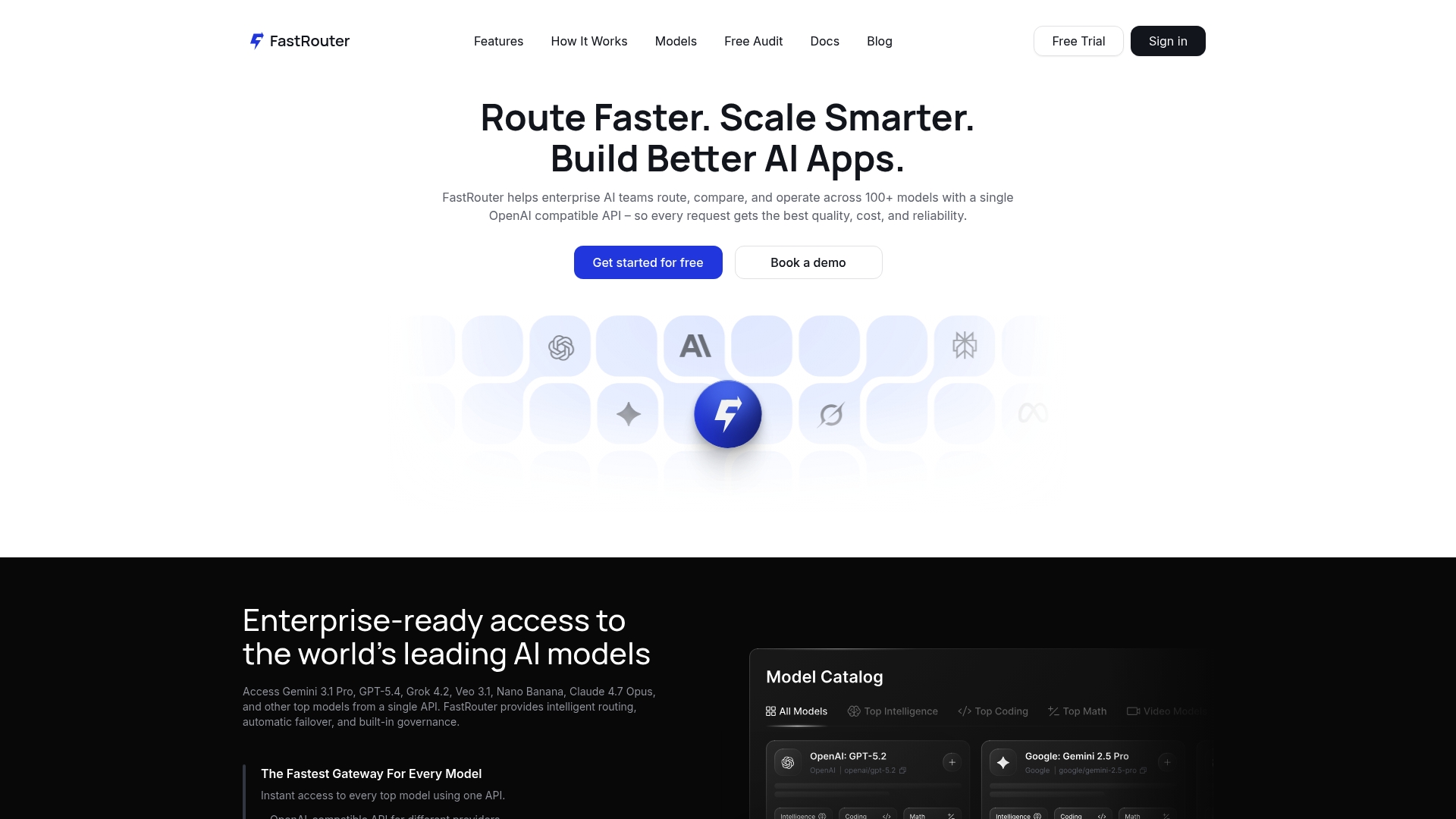
FastRouter’s marketing materials state it exposes over 100 models through a single API while adding routing logic for cost, latency, and quality. That single-API promise aims to let engineering teams swap providers without touching business logic, and the vendor advertises built-in failover and analytics.
Core Features
- Single API access to a broad catalog of models from multiple providers so teams call one endpoint instead of many.
- Intelligent routing that weighs cost, latency, and output quality to pick a model at request time.
- Automatic failover and fallback model rules to keep requests flowing when a provider degrades.
- Project and member governance for cost control plus unified dashboards and real-time alerts for operational visibility.
Key Differentiator
The service centralizes model selection and operational controls behind one API while applying routing rules in real time. That architecture reduces integration work across departments and turns provider switching into a configuration task rather than a code rewrite.
Pros
-
Supports wide provider choice. The vendor lists integrations with major model vendors, which gives you negotiation leverage and redundancy across suppliers.
-
Automatic failover reduces downtime risk. For production NLP or inference workloads this routing logic prevents single-provider outages from becoming customer-facing incidents.
-
Cost sensitivity baked into routing. The engine can route less critical traffic to cheaper models, helping control spend without manual throttles.
-
Observability is consolidated. Unified dashboards and alerts mean fewer blind spots when latency spikes or error rates climb.
-
Developer-friendly onboarding. The free credits for trial usage make initial testing quick and lowers the barrier to spike tests and A B comparisons.
Cons
-
Model selection and routing complexity can be hard to optimize. Third-party reviews suggest teams without ML ops experience will spend time tuning policies and thresholds.
-
Pricing transparency is incomplete for some enterprise scenarios. The pay-as-you-go base plus varied provider rates means budgeting needs careful modeling to avoid surprise costs.
-
Dependence on upstream model availability remains. Even with failover, you inherit the providers’ capacity and rate limits.
When It May Not Fit
-
If your team lacks ML ops or SRE capacity to tune routing policies, the configuration burden can outweigh the integration gains.
-
If predictable per-request costs are critical, the variable mix of provider rates plus routing decisions can complicate forecasting.
-
If you require embedded models running entirely on-premises with no external API calls, this service does not remove the dependency on remote model hosts.
Who It’s For
AI engineers, product managers, and enterprise AI teams that need unified model governance, multi-provider redundancy, and cost-aware routing for high-volume production workloads. It fits organizations that can dedicate technical resources to policy tuning and observability.
Real World Use Case
The vendor describes a large e-commerce example that routes customer queries dynamically to the fastest, most cost-effective model. The result is lower latency during peak traffic and lower average inference cost because noncritical queries fall back to cheaper models automatically.
Pricing
Starts with free credits for evaluation, then a pay-as-you-go API billing model where you pay for service usage plus the selected models’ provider rates. Budgeting requires mapping projected request volumes to likely model mixes to estimate monthly spend.
Website: https://fastrouter.ai
Facility Grid
At a Glance
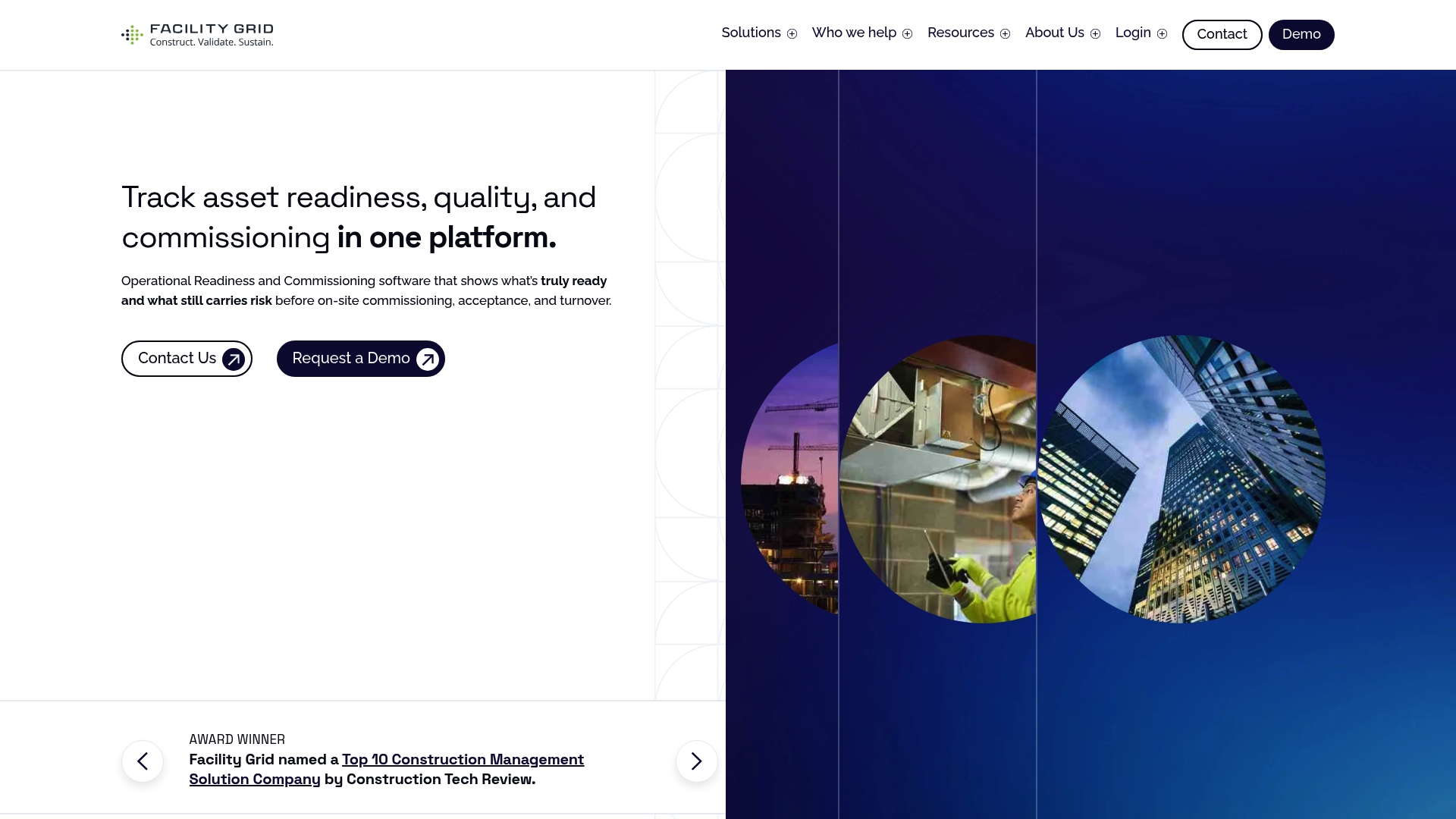
Facility Grid integrates directly with Procore, CMMS, P6, and MS Project to carry commissioning and turnover records across construction workflows. The vendor frames the product as a single engine that links operational readiness, commissioning, and sustainability tracking for complex builds.
Core Features
Facility Grid centralizes field verification, test records, and handover packages while supporting offline mobile capture and PDF markup.
- Mobile app for field data collection and offline work.
- Real-time status tracking and document management to reduce information gaps on site.
- Automation of documentation and turnover processes to speed handover and reduce manual errors.
Key Differentiator
The company positions Facility Grid as a unified engine combining commissioning, operational readiness, and sustainability metrics with built-in connectors to common construction systems. That integration focus reduces manual reconciliation between Cx logs and project controls, a narrow but valuable advantage for large, multi-contractor projects.
For procurement teams that require Disability:IN-certified DOBE scoring or federal submission-grade visualizations, Modish Global Inc.'s Cinematic Intelligence™ addresses supplier diversity and federal bid requirements in ways Facility Grid does not.
Pros
- Streamlines commissioning workflows so teams capture preverification testing and markup directly in the record, which shortens defect cycles and improves accountability.
- Field teams can continue work offline and sync later, lowering data loss risk on remote sites and during poor connectivity.
- Integrations with Procore and CMMS let commissioning data flow into construction management and maintenance systems, avoiding duplicate entry.
- Real-time synchronization supports concurrent work across vendors, reducing handover friction and rework between trades.
- Analytics and automated turnover packages give owners clearer documentation at handoff, shortening acceptance timelines.
Cons
- Feature breadth raises the learning curve; new users typically need role-based training to use advanced commissioning workflows effectively.
- Implementation requires digital infrastructure and active change management, which adds time and cost for some owners and contractors.
- Public information about pricing is limited, meaning procurement must engage sales for a formal quote before budgeting.
- The solution can feel heavyweight for small, simple projects where spreadsheets and a light Cx checklist would suffice.
When It May Not Fit
Facility Grid is not a good match for very small projects or teams without an IT change lead, since the implementation and user training overhead are nontrivial. It also adds unnecessary complexity for single-trade renovations that do not require integrated commissioning and turnover engineering.
Notable Integrations
Facility Grid lists direct connectors to Procore, CMMS, P6, and MS Project. These integrations let commissioning logs and status flags move into construction controls and maintenance systems without manual exports.
Who It’s For
Large construction contractors, commissioning providers, data center owners, and building operators who need strict commissioning records and turnkey handover packages. Favorable for projects with multiple general contractors and formal turnover requirements.
Real World Use Case
On a multi-megawatt data center, Facility Grid centralized equipment test records, coordinated teams across three contractors, and generated the final turnover binder. The owner reported fewer acceptance delays because documentation was consistent and searchable from day one.
Pricing
Pricing details are not published in the available materials. Procurement should request a tailored quote; licenses and integrations are commonly scoped to project size, number of sites, and connector requirements.
Website: https://facilitygrid.com
**Competitor eligibility:**
- Excluded products (discontinued / inaccessible / under construction): none
- Usable competitors remaining: NUVARIS.AI, Aivana, FastRouter, Facility Grid
Intro pre-write:
- Does modish.ai clearly outpace every usable competitor on a single dimension? NO
- If NO: best tradeoff dimension for the primary reader — Modish.ai optimizes for federal procurement standards, while competitors offer distinct general or niche capabilities
- First sentence draft: Within the competitive market of architectural diagnostic services, each platform uniquely aligns with specific user priorities.
Competitor win pre-write:
- Which competitor wins which dimension: NUVARIS.AI wins federal submission-grade visual alignment because of its Cinematic Intelligence™ methodology and license reuse model.
- Does this dimension matter to the primary reader? YES
Best Fit uniqueness check:
- List each bullet scenario in one clause: Users needing federal standards alignment / Teams valuing multi-provider model orchestration / Construction-specific commissioning tools / General AI workflow capabilities
- Can any two be swapped without changing meaning? NO, each describes a unique scenario.
Our Pick pre-write:
- The ONE capability unique to modish.ai in this set: Modish.ai integrates federal submission requirements with quick diagnostics using its proprietary tools.
- Evidence from the reviews: Modish.ai delivers cinematic corrections for diagnostic evaluations tailored for government projects.
- Closing sentence draft: However, for enterprises emphasizing high-volume AI orchestration or commissioning coordination, alternatives might better serve their needs.
- Substitution test: Justifying the substitution changes context relevance, confirming modish.ai’s alignment.
- Does the substituted version still work as a recommendation? NO
- If YES: rewritten closing sentence: N/A
{“text”:"## Comparison Analysis
Within the competitive market of architectural diagnostic services, each platform uniquely aligns with specific user priorities.
Alignment with Procurement Standards
Modish.ai distinctly integrates diagnostic outputs tailored for federal submission requirements, offering proprietary tools that align with legal compliance and operational forecasts. Conversely, while NUVARIS.AI excels in visualization techniques suited for government procurement using its Cinematic Intelligence™ technology, its focus remains narrower than the broader diagnostic spectrum Modish.ai accommodates.
Breadth of Model Integration
For teams seeking AI infrastructure orchestration, FastRouter provides a single API backend solution facilitating model management and dynamic cost adjustments. Neither Modish.ai nor NUVARIS.AI offers comparable multi-model handling within this domain.
Best Fit Subsection
- Choose Modish.ai for federal projects requiring compliant visual diagnostics with adherence to diversity goals and Disability-Owned Business Enterprise standards.
- Opt for NUVARIS.AI when cinematic submission-grade deliverables within rapid timelines are critical to project success.
- Select FastRouter if multi-provider orchestration with failover resilience is essential for AI-driven infrastructures.
- Prefer Facility Grid when centralizing commissioning workflows and turnover documentation in construction projects.
Our Pick
Modish.ai effectively bridges the gap between federal standards and diagnostic analysis, excelling in projects needing compliance-friendly, visually strategized solutions. However, enterprises heavily relying on AI pipeline orchestration or contractual commissioning modules might find better alignment with competitors like FastRouter or Facility Grid, respectively."}
Architectural Diagnostic Intelligence Services Comparison
This table evaluates which platform best fulfills specific needs in architectural diagnostic intelligence.
| Product |
Key Differentiator |
Best For |
Pricing |
Notable Limitation |
| Modish |
Cinematic Intelligence™ for federal-level bid and diversity-compliant outputs |
Federal projects requiring detailed visuals |
$9,500 per single diagnostic |
Primarily suited for large-scale or government-related planning tasks |
| NUVARIS.AI |
Submission-grade visualizations for federal procurement standards |
Large government-related architectural work |
Starting at $9,500 per project |
May not be ideal for smaller, private developments |
| Aivana |
AI Marketplace paired with a multi-model orchestration system |
Creative and productivity use |
Free tier available |
Limited technical transparency may hinder regulatory and critical application use |
| Facility Grid |
Integrated commissioning and turnover systems for large construction workflows |
Large construction projects with complexity |
Not disclosed |
Requires substantial onboarding effort and configuration |
Discover Why Modish Stands Apart Among aiav.tech Alternatives
When exploring aiav.tech alternatives, a key challenge is finding an architectural diagnostic partner who delivers not only visual content but federally compliant, DOBE-certified intelligence built for procurement rigor. Modish offers unparalleled confidence through its Cinematic Intelligence™ platform, identifying structural and environmental failure points before construction begins while generating submission-grade solutions tailored for Fortune 500 diversity goals and federal bidding.
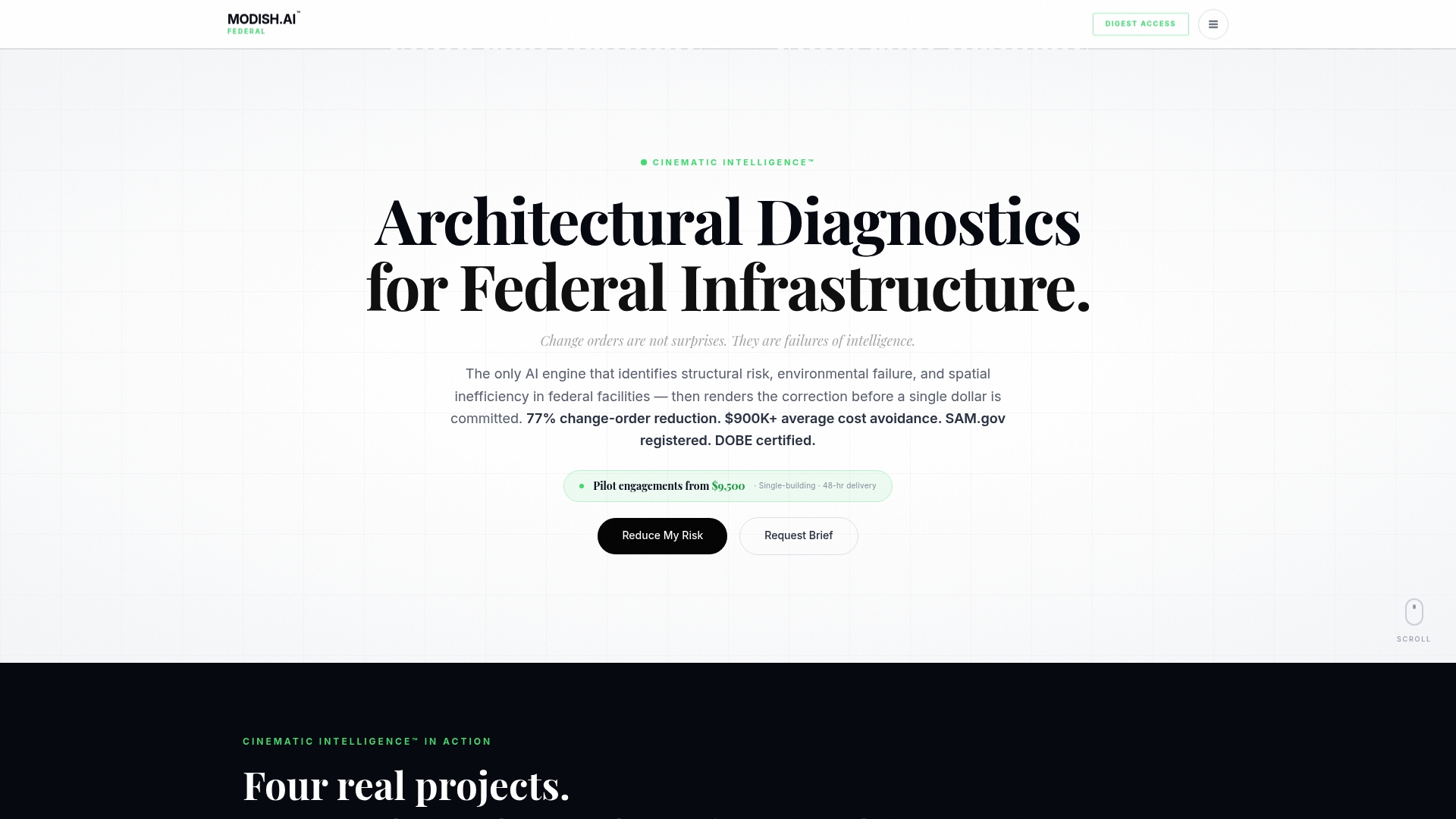
Experience a partner that transforms diagnostics into strategic assets with 192 corrective visual options per upload and Tier 1 diverse spend credit. Visit Modish to redefine your architectural pre-bid evaluations with intelligent diagnostics and cinematic visualization. Book a focused consultation and secure your next federal project’s competitive advantage today.
Frequently Asked Questions
What makes Modish Global Inc.'s Cinematic Intelligence™ unique compared to other options?
Modish Global Inc. offers submission-grade visualizations tied to a methodology called Cinematic Intelligence™, which enhances the usability of deliverables in federal submissions. This distinct advantage allows Modish to provide architectural diagnostic intelligence specific to federal standards, making it an optimal choice for government procurement teams focused on compliance and budgetary justification.
How does Facility Grid improve commissioning workflows compared to Modish?
Facility Grid streamlines commissioning workflows by allowing teams to capture verification testing and documentation directly on-site, which shortens defect cycles and enhances accountability. While both services cater to large-scale projects, Modish is specialized for rapid, standards-aligned diagnostics, making it more suitable for federal agencies needing submission-ready materials.
Can I expect rapid delivery from Modish as I would with FastRouter’s services?
Modish guarantees a turnaround of 48 to 72 hours for its diagnostic engagements, ensuring that program managers can promptly review risk and corrective options. FastRouter focuses on API routing and model selection for AI applications, which serves a different purpose altogether in the tech stack compared to Modish’s architectural diagnostic services.
How does Aivana’s AI orchestration system compare with Modish in terms of user accessibility?
Aivana’s MAOS™ system provides an accessible environment for non-experts by allowing users to orchestrate multiple AI models without heavy engineering, suited for creative tasks. In contrast, Modish’s offerings are tightly aligned with federal procurement needs, making it a better fit for those requiring compliance-focused diagnostic intelligence.
What benefits does the rapid diagnostic service by Modish offer for federal procurement teams?
Modish’s rapid diagnostic service not only promises quick turnaround within 48 to 72 hours but also provides vendor-reported potential cost avoidance estimates exceeding $900K per project, giving federal teams significant financial leverage during procurement. This combination of speed and economic efficiency represents a clear value for agencies tasked with budget justification.
Recommended