A&E Teaming Workflow for Federal Projects: 2026 Guide
A&E Teaming Workflow for Federal Projects: 2026 Guide
TL;DR:
- An effective federal A&E teaming workflow integrates project phases, data sharing, and communication protocols to prevent costly rework. Modish adds diagnostic intelligence that surfaces compliance issues early, shifting pre-design from reactive to proactive. Structured gate reviews and digital collaboration tools are essential for project success and compliance.
An effective A&E teaming workflow is a structured process that integrates project phases, resource planning, and communication protocols to enable architecture and engineering teams to collaborate on federal projects without losing time, money, or compliance standing. The AEC industry loses approximately €2 trillion annually due to fragmentation and misalignment. That figure is not a rounding error. It is the cost of teams working in silos, passing incomplete information across disciplines, and discovering conflicts too late to fix cheaply. Established frameworks like the PMBOK process groups and AIA phased design milestones exist precisely to prevent that loss. Modish Global Inc. adds Architectural Diagnostic Intelligence™ to this equation, giving federal A&E teams a pre-construction diagnostic layer that no other DOBE-certified firm in the country provides.
What are the key components of an A&E teaming workflow?
A federal A&E teaming workflow requires five foundational elements before any design work begins. Without all five in place, coordination breaks down at the first phase gate.
- Phase-based work breakdown structure. Federal contracts require deliverables tied to specific milestones. A work breakdown structure aligned to those milestones gives every team member a clear scope ceiling and prevents scope creep from eroding fixed-fee margins. Phase-level tracking prevents hidden margin erosion before billing cycles close.
- Common Data Environment (CDE). A CDE functions as a single source of truth for models, documents, and decisions. Proactive co-authoring via CDE reduces data silos and replaces the reactive, email-driven coordination that causes most rework.
- Centralized staffing and scheduling visibility. Teams that adopt phase-based scheduling engines achieve up to 8x faster staffing, 4x faster billing, and a 75% reduction in unbilled fees. That is the operational difference between a profitable federal contract and a margin-eroded one.
- Formalized communication protocols. Verbal agreements do not survive a federal audit. Every handoff between disciplines requires a documented record, a named reviewer, and a date stamp.
- Cloud-based collaboration engine. Generic file-sharing tools cannot connect models, issues, and decisions in real time. A purpose-built collaboration engine ties all data streams to live project phases.
Pro Tip: Set task ceilings at the sub-phase level, not just the phase level. Short ceilings surface budget drift weeks before a billing cycle closes, giving project managers time to act.
How to design a step-by-step A&E teaming workflow for federal projects
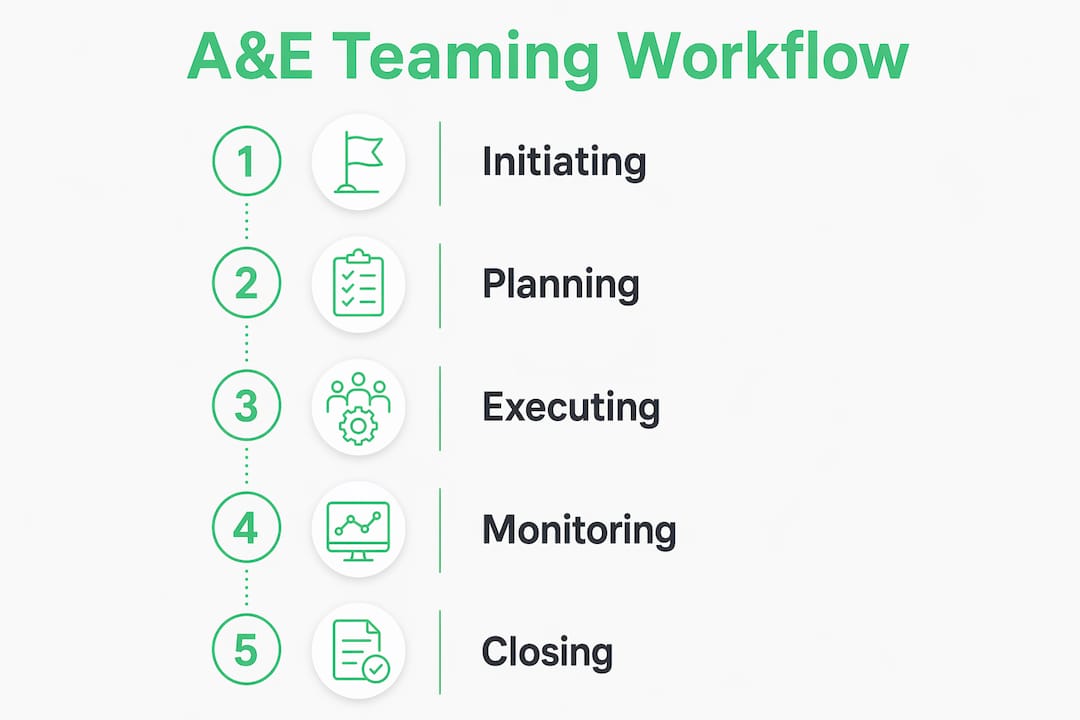
A well-designed federal A&E collaboration process follows the PMBOK five process groups: Initiating, Planning, Executing, Monitoring and Controlling, and Closing. Each group maps directly to a federal contract phase and carries its own gate criteria.
- Initiating. Define the teaming structure, assign discipline leads, and register the project in SAM.gov-compatible tracking. Confirm DOBE, SDVOSB, or WOSB teaming credits at this stage, not after award.
- Planning. Build the phase-based work breakdown structure. Assign task ceilings. Establish the CDE. Document the communication protocol, including who approves submittals and in what sequence.
- Executing. Run daily BIM coordination sessions. Integrating clash detection into the daily routine replaces milestone-only coordination and prevents late-stage firefighting. Connect construction scheduling software to live phase data so resource decisions reflect actual progress.
- Monitoring and Controlling. Track percentage complete against percentage spent at the task level. Use critical path method scheduling and weekly short interval scheduling to catch slippage early. Architectural Diagnostic Intelligence™ surfaces structural and code compliance failure points before they become change orders.
- Closing. Conduct a formal gate review with documented handoffs. Archive all decisions in the CDE. Capture lessons learned in a structured format that feeds the next pursuit.
The table below maps each process group to its primary federal deliverable and the tool category that supports it.
| PMBOK Process Group |
Federal Deliverable |
Tool Category |
| Initiating |
Teaming agreement, SAM.gov registration |
Contract management engine |
| Planning |
Work breakdown structure, schedule baseline |
Phase-based scheduling engine |
| Executing |
BIM coordination, clash reports |
CDE with model co-authoring |
| Monitoring and Controlling |
Progress reports, budget variance |
Phase-linked live data engine |
| Closing |
Closeout package, lessons learned |
Document archive and CDE |
Pro Tip: Treat DesignVault 3D™ as your closeout archive, not just a visualization tool. Federal contracting officers increasingly expect submission-grade 3D documentation at project close.
What common challenges arise in A&E teaming workflows?
Fragmentation is the most expensive problem in federal A&E project management. It does not announce itself. It accumulates quietly through missed handoffs, undocumented decisions, and discipline leads who assume someone else confirmed a coordination item.
- Reactive coordination. Most teams discover conflicts at model review meetings. By then, the design is committed and the fix costs multiples of what early detection would have. Daily clash detection closes this coordination gap before it becomes a change order.
- Loose verbal agreements. A verbal confirmation from a structural engineer does not protect an architect when a federal inspector flags a non-compliant detail. Every decision requires a documented record in the CDE.
- Invisible margin erosion. Fixed-fee federal contracts punish teams that cannot track percentage complete against percentage spent at a granular level. Without short task ceilings, budget drift hides until it is too late to recover.
- Staffing misalignment. Assigning the wrong resource to a phase-critical task delays submittals and triggers cascading schedule impacts. Centralized staffing visibility prevents this by surfacing availability and utilization in real time.
“Structured gate mechanisms with formal, documented handoffs between disciplines are non-negotiable for high-stakes federal projects. Without them, quality lapses and timeline drift are not risks. They are certainties.” — AEEF, Agent Orchestration in A&E Workflows
The fix for most of these problems is the same: move from reactive issue management to proactive, documented coordination embedded in the daily workflow. AI-driven issue tracking tied directly to BIM models gives project managers a live view of where conflicts exist before they become contract liabilities.
How can A&E project managers use technology to improve teaming outcomes?
Technology selection is the wrong starting point. Digital integration succeeds only when organizational delivery strategy aligns with collaborative workflows. A firm that installs a CDE but keeps its discipline leads working in separate file folders has not changed anything. The tool is inert without the process.
The shift that actually moves the needle is from reactive coordination to proactive design co-authoring. Real-time shared models, where architects and engineers work in the same environment simultaneously, eliminate the version-control conflicts that generate most rework. Intelligence engines in A&E connect models, documents, issues, and decisions into a single operational view that project managers can act on without waiting for a weekly status meeting.
Cinematic Intelligence™ takes this further by rendering corrective solutions in federal submission-grade visualization. When a structural failure point surfaces during pre-design, Cinematic Intelligence™ produces 192 corrective visualization options per Space, giving contracting officers and design leads a concrete decision set rather than an abstract problem. Pre-design risk identification at this resolution changes the economics of federal A&E pursuits entirely.
Continuous improvement requires the same discipline as the workflow itself. Lessons learned must be captured in a structured format, linked to the phase where the issue originated, and reviewed at the start of every new pursuit. Teams that treat lessons learned as a checkbox at project close repeat the same coordination failures on the next contract.
Pro Tip: Synchronize billing cycles to phase gate completions, not calendar dates. This single change reduces unbilled fees and gives contracting officers a cleaner audit trail.
Key Takeaways
A federal A&E teaming workflow succeeds when phase-based structure, a Common Data Environment, and formalized gate reviews operate together as a single system, not as separate tools.
| Point |
Details |
| Phase structure protects margins |
Short task ceilings at the sub-phase level expose budget drift before billing cycles close. |
| CDE replaces reactive coordination |
A Common Data Environment enables real-time co-authoring and eliminates version-control rework. |
| Gate reviews are non-negotiable |
Documented handoffs between disciplines prevent quality lapses and timeline drift on federal projects. |
| Organizational alignment drives results |
Technology alone does not fix fragmentation. Delivery strategy must align with digital workflows. |
| Diagnostic intelligence changes pre-design |
Architectural Diagnostic Intelligence™ surfaces compliance failure points before construction commits. |
What I have learned from federal A&E teaming in practice
The most consistent failure I see in federal A&E collaboration is not a technology gap. It is a gate review gap. Teams skip the formal handoff because the schedule feels tight, and they pay for it in the Monitoring and Controlling phase when a compliance issue surfaces that a 30-minute gate review would have caught in week two.
Architectural Diagnostic Intelligence™ changes the pre-design conversation entirely. When you can show a contracting officer 192 corrective visualization options for a structural failure point before a single construction dollar is committed, the project dynamic shifts from reactive problem-solving to informed decision-making. That is not a marginal improvement. It is a different category of service.
Early alignment among architects, engineers, and contracting officers is the single highest-leverage activity in any federal pursuit. Get the teaming structure, the CDE, and the communication protocol agreed upon before the notice to proceed. Everything downstream moves faster when the foundation is set. AI-driven workflows accelerate execution, but human oversight at the gate review level remains the quality control mechanism that federal compliance demands.
— Ben
Modish and the federal A&E teaming advantage
Federal A&E teams working on government pursuits need more than a collaboration checklist. They need a teaming partner who adds measurable value to the proposal and to the project itself.
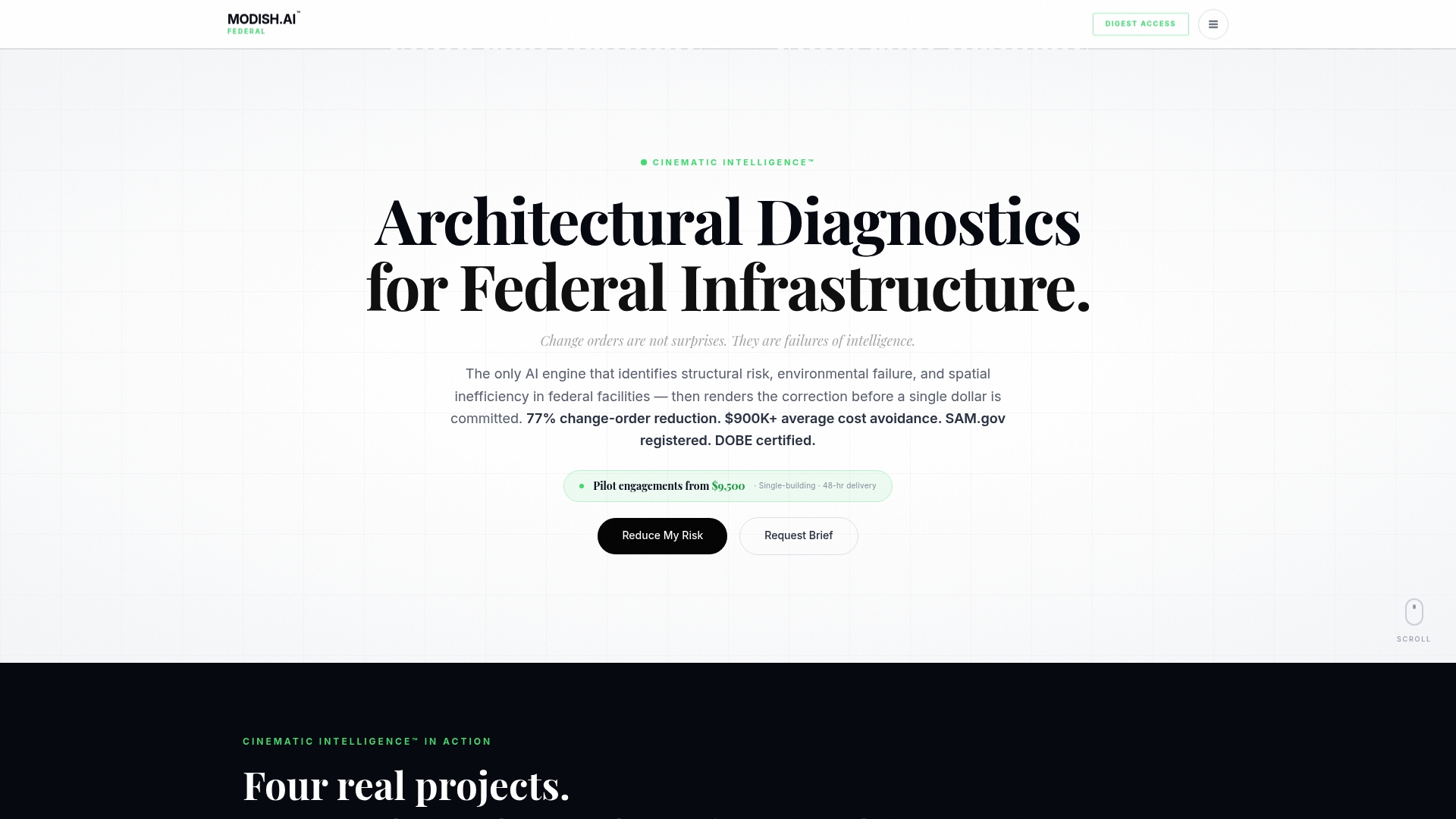
Modish is the only Disability:IN-certified DOBE in Architectural Diagnostic Intelligence™ in the United States. As a teaming subcontractor, Modish adds DOBE diversity scoring to federal proposals while delivering Cinematic Intelligence™, Multiplicity Modeling™, and DesignVault 3D™ for pre-bid evaluation and master planning. Engagements begin at $9,500 for a single-facility pilot. Modish is SAM.gov registered and teamed under READIGOV (SDVOSB/WOSB prime) for complete federal execution. Review federal past performance or explore pilot program options to see how Modish fits your next pursuit.
FAQ
What is an A&E teaming workflow?
An A&E teaming workflow is a structured collaboration process that integrates project phases, roles, communication protocols, and data environments to coordinate architecture and engineering disciplines on a shared project. Federal applications require alignment with PMBOK process groups and AIA phased milestones.
Why does the AEC industry lose so much to fragmentation?
The AEC industry loses approximately €2 trillion annually because disciplines work in data silos, pass incomplete information at handoffs, and discover conflicts too late to resolve without costly rework. Centralized collaboration environments and formalized gate reviews are the primary remedies.
What is a Common Data Environment in federal A&E projects?
A Common Data Environment is a shared digital infrastructure where all project models, documents, issues, and decisions are stored and accessed in real time. It replaces email-based coordination and serves as the single source of truth for all disciplines on a federal project.
How does Architectural Diagnostic Intelligence™ improve teaming workflows?
Architectural Diagnostic Intelligence™ identifies structural, environmental, and code compliance failure points before construction commits, then renders corrective solutions in federal submission-grade visualization. This shifts pre-design from reactive problem discovery to proactive, documented decision-making.
How do phase-based task ceilings protect fixed-fee federal contracts?
Phase-based task ceilings set a budget limit at the sub-phase level, allowing project managers to track percentage complete against percentage spent in real time. This granular visibility surfaces margin erosion weeks before a billing cycle closes, giving teams time to correct course.
Recommended