Intelligence in Master Planning: A 2026 Guide
Intelligence in Master Planning: A 2026 Guide

TL;DR:
- Intelligence in master planning integrates AI reasoning and data analytics to transform static plans into adaptive, decision-making systems. It accelerates workflows, improves accuracy, and enables scenario modeling that considers multiple futures and risks before capital investment. This approach ensures transparent decision justification and enhances stakeholder trust in urban and infrastructure development projects.
Intelligence in master planning is defined as the systematic integration of AI-powered reasoning, data analytics, and scenario modeling into the spatial and strategic decisions that shape cities, campuses, and federal facilities. The role of intelligence in master planning extends far beyond mapping. It converts static land-use diagrams into adaptive decision systems that can evaluate policy trade-offs, quantify infrastructure risk, and generate multiple coherent futures before a single dollar commits to construction. Tools like GeoAI, AI-powered digital twins, and Modish’s Architectural Diagnostic Intelligence™ are redefining what planners can know, and when they can know it.
How does intelligence improve accuracy and speed in master planning?
GeoAI capabilities simplify master plan preparation through object detection, pattern recognition, and predictive mapping. These functions reduce the manual labor traditionally required for basemap preparation and land-use classification. Raster-vector conversion and spatio-temporal detection, once multi-week tasks, compress into hours when AI handles the processing layer.

The accuracy gains are structural, not cosmetic. Advanced planning agents like SPIRAL achieve 83.6% accuracy in complex planning tasks using a three-agent architecture: Planner, Simulator, and Critic. That architecture mirrors how the best project managers already think, except it operates at machine speed across thousands of variables simultaneously.
For urban planners and architects, the practical result is fewer approval delays and stronger stakeholder communication. When AI generates the basemap and flags inconsistencies before the first public meeting, the conversation shifts from correcting errors to evaluating options. That shift saves weeks on federal A&E timelines.
- Object detection automates feature extraction from satellite and aerial imagery, removing manual digitizing from basemap workflows.
- Pattern recognition identifies land-use anomalies and zoning conflicts that human review misses at scale.
- Predictive mapping models growth corridors and infrastructure stress points before design begins.
- Spatio-temporal detection tracks change over time, giving planners a dynamic baseline rather than a frozen snapshot.
Pro Tip: Integrate GeoAI incrementally. Start with basemap automation on a single district before deploying it across a full master plan. Systematic adoption prevents data governance failures that derail larger rollouts.
Why master planning requires intelligent scenario evaluation
Spatial reasoning produces representations, not decisions. A beautifully rendered land-use diagram tells you what could go where. It does not tell you which option survives a 20-year infrastructure stress test or a regulatory shift. That gap is where intelligent planning strategies become non-negotiable.
AI enables structured decision logic: scenario generation, explicit trade-off evaluation, and prioritization of conflicting objectives across policy, economic, and environmental parameters. Real estate master planning is moving from assumption-led to probability-informed strategies. That shift means planners no longer present a single forecast. They present a probability-weighted set of futures, each stress-tested against financial viability, infrastructure capacity, and regulatory frameworks.
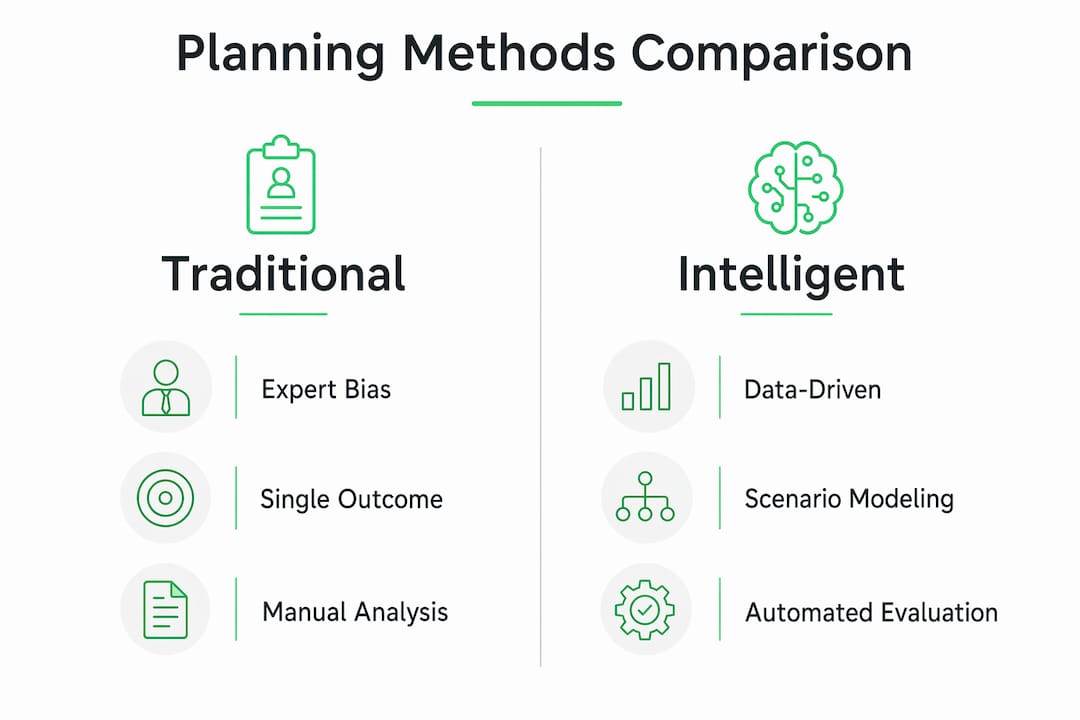
The table below shows where traditional and intelligent master planning diverge most sharply.
| Dimension |
Traditional Master Planning |
Intelligent Master Planning |
| Decision basis |
Expert intuition and precedent |
Data-driven scenario modeling |
| Scenario output |
Single preferred plan |
Multiple probability-weighted futures |
| Trade-off handling |
Iterative, slow negotiation |
Explicit, documented evaluation |
| Stakeholder communication |
Static drawings and reports |
Interactive, data-supported justifications |
| Risk identification |
Post-design review |
Pre-commitment diagnostic |
Premature convergence on a single design reduces flexibility and exposes projects to costly redesign. Intelligence prevents that by holding multiple coherent futures simultaneously. For project managers on federal pursuits, this is not a theoretical benefit. It is the difference between a proposal that survives peer review and one that does not.
The PM Gati Shakti National Master Plan demonstrates what AI-driven predictive modeling looks like at national scale. It uses 38,000+ GPUs to evaluate infrastructure projects worth Rs 16.1 trillion, optimizing risk before capital commitment. That is not a pilot program. It is a governance model that treats AI as core infrastructure, not an add-on.
AI-powered digital twins allow planners to simulate infrastructure behavior under varying conditions before committing capital. Sensors, simulation engines, and analytics combine to create precision scenario testing environments. A highway interchange, a federal campus, or a mixed-use district can be run through decades of simulated load, climate stress, and regulatory change before the design development phase begins.
For architects and project managers, the practical workflow shift looks like this:
- Define the decision parameters. Identify which variables, capacity, cost, compliance, resilience, carry the highest risk weight for the specific project.
- Build the digital twin baseline. Ingest existing facility data, site conditions, and regulatory constraints into the simulation environment.
- Run probabilistic scenarios. Generate multiple futures across the defined parameters, not a single optimized output.
- Document trade-offs explicitly. Record which scenarios were rejected and why. This documentation is critical for federal approval processes.
- Commit to design with evidence. Move into design development with a documented decision record, not a gut-driven preference.
Pro Tip: Governance-first AI adoption is not optional on federal projects. Transparent trade-off documentation converts opaque model outputs into defensible justifications that satisfy contracting officers and public stakeholders alike.
What practical changes does intelligence bring to planners and architects?
Master planning is evolving from fixed, single-plan delivery toward iterative stewardship. Planners who understand this shift function less as fixed-object designers and more as adaptive urban gardeners tending dynamic systems with continuous feedback loops. That metaphor is precise. A garden requires ongoing intervention, not a single planting event.
The importance of data in planning is clearest when reasoning-capable agents produce transparent, value-based justifications rather than black-box outputs. Statistical learning alone cannot satisfy a federal contracting officer or a city council. The reasoning layer matters as much as the prediction layer.
For your day-to-day practice, intelligence integration produces these concrete shifts:
- Scenario awareness replaces single-plan thinking. You hold multiple futures concurrently and test each against real constraints before committing.
- Stakeholder communication becomes data-supported. Design decisions arrive with documented justifications, not just visual presentations.
- Human judgment integrates with AI insight. The Data-Design-Decision architecture augments your expertise rather than replacing it.
- Pre-commitment diagnostics replace post-design reviews. Risk surfaces before capital commits, not after.
Modish’s Cinematic Intelligence™ and Multiplicity Modeling™ operationalize these shifts for federal and commercial master planning engagements. The role of AI in pre-design is no longer experimental. It is the standard for any project where approval timelines and compliance risk carry real cost.
Key takeaways
Intelligence in master planning is the critical layer that converts spatial representation into defensible, probability-informed decisions across policy, infrastructure, and design.
| Point |
Details |
| GeoAI accelerates basemap work |
Object detection and predictive mapping compress multi-week tasks into hours. |
| Scenario modeling replaces single forecasts |
Probability-weighted futures stress-test assumptions before capital commits. |
| Digital twins quantify infrastructure risk |
Simulate decades of load and regulatory change before design development begins. |
| Governance-first adoption is non-negotiable |
Transparent trade-off documentation satisfies federal approvals and stakeholder trust. |
| Planners become adaptive stewards |
Iterative feedback loops replace fixed-plan delivery as the professional standard. |
Intelligence is the profession’s next threshold
I have watched master planning projects stall not because the design was wrong, but because the decision logic was invisible. A plan arrived, stakeholders pushed back, and the team had no documented basis for the choices they had made. That is a governance failure, not a design failure.
What intelligence actually does is make the reasoning visible. When Modish deploys Architectural Diagnostic Intelligence™ on a federal facility, the output is not just a corrected visualization. It is a documented decision record: 192 corrective options per Space, each tied to a specific failure point, each traceable to a code or structural parameter. That record is what survives a procurement review.
The planners I respect most have already stopped treating AI as a drafting accelerator. They use it as a reasoning partner. They hold five futures at once, document why four were rejected, and present the fifth with evidence. That practice, combined with tools like DesignVault 3D™ and Multiplicity Modeling™, is what separates proposals that win from proposals that explain why they lost.
The profession’s next threshold is not spatial. It is epistemic. The question is no longer what you can draw. It is what you can justify.
— Ben
How Modish brings architectural diagnostic intelligence™ to master planning
Modish Global Inc. is the only Disability:IN-certified DOBE architectural diagnostic intelligence firm in the United States. For federal A&E teams and Fortune 500 project managers, that distinction carries procurement weight that no other firm in any supplier database can replicate.
Modish’s Cinematic Intelligence™ engine identifies structural, environmental, and code compliance failure points before construction commits, then renders corrective solutions in federal submission-grade visualization. DesignVault 3D™ delivers 192 corrective visualization options per Space, purpose-built for pre-bid evaluation and master planning risk identification. Engagements start at $9,500 for single-facility pilots and scale to $150,000+ for enterprise licenses. Explore Architectural Diagnostic Intelligence™ to see how Modish positions your next federal pursuit ahead of the field.
FAQ
What is the role of intelligence in master planning?
Intelligence in master planning integrates AI reasoning, data analytics, and scenario modeling into spatial and strategic decisions. It converts static plans into adaptive, probability-informed systems that evaluate trade-offs before capital commits.
How does GeoAI improve master plan preparation?
GeoAI simplifies master plan preparation through object detection, pattern recognition, and predictive mapping, reducing delays and improving accuracy in basemap and land-use classification workflows.
Why is scenario modeling critical in intelligent planning?
Scenario modeling prevents premature convergence on a single design by holding multiple coherent futures simultaneously. Probability-informed strategies allow planners to stress-test assumptions and document trade-offs for stakeholder and regulatory review.
What is a governance-first approach to AI in urban development?
A governance-first approach documents trade-offs and constraints transparently, converting AI model outputs into data-supported justifications. This practice is critical for federal project approvals and public stakeholder trust.
How do digital twins support infrastructure master planning?
AI-powered digital twins simulate infrastructure behavior under varying conditions before capital commits, integrating sensors, simulation engines, and analytics for precision scenario testing across capacity, climate, and regulatory variables.
Recommended