Architecture Risk Analysis Process: A Practical Guide
Architecture Risk Analysis Process: A Practical Guide
TL;DR:
- Effective architecture risk analysis begins early in projects, organizing risks by domains to prevent costly errors post-decision. Continuous risk evaluation, stakeholder accountability, and governance oversight are essential to mitigate liability, ensure compliance, and improve design resilience. Employing structured frameworks, detailed documentation, and advanced visualization tools enhances decision-making and sustains risk management throughout project lifecycles.
The architecture risk analysis process is the difference between a project that delivers on its promise and one that commits to a fatal design flaw before the first permit is pulled. For project managers, architects, and federal A&E engineers, deferred risk analysis doesn’t just create budget overruns. It creates liability, failed inspections, and compliance failures that no change order can fully repair. This guide covers the full process from stakeholder preparation through continuous monitoring, with structured methods you can apply to real projects starting today.
Table of Contents
Key takeaways
| Point |
Details |
| Start risk analysis early |
Embedding risk evaluation before design commits prevents costly late-stage corrections that no change order fully resolves. |
| Classify risks across four domains |
Organize architecture project risks by business, data, application, and technology to avoid gaps in coverage. |
| Distinguish initial from residual risk |
Re-score every risk after mitigation and document changed assumptions to maintain governance clarity. |
| Use review boards for governance |
Cross-functional architecture review boards prevent siloed decisions and enforce accountability across technical and business stakeholders. |
| Monitor continuously, not episodically |
Periodic reviews miss configuration drift and technical debt. Build risk evaluation into every sprint and design milestone. |
The architecture risk analysis process: what to prepare
Before a single risk is logged, the governance infrastructure must be in place. Skipping this step produces a risk register that no one owns, reviews, or acts on. That document becomes a compliance artifact rather than a decision-making tool.
Stakeholder identification comes first. Define who holds accountability for each risk domain: business owners, security leads, principal architects, and compliance officers. Architecture review boards composed of architects, security leaders, risk officers, and relevant stakeholders enforce governance and prevent risky architecture approvals from advancing without scrutiny.
The documentation layer matters equally. Before any analysis begins, gather use case diagrams, data flow diagrams, design decision logs, and any existing quality attribute scenarios. These artifacts give risk analysts something concrete to interrogate rather than assumptions to argue about.
Here is a reference table for the core tools and standards that should govern your preparation phase:
| Category |
Tool or Standard |
Purpose |
| Governance |
Architecture Review Board |
Approval authority and risk oversight |
| Frameworks |
NIST SP 800-30, ISO 31000 |
Risk assessment methodology and taxonomy |
| Documentation |
Design Decision Log, Data Flow Diagrams |
Artifacts for risk identification |
| Compliance |
NFPA 101, ADA, FAR Part 36 |
Regulatory alignment for federal and commercial work |
| Diagnostics |
Architectural Diagnostic Intelligence™ |
Automated failure point identification pre-construction |
Pro Tip: Build your risk register template before the first design review meeting. Teams that create the register reactively tend to record symptoms rather than root causes.
Regulatory context shapes which risk categories receive the most scrutiny. A federal facility carries FAR compliance requirements that a commercial office project does not. Cybersecurity frameworks like NIST govern data architecture decisions in ways that building codes never will. Knowing your regulatory environment before the analysis begins determines how granular your risk scoring must be.
Identifying and assessing architecture risks
Structured identification separates professional risk analysis from guesswork. The goal is to surface risks tied to specific quality attributes, such as availability, scalability, security, and maintainability, before those attributes are locked into design decisions.
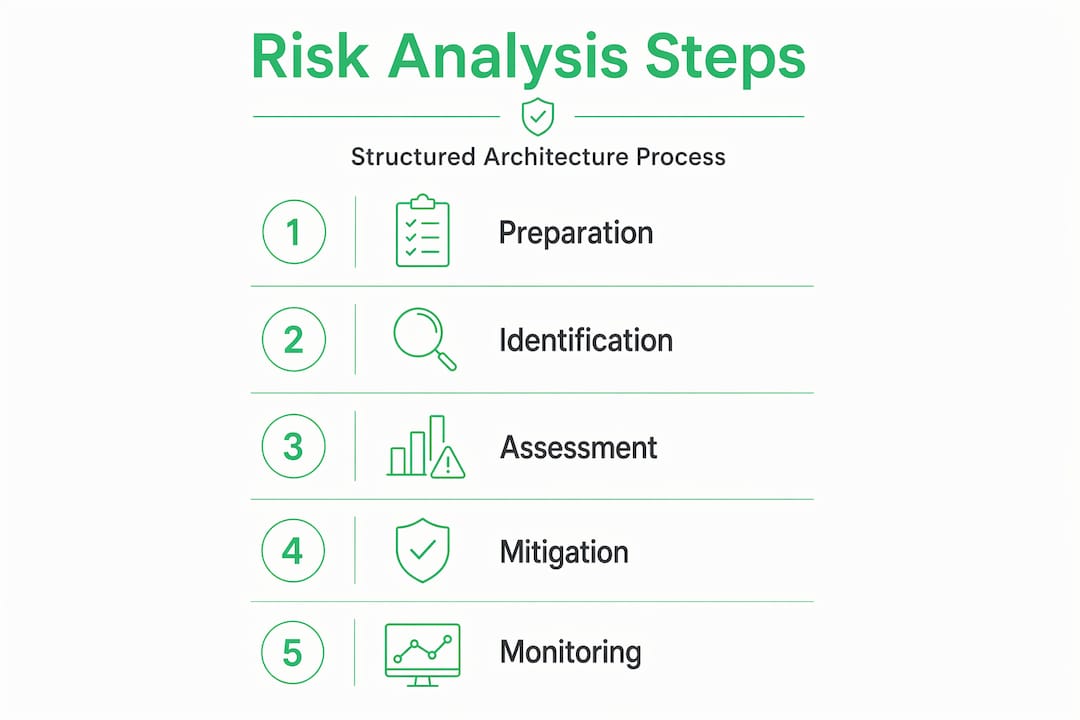
AARM integration combines Agile Architecture Risk Management with Continuous Risk Management to enable early identification of architectural risks tied to quality attributes, reducing expensive late fixes. Practitioners treat each architectural decision as a “risk hypothesis” reviewed iteratively during sprints to detect signals before they become defects.
Follow this sequence for structured risk identification:
- Map quality attributes to design decisions. For each major architectural decision, list the quality attributes it affects and ask: what fails if this decision is wrong?
- Classify risks by domain. Assign each identified risk to one of four domains: business, data, application, or technology. This prevents category overlap and ensures nothing falls between team boundaries.
- Score probability and impact. Use a 5x5 likelihood-impact matrix. Record the initial risk score before any mitigation is applied.
- Build a design risk register. Design risk registers track project-specific hazards rather than generic risks, focusing on the 26 key hazard areas most relevant to your project type.
- Run pattern and quality attribute matrices. Cross-reference known risk patterns against your architecture’s design choices to find structural vulnerabilities that weren’t surfaced through brainstorming alone.
- Evaluate continuously. Continuous risk evaluation during development prevents accumulating technical debt and preserves alignment with quality attributes across every sprint cycle.
For construction and federal facility projects, causal modeling adds precision that expert judgment alone cannot deliver. A 2026 study applying DEMATEL and ISM-MICMAC methods achieved 88.9% accuracy in architecture risk prioritization by combining causal analysis with machine learning validation. That level of defensibility matters when you are presenting risk findings to a federal contracting officer or a Fortune 500 facilities committee.
Pro Tip: When stakeholders push back on a risk score, the argument ends faster when you show the causal chain from design decision to failure mode rather than citing a probability number in isolation.
Mitigating risks and verifying controls
Identifying a risk without a mitigation strategy is documentation theater. The mitigation phase requires matching each risk to a specific control that targets either probability reduction, impact reduction, or both, then re-evaluating residual risk after the control is applied.

SAP’s risk guidance emphasizes that effective residual risk management requires re-scoring risks after mitigation and explicitly documenting changed assumptions or constraints to maintain governance clarity. This is where most teams take shortcuts that come back as audit findings.
The following table compares common mitigation strategies and their primary effect:
| Strategy |
Targets |
Effectiveness |
Best For |
| Redundant system design |
Impact |
High |
Availability and fault-tolerance risks |
| Access control enforcement |
Probability |
High |
Security and data risks |
| Phased implementation |
Both |
Medium |
Integration complexity risks |
| Architecture review board approval gates |
Probability |
Medium-High |
Governance and compliance risks |
| Automated compliance monitoring |
Impact |
High |
Regulatory and safety risks |
Key practices that make mitigation defensible rather than theoretical:
- Document the specific assumption being changed when a risk is re-scored after mitigation. “We added encryption” is not sufficient. “We reduced the probability of unauthorized data access from 4 to 2 because AES-256 encryption was applied at rest and in transit” is.
- Use architecture review boards as approval gates, not post-hoc reviewers. Cross-functional governance boards prevent siloed decision-making and ensure business and technical risks are jointly managed.
- For federal and safety-critical environments, apply an architectural risk assessment checklist before any design advances past the schematic phase.
- Automate compliance monitoring where frameworks allow. Manual review cycles create gaps between the moment a configuration changes and the moment a risk is flagged.
Monitoring and updating risk analysis over time
A risk register written at project kickoff and never updated is a liability, not an asset. Architecture risk management requires scheduled re-evaluation at defined milestones and continuous monitoring between those milestones.
NIST’s enterprise risk guidance frames risk registers with scenario-based documentation to prioritize risks across assets, with likelihood and impact estimates supporting enterprise risk profiles and response prioritization. That structure applies directly to architecture risk registers in both software and facility contexts.
Effective ongoing monitoring includes:
- Sprint-based architecture reviews. CMU SEI recommends dedicated “Architecture Monday” reviews focused specifically on architectural risks, not general sprint retrospectives.
- Configuration drift detection. Automated tools flag deviations between the approved architecture baseline and what is actually deployed or built.
- Technical debt tracking. Unresolved risks that are accepted rather than mitigated must be logged as technical debt with re-evaluation triggers.
- Scenario-based risk updates. When project conditions change, update the risk register with scenario documentation that records what changed, why the risk profile shifted, and what new controls apply.
- Stakeholder reporting cadence. Decision-makers need periodic summaries, not raw risk matrices. Translate risk scores into business impact language for executive and contracting officer audiences.
Pro Tip: Set a calendar trigger for risk register review at every major design milestone and after any regulatory update that affects your project type. Risks do not stay static, and neither should your documentation.
The goal is an architecture risk analysis process that self-corrects as the project evolves. Modish’s AI-driven architectural review infrastructure supports this by identifying compliance failure points continuously rather than waiting for a scheduled audit.
My take on why most risk analysis fails before it starts
I’ve reviewed enough post-mortem reports on failed architecture projects to see the pattern clearly. The risk analysis was done. The register existed. The review board met. And the project still committed to a structurally flawed design six months before anyone noticed.
The failure point is almost never the absence of a process. It’s the timing and the depth. Risk analysis treated as a gate-keeping exercise rather than a design-informing tool will always produce documentation that trails reality. By the time the register is updated, the design decision it should have influenced has already been committed.
What I’ve found actually works is treating every architectural decision as a live risk hypothesis, the way the SEI framework describes it. You ask not “what could go wrong generally” but “what quality attribute does this decision threaten, and under what conditions does that threat materialize.” That framing makes risk analysis feel like design thinking rather than compliance overhead.
I’ve also learned that cross-functional review boards only work when business representatives have genuine veto authority, not just an invitation to observe. When technical leads can override business risk concerns, the board becomes a formality. When both sides carry equal accountability, the decisions that come out of those rooms are materially better.
Modish’s Cinematic Intelligence™ engine changes the visibility problem. When risk findings render as federal submission-grade visualizations, the gap between “what the risk register says” and “what the stakeholder understands” closes. That translation layer is where governance actually breaks down in most organizations.
— Ben
How Modish powers your architecture risk analysis
Modish Global Inc. is the only Disability:IN-certified DOBE architectural diagnostic intelligence firm in the United States, and that distinction shapes how the Architectural Diagnostic Intelligence™ engine was built. Risk identification, analysis, and continuous monitoring are not add-on features. They are the core function.
The Modish diagnostic engine processes facility Spaces and returns 192 corrective visualization options per submission, rendered in federal submission-grade quality. Multiplicity Modeling™ generates scenario-based risk comparisons across design alternatives. DesignVault 3D™ archives every risk finding and corrective visualization in a traceable, audit-ready format that satisfies federal contracting officer documentation requirements.
For federal A&E primes and Fortune 500 facilities teams ready to remove guesswork from pre-construction risk evaluation, Modish’s federal division offers engagements from $9,500 single-facility pilots to $150,000+ enterprise licenses. Every engagement counts as Tier 1 diverse spend credit. Contact Modish to schedule a diagnostic review.
FAQ
What is the architecture risk analysis process?
The architecture risk analysis process is a structured method for identifying, assessing, mitigating, and monitoring risks tied to architectural design decisions across business, data, application, and technology domains. It runs continuously from early design through project completion.
When should risk analysis begin in an architecture project?
Risk analysis should begin before any design decision is committed. Embedding risk evaluation early avoids costly late-stage design failures and preserves alignment with quality attributes throughout development.
What is residual risk in architecture risk management?
Residual risk is the risk that remains after a mitigation control has been applied. SAP’s guidance emphasizes re-scoring risks after mitigation and documenting changed assumptions to maintain governance clarity.
How do architecture review boards support risk analysis?
Architecture review boards assess design fit, integration complexity, security, and operational supportability before implementations are approved. They serve as governance gates that prevent risky decisions from advancing without cross-functional accountability.
What frameworks support architecture risk analysis in federal projects?
NIST SP 800-30, ISO 31000, and FAR Part 36 provide the primary frameworks for federal architecture risk analysis. An architectural compliance checklist tailored to federal A&E requirements helps teams apply these frameworks at each design phase.
Recommended