The Role of AI in Facility Safety: 2026 Guide
The Role of AI in Facility Safety: 2026 Guide
TL;DR:
- AI in facility safety has shifted from detection to prediction, significantly reducing injuries and liabilities. It uses advanced technologies like computer vision, sensor fusion, and risk scoring to intervene before hazards materialize. Successful AI deployment relies on cultural integration, continuous governance, and proactive risk management strategies.
Most facility managers think of AI as a monitoring upgrade. A smarter camera. A faster alert. What the data reveals is something far more consequential: the role of AI in facility safety has shifted from detection to prediction, and that distinction is worth billions of dollars in avoided injuries, liability, and audit exposure. Physical AI systems deployed today are not watching accidents happen. They are calculating the conditions that cause accidents and intervening before the moment arrives.
Table of Contents
Key takeaways
| Point |
Details |
| AI predicts, not just monitors |
Modern AI systems anticipate hazards seconds before they occur, not after an incident is logged. |
| Compliance becomes continuous |
AI embeds regulatory logic directly into work order systems, eliminating documentation gaps that cause audit failures. |
| Risk scoring goes dynamic |
Multi-agent AI architectures synthesize technical, human, and environmental data into real-time risk scores. |
| Culture determines adoption success |
Projects that treat AI as a technology rollout rather than a cultural initiative consistently fail to deliver results. |
| Human oversight is non-negotiable |
Ethical AI governance requires humans to retain final decision authority over safety-critical interventions. |
The role of AI in facility safety: how it actually works
The mechanics of AI in workplace safety are more sophisticated than most briefings acknowledge. Three core technologies work together: computer vision, sensor fusion, and predictive analytics.
Computer vision systems analyze live video feeds for posture deviation, proximity to restricted zones, and behavioral anomalies. A worker reaching across a machine barrier in a way that slightly mirrors historical injury events will trigger a flag before contact occurs. In automotive plants and distribution warehouses, physical AI systems in 2026 report a 90 to 99% reduction in workplace injuries through exactly this mechanism. The numbers hold across deployment types: organizations report 67 to 97% injury reductions with 4 to 18 month return on investment, and worker approval rates between 82 and 94%.
Sensor fusion adds a layer that cameras cannot capture alone. Air quality sensors, vibration monitors, thermal cameras, and load sensors feed into a unified data model. When a combination of elevated heat, unusual vibration, and reduced airflow registers simultaneously, the system recognizes the signature of imminent equipment failure even when no single sensor reading crosses its individual threshold.
The automated interventions that follow are precise and fast:
- Equipment shutdown triggered by hazard-condition thresholds
- Proximity alerts pushed to wearable devices worn by workers in affected zones
- Maintenance dispatch initiated without human latency in the loop
- Safety officer dashboards updated with incident context in real time
Pro Tip: When evaluating AI safety solutions for your facility, ask vendors specifically how their system handles sensor disagreement. A system that requires consensus among multiple sensor types before triggering an alert will dramatically reduce false positives and avoid the alert fatigue that causes workers to ignore warnings.
AI compliance automation: from episodic to continuous
Manual compliance documentation has a structural weakness that predates any technology conversation. 41% of code violations discovered during audits are preventable, caused by incomplete or unfiled documentation rather than any failure of actual maintenance work. The work was done. The record was not created, tagged correctly, or connected to the relevant regulatory framework.
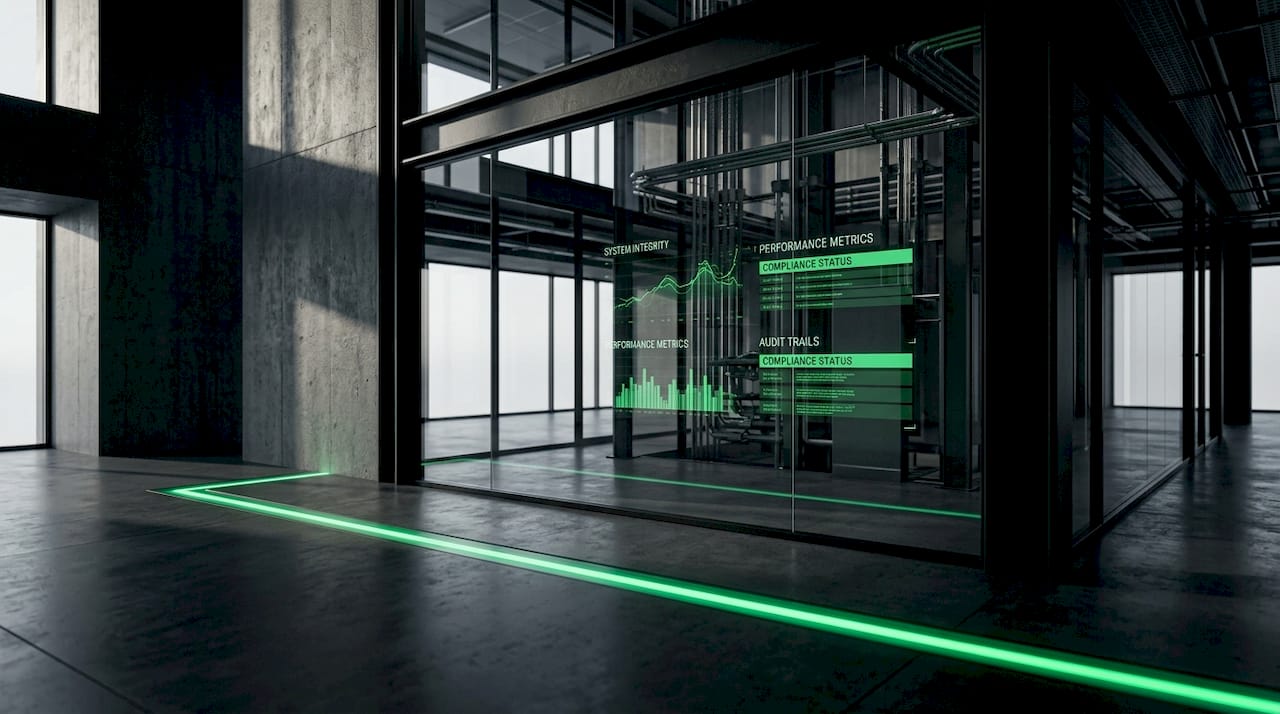
AI changes the compliance architecture at the source. When a work order is created in an AI-embedded facility management system, the regulatory logic travels with it. Inspection records are generated automatically. Documentation is tagged to the applicable standard. Scheduling is adjusted when regulatory content updates are detected in frameworks like NFPA, OSHA, ADA, and current energy codes.
The practical result for a facility manager looks like this:
- A fire suppression inspection is completed by a technician
- AI auto-generates the inspection record and links it to the relevant NFPA chapter
- Any gap in evidence completeness is flagged before the file is closed
- The next required inspection is scheduled without a calendar reminder from a human
- An audit-ready dashboard reflects the updated compliance status across the entire portfolio in real time
| Compliance task |
Manual approach |
AI-driven approach |
| Documentation creation |
Technician files report after the fact |
Auto-generated at work order completion |
| Regulatory tagging |
Manual classification, frequent errors |
Embedded logic applies correct framework automatically |
| Audit preparation |
Weeks of document retrieval and review |
Continuous portfolio view, always current |
| Regulatory update monitoring |
Periodic manual review |
Automated content monitoring with gap flagging |
The role of AI in code compliance is not to replace the expertise of your team. It is to remove the administrative friction that causes compliance gaps to accumulate invisibly until an auditor surfaces them.
From reactive to predictive: rethinking risk management
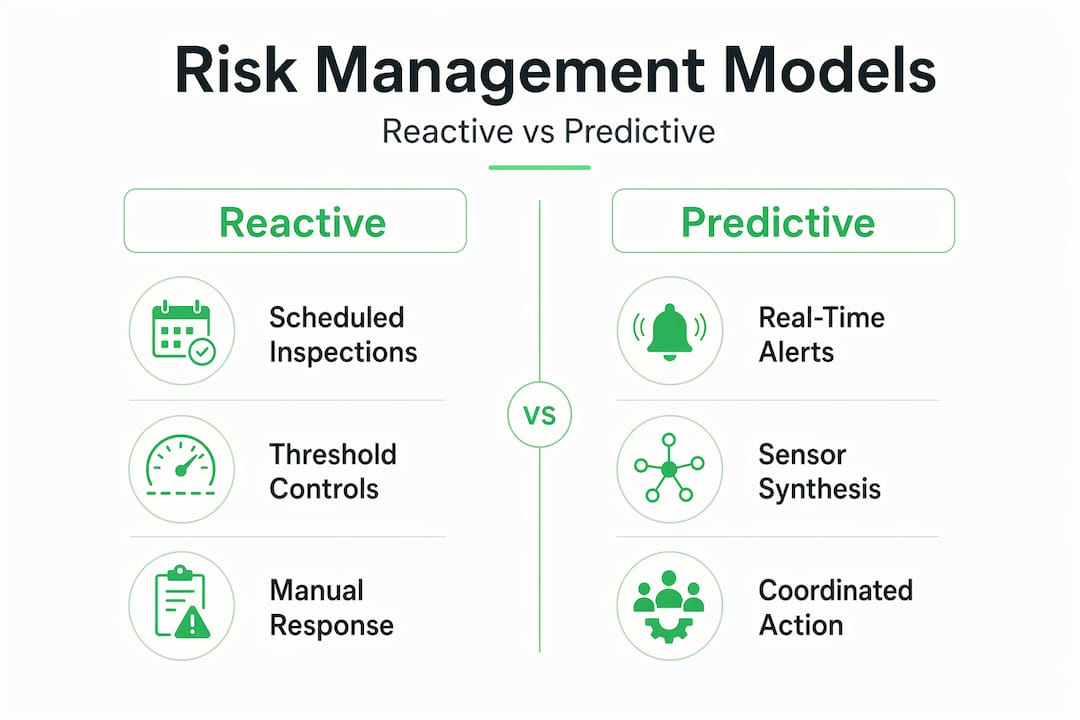
Severe workplace injuries in the United States exceed $50.8 billion annually. Traditional risk management models, built around scheduled inspections and static control thresholds, were not designed to absorb that scale of exposure. They were designed to document it after it occurred.
The contrast between reactive and predictive architectures is not subtle.
A scheduled inspection happens quarterly. A machine degrades daily. A static hazard control kicks in when a threshold is crossed. A predictive model flags the trajectory toward that threshold three days in advance. The gap between those two timelines is where most industrial accidents live.
Multi-agent AI architectures address this gap by synthesizing technical data from equipment sensors, human behavioral data from computer vision, and environmental data from building systems into a single dynamic risk score. The score is not static. It updates continuously as conditions shift.
Pro Tip: Request that any AI risk management vendor provide a documented false-positive rate from a live deployment, not a controlled pilot. High false-positive rates are the leading cause of alert fatigue, which causes workers to disable or ignore safety notifications within weeks of deployment.
Multi-agent AI systems also coordinate responses across monitoring domains simultaneously. When a hazard signature is detected, alert automation acts first. Humans validate and adjust after. This sequence reduces human error in emergency response without removing human authority from the decision chain.
Integration challenges and governance that actually holds
The most common AI safety deployment failure has nothing to do with the technology. Treating AI safety programs as technological rollouts rather than cultural initiatives produces disengagement, poor data quality, and employee distrust. Workers who believe they are being surveilled, not protected, find ways to subvert the data. The model degrades. The safety case collapses.
What separates successful deployments from failed ones:
- Frontline workers are engaged before deployment, not after
- Surveillance boundaries are communicated explicitly and held to
- Data privacy policies are written in plain language and shared proactively
- Workers receive direct access to the safety insights the AI generates about their own environment
- AI safety governance is embedded within existing enterprise risk and cybersecurity frameworks, not created as a parallel structure
“AI suggests, but humans decide.” This is not a philosophical position. It is a design requirement. Systems that autonomously modify equipment or make safety-critical decisions without human decision authority create liability exposure that exceeds the risk they were built to eliminate.
Continuous performance monitoring of deployed AI models is not optional. Data drift, the gradual divergence between the conditions a model was trained on and the conditions it now operates in, will degrade safety efficacy silently. A model that was 94% accurate at deployment may be performing at 71% six months later without a single alert being generated about its own performance.
Practical steps for facility managers and safety officers
If you are assessing where your facility sits on the AI readiness spectrum, start with an honest maturity audit before selecting any technology. 92% of organizations plan to increase AI investments but only 1% consider their deployment mature enough to scale business outcomes. The gap between intention and execution is almost always an infrastructure and governance problem, not a budget problem.
- Audit your current documentation architecture before any AI procurement. Know where your compliance records live, how they are created, and how frequently they fail to connect to the right regulatory framework.
- Map your highest-frequency near-miss incidents over the past 24 months. These are your priority zones for computer vision and sensor deployment.
- Establish a worker communication protocol before any camera or sensor goes live. Transparency at the start prevents the trust erosion that derails programs later.
- Require vendors to demonstrate AI risk management alignment with ISO/IEC 42001 or equivalent standards, with defined roles and systematic risk assessment processes documented.
- Plan for model governance from day one. Assign ownership of post-deployment performance monitoring and set a review cadence before the system goes live.
Pro Tip: For federal facilities, Architectural Diagnostic Intelligence™ tools that produce federal submission-grade visualizations of compliance risk are not just a safety asset. They are a procurement differentiator when documented in pre-bid evaluations and master planning submissions.
My perspective on where this technology is actually going
I’ve watched AI safety programs get sold as turnkey solutions and deployed as surveillance systems. Neither outcome is what the technology is capable of, and both reflect a failure of implementation philosophy rather than a failure of the AI itself.
What I’ve learned after years of working in Architectural Diagnostic Intelligence™ is that the facilities that get the most from AI are the ones that treat it as a collaborative system with human judgment at the center. Not a replacement for that judgment. A multiplier of it.
The perspective a disability-owned enterprise brings to this work matters more than most people realize. Inclusive safety design, the kind that accounts for sensory, physical, and cognitive variation in how people move through and work within built environments, produces safer outcomes for everyone. That is not a social argument. It is an architectural one.
AI is not a set-and-forget technology. The facilities that will define the next generation of safety performance are the ones that treat their AI infrastructure the way they treat their structural systems: with regular inspection, deliberate governance, and continuous improvement built into the program from the start.
— Ben
How Modish brings AI diagnostic intelligence to your facility
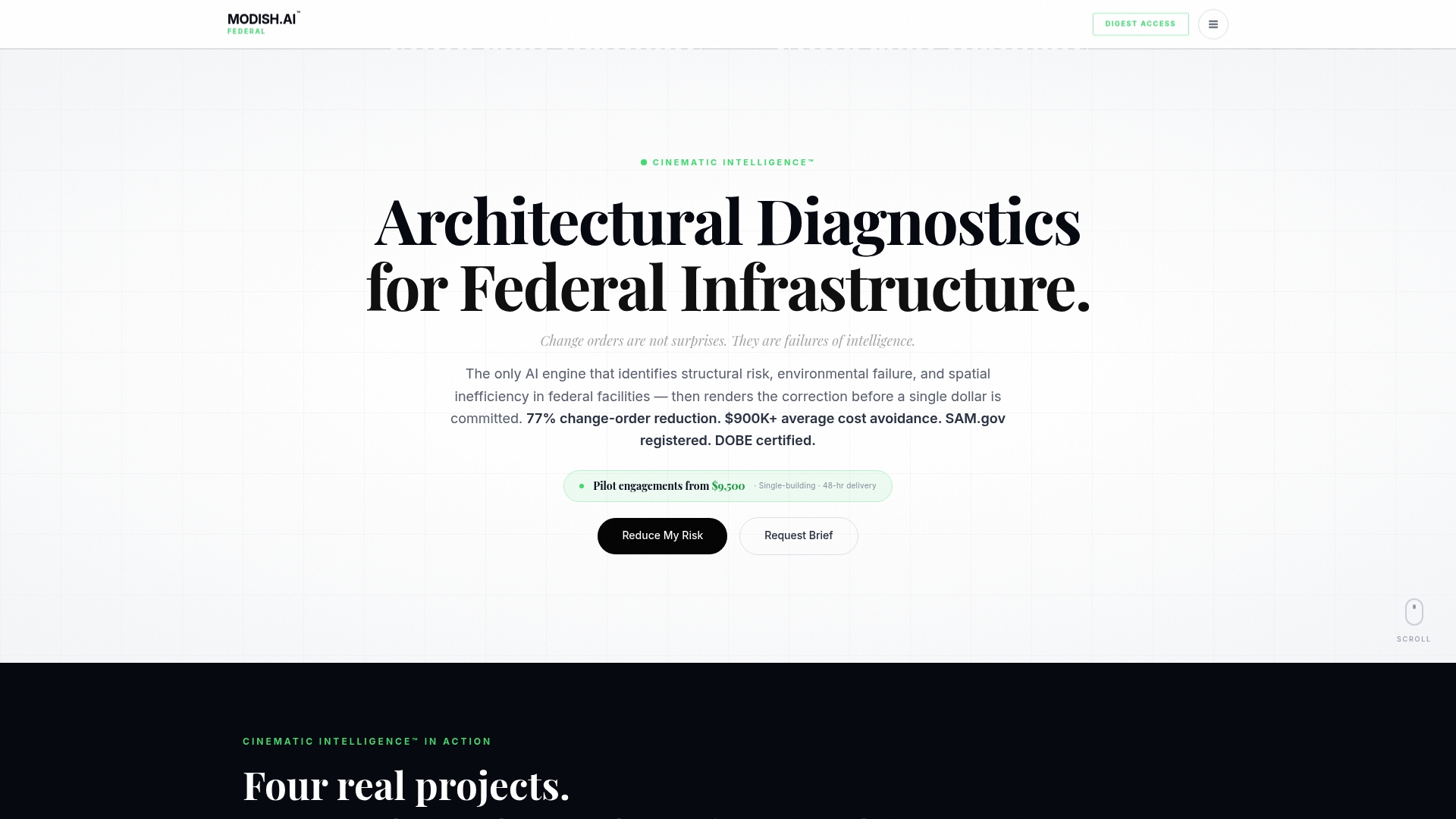
Modish is the only Disability:IN-certified DOBE in architectural diagnostic intelligence in the United States. The Cinematic Intelligence™ engine and Multiplicity Modeling™ infrastructure go beyond traditional facility safety software by identifying structural, environmental, and code compliance failure points before construction commits. Every Space processed returns 192 corrective visualization options rendered to federal submission grade.
For facility managers and safety officers who need more than a dashboard, the Architectural Diagnostic Intelligence™ engine delivers a pre-design risk identification capability purpose-built for federal and enterprise environments. Engagements begin at $9,500 for single-facility pilots. Explore service options and pricing, or connect with the team to schedule a diagnostic consultation.
FAQ
What is the role of AI in facility safety?
AI in facility safety moves beyond monitoring to prediction, using computer vision, sensor fusion, and machine learning to anticipate hazards before they occur. Physical AI systems report injury reductions of 67 to 97% in documented deployments.
Why use AI for facility compliance?
AI embeds regulatory logic directly into work order and inspection systems, eliminating the documentation gaps that cause 41% of audit violations. Compliance becomes continuous rather than episodic, with audit-ready records generated automatically.
How does AI reduce risk in facilities?
Dynamic AI risk scoring synthesizes equipment, environmental, and behavioral data into real-time assessments that flag deteriorating conditions before thresholds are breached, reducing both unplanned downtime and incident liability.
What governance standards apply to AI safety systems?
ISO/IEC 42001 and the NIST AI Risk Management Framework provide the primary governance structures for AI in workplace safety, requiring defined roles, systematic risk assessments, and continuous performance monitoring post-deployment.
How does Modish use AI for facility diagnostics?
Modish applies its Cinematic Intelligence™ engine and Architectural Diagnostic Intelligence™ infrastructure to identify structural and code compliance failure points in commercial and federal facilities, delivering corrective visualizations before construction or procurement commitments are finalized.
Recommended